
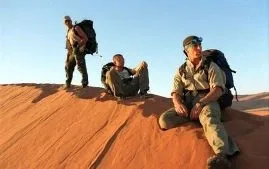
"Why Africa?"
"Why Africa?" – the laser displayed on the screen before the diplomats, officials, and businessmen gathered for the meeting with the team. "?!!!!" – thought the restrained diplomats...
To the question "Why did the Equites team (Goltis, Alexander Komarov, Konstantin Mogilnik) set off on a journey through Africa (70,000 kilometers around the perimeter of the continent)" there are several answers and assumptions. For example – "the guys are promoting someone's brand." Or "it will be a grand TV show." Or "chronic travelers found a sponsor and are having fun in their own way."
When we, journalists, were invited to another "Step Towards Africa," in the sharp-tongued crowd of brethren one could hear even more. However, time passed, the "event," so to speak, progressed according to plan, and finally, from the taxiways they turned onto the runway – only a few days remain before the start of the Great African Crossing, and the question "Why Africa?" still troubles many.
So, "Why?"
GOLTIS
– One of the directions of our expedition is scientific research work. For example, during the journey across the African continent, we will study the capabilities of the human body in various climatic zones, its ability to adapt to extreme conditions. After all, as is known, Africa is literally teeming with various infections and bacteria. All team members underwent special training using a unique program. Therefore, both for me, as its author, and for doctors, the results obtained will be very interesting.
The second direction is ethnographic research. For this purpose, we have compiled special questionnaires that will be filled out during meetings with various peoples and tribes. We will describe customs, culture, crafts, as we plan to pass through little-explored territories.
Next is the collection of information about flora and fauna. We will not dry butterflies and beetles, but photographing and video recording of exotic species is also part of our expedition's task.
In addition, diving into deep-water lakes located in the craters of extinct volcanoes is planned. We are not aware of any cases where this was done before us. Let's imagine a climber who climbs to a height of 3-4 thousand meters, also transporting scuba gear. The sight is as comical as it is unreal. We are physically preparing to accomplish this task.
Another direction is geographical. Need it be said that the map of Africa only approximately reflects what is there...
SASHA
– Indeed, if you look at the most detailed map of Africa, we will see a sparse but network of roads, bridges, marked cities and settlements... But the fact is that all these maps carry information from about 30-40 years ago. Since the early 60s, when almost all African countries gained independence and Europeans left, due to endless wars, revolutions, and other cataclysms, the continent's economy fell into decline. The roads, which nowhere need constant maintenance as in Africa, are not looked after, and therefore many of them have simply disappeared from the face of the earth.
Take Angola, for example. In this country, about 10% of the previously existing roads remain. In addition, last year, the strongest flood washed away 3 remaining functioning bridges. As a result, today only one railway bridge has been restored and is operational throughout the country, which has also been opened to automobile traffic. And other countries are no exception.
Therefore, one of the most important tasks of our expedition is geographical and cartographic research. Most likely, after the expedition, it will be Ukrainian cartographers who will have the most recent and reliable information about this continent.
KOSTYA
– The nature of our expedition is eco-humanitarian. Our task is to document environmental and humanitarian disasters occurring on the African continent during the journey. These studies will become a litmus test for any country in the world. After all, all processes occurring on Earth are closely interconnected. As part of our action, the "Equites Forum" has been created, whose task is to use all available modern means (Internet, television, print media) to tell and convey to the general public the information that is usually known only to a narrow circle of specialists. For this, a form such as a television show was chosen – an opportunity to convey a message to people in a playful, easy, accessible form. In addition: entertaining while educating...
Summarizing all of the above, we can now draw quite definite conclusions. In August, an unprecedented in scale and adventurousness African Crossing will start, carried out by the Equites team, consisting "one hundred percent" of Ukrainian guys. Goltis, Alexander, and Konstantin underwent special training using a unique method. Each of them possesses knowledge and skills that are mostly inaccessible to an urban dweller.
Thanks to the most modern means of communication with which the team is equipped, residents of Ukraine will be able to directly participate in the TV show, which will be regularly broadcast throughout the journey. Ukrainian viewers will see footage that no one has seen before, will be able to come into contact with the life of a continent that most know only from the fairy tale "Aybolit."
And about how the team is equipped and what they can do on their own without outside help, read in our next issues.
"Zagranitsa" No. 29(82), 2001.