
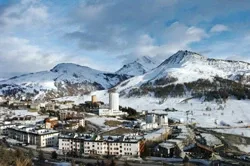
The capital of the XX Olympic Winter Games 2006, the large Italian city of Turin, was chosen more than six years ago – on July 19, 1999, at the 109th session of the International Olympic Committee (IOC) in Seoul. Five other cities vied for the right to host the 2006 Games: Helsinki (Finland), Klagenfurt (Austria), Poprad (Slovakia), Sion (Switzerland), and Zakopane (Poland). Turin and Sion made it to the final round of voting. In the end, 53 IOC members voted for Turin, and 36 for Sion. Thus, from February 10 to 26, 2006, Turin will become the center of the sports world.
You must agree, it would be curious to know what the Olympic capital is like three months before the start of the competitions. Let's try to understand. News from Turin did reach us bit by bit, but somehow we never got around to organizing this data.
And yet quite curious events were taking place. For example, almost a year ago – in early November 2004 – the president of the Turin-2006 organizing committee, Valentino Castellani, resigned. The reason was a scandal that erupted over financial holes in the budget of the upcoming Olympic Games. Mario Pescante (who was responsible for sports affairs in the Italian government) was then appointed acting head of the Olympic organizing committee.
And the sum is considerable – €530 million. Questions immediately arose as to whether the Italians would manage to build all the necessary facilities by the required deadline. By the way, the organizing committee's leadership refused to make public comments about such a large budget deficit. As interested parties later explained, the budget was calculated in 1999, and compared to the estimated figures, it had grown by 75% (not bad, you'll agree!). The mayor of Turin, Sergio Chiamparino, was forced to demand from the Italian government the creation of a special control mechanism that would monitor the implementation of the Games budget.
But this was only the beginning. Less than a year before the opening of the Winter Olympics, further important changes took place in the leadership of the 2006 Games organizing committee. Instead of Secretary General Paolo Rota and his deputy Marcello Pochettino, who had worked in their positions for almost five years, engineer Cesare Vaciago and sports manager Luciano Barra were appointed. The reason for the reshuffle was a financial scandal that left the organizing committee's budget short of almost €170 million. However, it is hard to imagine that on such a grandiose construction site no one would have cast an eye on even one euro cent. Any construction is a great opportunity to improve one's financial position in a short time. Recall at least the unforgettable "The Little Golden Calf" by Ilf and Petrov, as well as how Comrade Koreiko amassed his millions.
On top of that, a sponsorship agreement was terminated, due to which the organizing committee lost another €150 million. The Italian Senate had to allocate an additional $103.71 million for the Olympics. And in the end, the Turin-2006 organizing committee approved the budget of the upcoming Games in the amount of $1.46 billion. It also became known that a specially created committee would handle the Winter Paralympic Games, and its funding would be provided not by the Turin-2006 organizing committee, but from other sources.
Among the more pleasant news, it is worth noting that 6.5 thousand residents of Piedmont and other northern regions of Italy responded to the call of the organizing committee of the 2006 Winter Olympic Games. They expressed a desire to take part in the opening and closing ceremonies of the Games, scheduled for February 10 and 26, 2006. In September, producers, choreographers, and directors of the two festive shows were to select 4.5 thousand people – three thousand direct participants in the grand spectacle and another one and a half thousand technical assistants. Most of the volunteers are athletes, novice ballet dancers, acrobats, and musicians. The youngest of them is 9 years old, and the age of the oldest approaches 80 years. The decisive word in the selection belonged to American choreographer Doug Jack, the director of dance suites at the last five Olympics. Since September, selected candidates have begun regular classes with specialists. At the same time, they all took an oath not to disclose the plot of the productions, which should be a surprise for billions of TV viewers.
It has also been determined that the traditional torch relay of the 2006 Winter Games will be opened by Italian marathon runner, Athens 2004 champion Stefano Baldini, and a total of 10,001 participants will take part in the torch procession. It will all begin on November 27, 2005, in Ancient Olympia, and before heading to Italy, the flame will visit all the ski resorts of Greece. In Italy, the procession is to begin in December in Rome. Among the torchbearers are famous athletes: the 1976 Olympic champion in alpine skiing, winner of five World Cups in downhill, Austrian Franz Klammer, Polish race walking master Robert Korzeniowski, Italian basketball player Dino Meneghin, and others. Each relay participant will carry the torch for about 400 meters.
General rehearsals at the Olympic venues were held last winter. At that time, many officials visited Turin and its surroundings. Among them was the president of the Russian Olympic Committee, Leonid Tyagachev, who gave a positive assessment of the organizing committee's work and highlighted a number of problems that both the participants of the 2006 Games and spectators would have to face.
The organizing committee of any Olympics at the stage of construction and commissioning of Olympic facilities serves as a target for the press," Tyagachev reflects, "the Turinese also did not avoid critical remarks addressed to them. The main traditional doubt: will the builders meet the planned deadlines, will the quality of the facilities correspond to the highest standards set for the hosts by members of the Olympic family and the IOC? Over several decades I have visited practically all world-famous winter sports centers, and as a professional I can say: Turin is the optimal option for holding the White Olympics on a modern scale, work here is proceeding according to schedule, there can be no fears about any disruption to the pace of Olympic construction.
"Of course, there are also certain difficulties. The 2006 Olympics will be divided into two equal parts – in terms of geography and competition program. Practically all competitions held on ice, on skates – hockey, figure skating, speed skating, short track – will take place directly in Turin, while cross-country skiing, biathlon, ski jumping, Nordic combined, all alpine skiing disciplines, and bobsled are moved to the mountainous area, at a distance of more than 100 kilometers from the capital of the Olympic Games. Given the predicted traffic load on roads in February 2006 in this region, we need to think today about how to effectively solve the tasks of delivering athletes, equipment, and gear to the branches of the Olympic Village located in the mountains. In addition, according to existing regulations, competition medalists are required to participate in award ceremonies, which will be held on one of the central squares of Turin every evening. This means that for a bus trip, for example, from Sestriere to Turin and back, and for participation in the celebrations, athletes will need no less than 5-6 hours, and many of them need to prepare for subsequent starts of the Olympic program. I think that transport problems can be effectively solved with the help of helicopters. There are enough specially equipped sites here, including in small mountain towns. Of course, renting helicopters is not a cheap pleasure, but already today some of our partners express readiness to take on these expenses."
But it is also interesting to learn the opinions of other eyewitnesses. For example, journalists who visited Turin and personally inspected the places where the Olympic Games will be held. The opinion of many comes down to the fact that it can hardly be worse than in Athens, so in Turin, if compared with the Greek capital, everything is fine. If in Athens a year before the Olympic Games many sports facilities had not yet been completed, the commissioning of which was delayed for various reasons, and the transport system had not been set up, then in Turin and its surroundings in January 2005 serious events took place. For example, the European Short Track Speed Skating and Figure Skating Championships at the Turin Olympic Stadium "Palavela", World Cup stages in skiing and bobsled in Pragelato and Cesana.
Moreover, a high-speed motorway now leads to Cesana, not narrow village streets, which could take several hours to conquer. At the same time, the 90-kilometer stretch from Turin to Oulx (this route should connect the two main Olympic hubs) can be covered in a little over an hour (depending on how fast you drive) and cost €10. Oulx is a small town and relatively far from the skiing, bobsled, and biathlon stadiums. Cesana, located several kilometers from the luge-bobsled track, is even smaller: a handful of hotels, a sports store, and a ski lift where the organizing committee of the Bobsleigh World Cup stage strongly recommended that all arriving journalists and spectators leave their cars to avoid traffic congestion on the mountain near the stadium. At every step, along with posters reminding of the future Games, there are calls to local residents to rent out their homes for the duration of the Olympic competitions. Another 20 kilometers of mountain road separate Cesana from Sestriere, where the second largest Olympic Village after Turin will be located. The ski stadium is a 10-minute drive away. The course was built two years ago, and then the hosts heard a lot of complaints from athletes and coaches about its terrain: too steep climbs. The wishes were taken into account – the terrain is now noticeably more interesting, although, according to skiers, it has not become easier to run.
The Italians least of all expected that in the middle of winter there would be no snow at the Olympic arenas. But that is exactly what happened. Right up to the first day of competition, snow cannons operated around the clock. The thickness of the resulting snow blanket reassured everyone: no matter what surprises the weather threw, there would be no problems with snow in Italy. The bobsledders were less fortunate in this regard. The finishing of the concrete chute of the track was carried out even during the last training sessions, cement dust continuously hung in the air, mixing with water and snow and settling on the ice surface. But even this the enterprising Italians tried to compensate. A special press release abounded with sincere apologies, and numerous volunteers instantly fulfilled any requests and wishes of visiting guests. A car to drive two kilometers along the muddy road to the start? No problem! Coffee? Here is a thermos. Also cookies, sandwiches, and chocolate. Or maybe you would like some mulled wine? "Do you really like it?" an elderly volunteer in Pragelato quizzed journalists. "We are trying very hard. They say, however, that many are dissatisfied: the Olympic venues are, they say, too far from each other."
However, for the Winter Olympic Games, long distances are not new. Travel took a lot of time in Lillehammer, Nagano, and Salt Lake City as well. But in terms of organization, the Italians are not lagging behind their predecessors. It turns out that the 10,000-seat Palavela stadium is too small to accommodate everyone who wants to attend. Especially considering that quite a few seats will be given to journalists and officials. So one can imagine the level of ticket prices and the excitement with which they will be snapped up. At the same time, the work of cafés and restaurants concerned journalists. Even during the European Figure Skating Championships, which drew full houses every day, nearby establishments were closed for lunch from two to seven in the evening, and the press center cafeteria could not satisfy all journalists, let alone spectators. One can only hope that mercantile interests will prevail among Italians during the Olympic Games.
It remains to add that in Turin, 84 sets of medals will be awarded in 15 sports. Alpine skiing competitions will be held from February 12 to 25. Bobsleigh athletes will compete on February 18-25, biathletes on 11-25, skiers on 12-26 February. Curling competitions are scheduled for February 13-24, freestyle skiing on 11-23, figure skating on 11-24 February. Longer than others – from February 11 to 26 – male and female hockey players will compete. The shortest program is for Nordic combined athletes on February 11 and 15, as well as skeleton athletes on 16-17. Slightly longer is for luge athletes on 11-15. Snowboard competitions will stretch from February 12 to 23, and ski jumping from February 11 to 20. Speed skaters will take to the start on February 11 and finish on the 25th, short track representatives will compete for medals on February 12-25.
About 2,500 athletes, 650 judges, and 10,000 journalists are expected to take part in the Olympic Games, who will be housed in three Olympic Villages – in Turin, Bardonecchia, and Sestriere. There are seven main venues where competitions will take place – Turin, Bardonecchia, Cesana, Pinerolo, Pragelato, Sauze d'Oulx, and Sestriere. It is planned that about 1.5 billion viewers will watch the Olympic Games in Turin.