
BOMBS STARTED EXPLODING UNDER SHUTTLE TRADERS
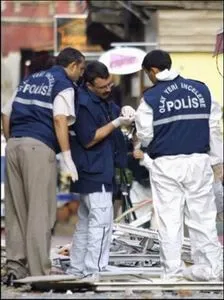
On the night before Tuesday, several explosions occurred in the historic center of Istanbul. As Gazeta.Ru reports, two of them occurred simultaneously in two small hotels, and two more bombs exploded at a gas station.
Two people died in the first blast. The identity of one of them has already been established: he is 31-year-old Turkish citizen Haydar Baydar. The bomb was on the third floor of the small, inexpensive Pars hotel, popular among residents of Eastern Europe. It is located in one of the central districts of Istanbul, not far from the Grand Bazaar shopping area, so shuttle traders often stay there.
According to hotel staff, an anonymous call warning of an explosion came 10 minutes before the blast. The anonymous caller told the hotel management that a bomb had been planted in one of the rooms. Employees reported the threat to the police, but they simply did not have time to wake all guests in 10 minutes. At the moment of the explosion, 37 people were in the six-story hotel. According to the explosion eyewitness Umut Akgul, the blast was very powerful, glass flew in all directions, and the shock wave tore off the exterior wall on the two upper floors of the hotel.
Another explosion occurred simultaneously with the first on the second floor of the Holiday hotel. It is located literally a five-minute walk from the Pars hotel, in the Sultanahmet district, popular among tourists, in the historic center of the city. This is also a small and inexpensive hotel, in demand among citizens of the former Soviet Union. At the time of the blast, 20 people were in the hotel. Details of the second incident have not yet been reported.
According to AP, as a result of the two explosions, a total of seven people were hospitalized, including two Dutch, two Chinese, a Ukrainian, a Turk, and a Turkmen. However, according to police, the injuries are not life-threatening.
Earlier that same night, terrorists blew up a gas station on the outskirts of the city. Another explosion occurred there half an hour later. Fortunately, there were no casualties. At the time of the explosion, four people were working inside the station. As reported by Tayfun Demirogen, a representative of the Demirogen Group company that owns the station, an anonymous warning call also came 10 minutes before the explosion.
As the head of the Istanbul police, Selalettin Sera, told the media, “The explosions were apparently carried out by terrorists.” Who is responsible for these attacks is not yet known.
Just two weeks earlier, on July 24, an explosion occurred in one of the hotels in the Turkish city of Kemer, located on the Mediterranean coast. Twenty-one people were injured then, including tourists from Ukraine, Germany, and Austria. According to official data, the cause of the tragedy was a gas cylinder.
Even earlier, on June 23, two explosions occurred at a short interval. One of them took place in Istanbul, a little more than twenty meters from the Hilton hotel building, the other in Ankara. On June 24, a passenger bus was blown up in Istanbul. At least three passengers died, and ten more were injured. The authorities blamed the left-wing radicals for this terrorist attack. And on June 25, in the Hatipoglu hotel in Alanya, there was an explosion of a gas cylinder. However, the CNN-Turk news agency then circulated a report about a terrorist attack, and Reuters even specified that the bomb exploded in the hands of a suicide bomber.
Recently, holidays in Turkey have come to be called extreme. This is due to the fact that the “People's Congress of Kurdistan” (formerly the Kurdistan Workers' Party) announced the end of the five-year ceasefire with the Turkish authorities. After that, Kurdish rebels began military and terrorist actions against Turkish troops and police.
In addition, Islamic fundamentalists repeatedly expressed their displeasure over Turkey's desire to join the EU, also carrying out terrorist acts in the country's main cities (they, for example, organized last year's explosions in Istanbul, where about 60 people died).