
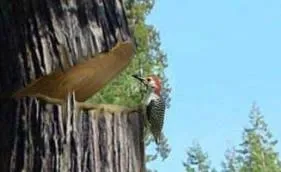
Woodpecker is not afraid of splitting its head during impact work
The topic of our conversation today is somewhat humorous. Nevertheless, many people sooner or later wonder why woodpeckers don't get headaches, and why horses start licking walls? We will reveal the secret.
Let's start with woodpeckers. Few people know that during a strike, the speed of this bird's beak reaches 2000 kilometers per hour. The question is how does the woodpecker's brain remain intact and unharmed? In fact, each strike lasts no more than thousandths of a second, and at that moment the overload fluctuates within 1000 g. From our physics course, we know that g is a unit used to measure overload force. To overcome Earth's gravity, a force of 1 g is needed, and astronauts experience an overload of 4 g during space flight.
Oddly enough, it is the neck muscles that can save the woodpecker's head. During a strike, thanks to the neck muscles, the woodpecker's head along with its beak moves in a straight line. If the trajectory were at an angle to the straight line, the woodpecker would not survive.
We have some more good news: we found out why a horse licks walls. We are talking specifically about wooden structures that horses literally gnaw.
By nature, any horse wants to chew constantly. Consequently, the animal may simply lack feed. However, this is not so common. The most common cases are when owners incorrectly select feed components. The horse lacks minerals and vitamins necessary for the normal functioning of the animal's body, and it tries to find them. Most often, horses feel a lack of phosphorus and calcium, and these elements can be found in the earth.
If the animal shows an unhealthy interest in sand, it lacks sodium. But a horse should not eat earth, because it contains harmful impurities, such as chlorides. Therefore, any horse owner must carefully approach the issue of feed selection. Bran and feeds should contain a large amount of vitamin D, carbohydrates (without them normal body functioning is impossible), cobalt and iodine, as well as magnesium. Finally, feed should include sulfur, salt, magnesium, iron, selenium, manganese and zinc.
If the animal does not receive the necessary vitamins and minerals, the hooves begin to crack, immunity decreases – meaning the horse will be passive and have a sickly appearance.
Now you will definitely know the answers to questions about why horses bite walls, and why woodpeckers' heads don't fall off during 'work'.
_