
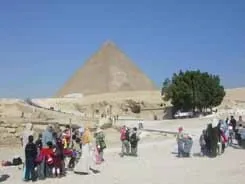
A whimsical combination of modernity and ancient traditions, the exoticism of African-Asian lands, a multifaceted tourist infrastructure, and most importantly, cultural service, become key factors for our compatriots when choosing a vacation destination. At the same time, Egypt is a Muslim country with its own ingrained customs, mentality, and rules, not always known to our tourists. Bogdana Orlova, a travel agent from "Magazin Goryashchikh Putevok", who visited Egypt at the end of last year, gave several useful tips, knowledge of which may help avoid situations that could spoil a long-awaited vacation.
Bargaining is appropriate here
The most popular purchases in Egypt are papyri, perfume oils, essences. In shops you can buy basalt figurines, items made of gold, silver, malachite, and precious stones, and national clothing. But one should remember that local market stalls are literally flooded with cheap fakes. For example, the papyri sold are in most cases made not from reed but from rice paper or banana leaves with a stamped design. Therefore, to avoid being made a fool, you need to buy souvenirs in specialized stores that issue quality certificates.
In fairness, it should be noted that even this piece of paper cannot give a 100% guarantee of authenticity. So, in a chic shopping center in Sharm el-Sheikh, tempted by the dazzling sparkle of coral beads, a substantial discount, and the presence of a certificate, I was ready to part with my money. Fortunately, a member of our group who had a background as a marine geologist was nearby. He held out a lighter to the seller, suggesting they set the item on fire (it turns out that real corals, including pearls, do not burn). What disappointment I felt when, under the flame, this wonder of nature turned from a noble ornament into a shriveled raisin!
By the way, in the resort areas of Egypt, you can (even should!) haggle not only in markets but also in seemingly presentable little shops. Moreover, the price of goods can drop by two or even three times during bargaining. A pattern has been noticed: if during the price discussion the smile disappears from the shopkeeper's face, it means the figure is approaching the normal cost. It is strictly forbidden to buy soft drinks "on tap" or to take ice for cooling from street vendors. And heaven forbid you should acquire or deal in drugs - Egyptian law provides the death penalty for such acts. Why tempt fate?
"Camel, want?"
If you have come to the country of desert and camels with a firm intention to visit all historical monuments and places of tourist pilgrimage, be prepared to part with not just a few hundred dollars. For your information: the official currency of Egypt is the pound. But with American "money" in your pocket, you can easily do without the national currency.
Tourists should be careful in choosing sightseeing trips. In particular, an excursion to Mount Sinai with a visit to St. Catherine's Monastery can turn into an extreme climb for an unprepared person. Judge for yourself: the ascent begins around midnight and lasts almost six hours. During this time, you need to cover 2,285 meters. Moreover, the mountain trail narrows in some places to one and a half meters, with a sheer cliff on one side and an equally sheer abyss on the other. Also stressful are the constantly bustling Bedouins with camels and their questioning call from the dark: "Camel, want?" Add to that the high-altitude cold and wind, forcing you to quickly wrap yourself in "arafatkas" and ponchos bought on the spot. So the transformation of civilized people into children of the mountains happens on Mount Sinai in just one night. Why do Egypt's guests, risking their lives, climb the "sacred peak"? According to legend, a person who climbs the mountain and greets the sunrise there has all their sins forgiven. And for the breathtaking view, it is worth the effort. This pleasure will cost you $40-90. It all depends on the greed of the guides. In short, the choice is yours...
Incidentally, if you drive past military facilities, it's better not to photograph them. Do not collect fragments of historical monuments, break or even pick up corals. An attempt to export marine flora and fauna can easily lighten your wallet by a thousand dollars, as it is prohibited by local law. If you decide to ride a camel, remember: you can get on for free, but to get off, you'll have to pay.
On the very first day of arrival, the guide warned the group that it is forbidden to feed fish in the sea. Taking the warning in a purely Slavic manner, we turned a deaf ear and, entering the water, began to feed bread to the colorful aquatic creatures. A minute later, the water was teeming with ichthyologists' wards, increasing not only in number but also in size. Soon the "big ones" started grabbing at our legs, forcing us to literally fly out onto the shore. Thankfully, the sharp-toothed moray eels didn't have time to join the feast...
Help Yourself
The arrival of our tourist group on the sunny shore of the Red Sea was preceded by an unpleasant incident that happened to one of the tour participants. At Boryspil Airport, a video camera disappeared from her suitcase that was checked in as baggage. Therefore, to all passengers flying through Boryspil terminal, which has not the best reputation, a banal (but no less relevant) piece of advice: do not leave expensive items in your luggage. It's better to move them to your carry-on. It is preferable to have suitcases with combination locks. If you don't have them, don't spare 15 hryvnias to wrap your luggage in cellophane. Paying for this service will help protect you from more significant losses. It is worth noting that in case of total baggage loss, the airline compensates damages at the rate of $50 per kilogram. True, long bureaucratic delays are unavoidable in this case.
As for Egyptian hotels, it is recommended to keep money and valuables in safes. In some hotels, safes are directly in the rooms. If you still decide not to hide your savings behind an iron screen, the likelihood of them disappearing from the room is small, but it still exists. One of our fellow travelers, who lost several greenbacks from a stack of dollars carelessly left in the room, was convinced of this.
Although the water in Egypt is safe for health, its composition differs from Ukrainian water. Therefore, it is better to drink water from plastic bottles, which are sold in any store or bar. For brushing teeth and washing fruit, it is also preferable to use bottled liquid. As for stronger water (i.e., alcohol), it can be consumed, but with caution. You can be arrested for appearing intoxicated in a public place.
At the Red Sea itself
About 90% of Egypt's land is occupied by deserts, where only 1% of the country's population lives. This is felt when you drive beyond the narrow strip of the resort area located at the very edge of the sea. Sand, sand, for many kilometers not a single person. But despite the arid climate, the tourist areas abound with exotic plants. For example, the Chinese rose, which is sold in pots here, is just a 'border' shrub there. Three-meter ficus trees and cacti as tall as a man are impressive. Not to mention the palm trees that grow on the territory of every self-respecting hotel.
By the way, having your own palm tree is not a cheap pleasure. Trees are grown by a special plant nursery, and the cost of one representative of tropical flora exceeds $3,000. And plants survive in such harsh natural conditions only thanks to daily careful care: each bush and tree has a drip irrigation system. Even the desert retreats before such care.
* In winter, the water temperature in the Red Sea does not drop below +20 degrees, in summer it reaches +30.
* A visa for tourists for up to one month is issued upon arrival at the Egyptian airport. Its cost is $15.
* Export of the national currency – the Egyptian pound – from the country is prohibited.
* Tips for small services in Egypt are called 'baksheesh'.
* If you bring alcoholic beverages into the hotel or disco, you will have to pay a fine of about 100 pounds (just over $16).