
Previously, watchtowers sprouted on almost every Mediterranean rock
Life on the seashores was never calm. The blue vastness promised not only storms, but also the arrival of unexpected guests - conquerors and just pirates. The Phoenicians, Greeks, Vikings, Normans, Saracens, Aragonese, envoys of James the Conqueror and William the Conqueror, and Mehmed the Conqueror attacked from the sea. Fortresses on the seashores were built by all powers that were fortunate to be maritime. The Turks especially tried: during the Ottoman Empire, watchtowers sprouted on almost every Mediterranean rock. They were built either by the Ottomans or by those who defended against them. In the 16th century, the Turks owned almost the entire Mediterranean Sea.
France: The Collected Works of Vauban
In the Middle Ages, there were about 50 thousand fortresses and fortified castles in France. Almost all have survived, though some in the form of picturesque ruins. Some fortress-castles remain private property, others have been turned into museums. The engineer and architect Vauban, appointed by Louis XIV as the chief fortifier of the country, especially tried to strengthen the shores of France.
The fortresses of France protect both the Mediterranean and ocean shores. The most amazing structure on the Atlantic is the fortified monastery of Mont-Saint-Michel, rising as an impregnable fortress on a small rocky island. One can reach it along the crest of a narrow causeway. Previously, pilgrims came to the monastery at low tide, risking drowning in the quicksand. The Benedictine Abbey of Saint-Michel was founded in the 10th century by King Richard I, then over the centuries it was added to and rebuilt. Now it is an amazing city, a living cartoon, an illustration from a fairy-tale book: the Royal Gate leads to the Grand Rue street, where five-hundred-year-old houses climb up the steep slope, the pavement rises to the top, to the monastery of Grand-Degré.
The seaside city of Caen is guarded by a castle built by William the Conqueror in the 11th century. The castle is surrounded by an earthen rampart and restored to its original form; it houses a museum of modern art. Above the famous Cherbourg stands Fort de l'Roule, which offers a beautiful view of the harbor. One of the impregnable fortress-cities is the charming Saint-Malo. For centuries it was known as a city of pirates. Gustave Flaubert called it a 'stone crown above the waves.' The old city center is a well-fortified citadel, with houses of wealthy pirates and shipowners of past centuries around the ancient Saint-Vincent Cathedral. The castle, which now houses the city museum, was built 500 years ago for Duchess Anne. It is surrounded by ramparts, which you can climb to look at the city and citadel from above. On a small cape stands a later fortress, built by the ubiquitous Vauban.
A trip along the Atlantic coast to the southwest will give the charm of La Rochelle with its wonderful harbor, guarded by formidable fortress towers. These towers bear the names Chain and Saint-Nicolas. They remain from the ancient fortress that was destroyed in 1627 by the troops of Cardinal Richelieu: at that time La Rochelle was a center of Protestantism. At night, a heavy chain was stretched between the towers. The third tower, called La Lanterne, served as a lighthouse. You can climb it to see the city from above. Opposite La Rochelle in the ocean lies the Île de Ré, whose main port is protected by bastions of a 17th-century fortress.
You can admire French fortresses on the Mediterranean Sea, amidst the beautiful nature of the blessed south, under the blue sky, to the gentle whisper of emerald sea waves. For example, in the small town of Collioure, whose pink and yellow houses stand in a lovely bay among the Pyrenean foothills. The coast near the Pyrenees and the Corbières mountains is called the Côte Vermeille. 'Gilded silver' - that is how the name of one of the most beautiful corners of France is translated. There, small coves hide among silver schist rocks, the air is filled with the scent of pines and cypresses, and the magical light drives artists crazy.
The first fortress appeared in Collioure in 673, during the time of the Visigothic king Wamba. The Templars built a castle-citadel in the fortified village, and in 1276 the King of Majorca made it his summer residence. In the 15th century, the castle was fortified by the King of Aragon, and two centuries later the tireless Vauban took it over. Now this huge fortress of gray stone and brick battlements added by Vauban rises in the depths of the bay, strangely contrasting with the cheerful village. It is called the Royal Castle, and exhibitions of contemporary artists are held in its halls. All interesting rooms are open to visitors - the 13th-century donjon, the Queen's Hall with stained glass windows, and the dungeons with vaulted ceilings. In 1642, the Aragonese Collioure was besieged by the army of Louis XIII. The king needed 10 thousand soldiers, including a company of musketeers, among them the glorious d'Artagnan, to take the city. In addition to the Royal Castle, there are three more fortresses in Collioure: Fort Carré, Fort Rond (also the Fort of the Star), and Fort Miradou, also rebuilt by Vauban. On the mountain above the city rises the main Vauban masterpiece - the huge and gloomy Fort Saint-Elme.
Everything that does not belong to the Côte Vermeille and the Côte d'Azur lies in the Gulf of Lion. On its shore are two large ancient cities - Toulon and Marseille. The harbor of Marseille is the picturesque Old Port. The narrow entrance is guarded by the forts of Saint-Nicolas and Saint-Jean. But the city's fame comes from another fortress - the gloomy Château d'If, built on an island. In this model prison, the Count of Monte Cristo languished. Toulon lies around its harbor in an amphitheater of high hills. All its hills are crowned with fortresses, and the city fortifications still serve as a prison.
Glorious Carthage
Fortresses were built in different times - large and small, tall and low, with citadels and bastions, standing on the shore or on an island in the harbor. One of the most powerful fortresses was the Punic Carthage, built 3,000 years ago. From the land side, the city on a hill was protected by a triple wall, from the sea side by a single wall. The perimeter of this fortress reached 29 km! It covered the inner fortress of Byrsa and the suburb of Megara, where 700,000 people lived, and even included a port whose entrance was locked. The inner wall rose to a height of 13.5 m, above it towered four-tiered 18-meter towers. At the base of this wall there were barracks for 24,000 garrison soldiers, stables for 4,000 horses, and stalls for 300 war elephants.
Now Carthage, which has become a suburb of the city of Tunis, impresses with an almost complete absence of anything Punic. It is immediately obvious: Cato the Elder did not waste words - the city was destroyed. As legend says, its stones were scattered, the earth was plowed and sprinkled with salt. True, a few stones and columns still survived. The archaeological zone includes the Byrsa hill with the National Museum of Carthage, the Tophet Salammbo burial ground of sacrificial infants, the Punic ports (a round hill surrounded by water), the Antonine Baths, mosaics of Roman villas, the foundations of the Damous El Karita basilicas, and a renovated theater. And pitiful remnants of the fortress walls.
Ideal Fortresses
Sea fortresses and watchtowers were first built by the ancient Greeks. But they were destroyed so many times by enemies, fires, and earthquakes that they have reached us at best in the form of ruins. However, structures from later eras have survived. On the Balearic Islands, the coasts of Spain, on Ischia and Sicily, there are Aragonese fortresses that also served as castles and sometimes as monasteries. Mallorca bristles with watchtowers called "atalayas".
Particularly many bastions remain from the Renaissance. The representatives of strong maritime powers - the Ottomans, Venetians, and Genoese - succeeded the most in building sea fortresses. An example of Genoese fortification art is the fortress in Sudak, and Venetian masterpieces are scattered throughout the Mediterranean: along the coasts of Turkey, Greece, Croatia, and Italy. By this time, the Turkish fleet was already armed with cannons, and early medieval fortresses with their crenellated walls and drawbridges had become obsolete. Therefore, the best Italian architects took up the modernization of fortifications. The walls of new forts were built at an angle to soften the impact of cannonballs.
By the way, an unsurpassed master of fortification was the artist Albrecht Dürer. He proposed a new idea for building fortresses. The idea was simple and logical. Dürer considered that since assaulting towers is more difficult than breaching walls, one should increase the size of the former and reduce the latter. Then the enemy would be forced to assault the towers. Thus appeared fortresses with low but very thick towers and low massive walls. Cannons were placed on the upper tiers of the towers, and casemates for storing weapons were located on the lower levels. To protect defenders from cannonballs, well-fortified barracks appeared in fortresses, often in underground floors. Thus emerged "fortresses with bastions." Examples of this genre are the Peter and Paul Fortress in St. Petersburg, and the fortresses of Antibes and Collioure in France.
Swedish Record
Currently, the largest sea fortress in the world is considered to be Suomenlinna - maritime fortifications near Helsinki, built on seven rocky islands of Vargskären, which means "Wolf Skerries". The fortress has a double name: in Finnish it is called Suomenlinna ("Finnish Fortress"), and in Swedish - Sveaborg ("Swedish Fortress"). It was built by the Swedes in 1770, and 38 years later it was taken by the Russian fleet. Since then, there was a Russian military base - docks, arsenals, a sailor school, barracks, storehouses, powder magazines, and freshwater reservoirs. There is a lighthouse on the cathedral bell tower, its light is clearly visible from Helsinki. Huge black cannons stand on the bastions. Inscriptions are engraved on them: "Perm Steel Cannon Factory", "Weight without lock 976 poods", "Obukhov Steel Foundry". Tourists touch the cannons and respectfully say: "Obuhov, Obuhov!". The cannons stand in the same positions where they stood in the previous century. The guns are in good condition, the casemates and magazines are intact - probably it is an ideal place for boys who love to play war. Actually, Suomenlinna is a small town with its own streets, bridges, post office, museums and bastions. Its granite walls rise directly from the water. It is considered one of the districts of Helsinki, for the defense of which it was once built. Regular boats and ferries, which are part of city transport, continuously run between the city and the islands.
Greece: From Crete to Rhodes
Where to start a journey through sea fortresses if not from Greece? Cradle of civilization, center of the universe, beautiful country of olives and the purest, most transparent sea - ever-noisy, blue with a hint of green - Greece beckons with its childlike serenity, rural way of life, peaceful tranquility.
The first Greek fortress was the Athenian Acropolis - at the highest point of the city, on the sacred hill. The Acropolis is difficult to call a fortress in the architectural sense - it stands on a rocky pedestal, and the steep slopes 156 m high serve as a shelter no less reliable than moats and walls. Although 2,500 years ago Athens was surrounded by a fortress wall guarded by brave warriors.
Athens with the Acropolis became the model for Greek cities. Only Sparta had no fortress - the brave inhabitants of the city were so feared that no enemy dared to attack them. Much water has flowed in the Mediterranean, and on the land of Hellas other citadels arose - Ottoman, Genoese, Venetian, Byzantine. In Thessaloniki, only the White Tower, a symbol of the city, remains from the 15th-century Turkish fortress. In the Upper Town, where the Byzantine citadel was, fragments of an 8 km long wall are visible.
On the island of Euboea, in Chalcis, the Turkish fortress of Karababa has been preserved. It stands above the sea, and soft hills embrace the spacious horizon, and huge white gulls cry in the sky above them. No less picturesque are the ruins of the Acrocorinth fortress, which protected ancient Corinth on the shore of a narrow gulf. In the Middle Ages, the ancient Corinthian Acropolis turned into this fortress. Its powerful walls are a memory of the era of Byzantium and Venetian rule. The Byzantine citadel - a fortification inside the fortress - was built on the foundations of ancient structures from the 4th century BC. From the fortress there is a beautiful view of the gulf and the surrounding hills.
In the Peloponnese, it is worth seeing the city of Nafplion. Above it dominates the fortress of Palamidi, which is reached by a thousand steps. The Venetians surrounded it with walls, and the fortress became impregnable. At the entrance to the harbor of Nafplion on the small island of Bourtzi stands another powerful fortress, also Venetian. It is called Akronafplia and protects a beautiful castle and the tiled roofs of houses. In the south of the Peloponnese, in Monemvasia, the fortress rises on a huge cliff. Its name comes from the Greek 'moni emvasi' - 'one entrance'. The streets of the Lower Town, which it protects, lead to Byzantine churches and the Venetian port, inviting to taverns and cafes. And in Patras, the fortress was built in the 13th century by the Franks, and then completed by the Venetians and Turks.
The Frankish fortress, built in 1204, also remains in Platamonas. In its gloomy and mysterious walls, theatrical and folklore festivals are held in summer.
Charming fortresses can be found on the Greek islands. On Lesbos - in Mytilini, on Paros - in Parikia, on Naxos - in the Castro quarter of Naxos town. At the top of the fortress hill, along which narrow alleys wind, in a former monastery there is an archaeological museum that houses 'Cycladic idols' - stone sculptures four thousand years old.
Rhodes still preserves the memory of the Knights of St. John. In the city of Rhodes, the ancient Knights' Quarter has been preserved with the majestic Palace of the Grand Masters; in Lindos, the Acropolis is enclosed by a fortress wall. On Corfu, the Venetian fortress in the city of Corfu has been preserved, and in Kassiopi Bay you can climb around the ruins of medieval fortifications.
The most beautiful Venetian fortresses have been preserved on Crete. In the 13th-16th centuries, the Venetians built or reconstructed fortresses in Heraklion, Rethymnon, Chania, on the islands of Gramvousa, Souda, and Spinalonga. In the center of Rethymnon, they also erected a mighty citadel, where armories, cisterns, and a mosque later built by the Turks have been preserved.
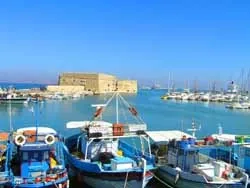
In Heraklion, the first fortifications were built by the Arabs, and they named the city Rabdh-el-Kandak, which means 'Fortress Moat'. The Venetians strengthened the fortress and named the city Candia. Now the fortress wall surrounds the streets of the Old Town, and a small fort guards the harbor, especially beautiful in the evening light. The fort's wall is decorated with three winged Venetian lions, and theatrical performances are held in the inner courtyard.
In Chania, the city hill was first surrounded by Minoan, then ancient fortifications. The Venetians built Castel Vecchio (Old Fortress) on the hill, and at the entrance to the port - the 'new' Firkas fort. In the Maritime Museum near the fort, ship models and navigation instruments are displayed. The most unusual café in old Chania is called 'Fortezza'. It is located on the pier in the ruins of the fort.
Agios Nikolaos, which was Venetian San Nicolò, guards the stunning island fortress of Spinalonga. Translated from Italian, its name means 'Long Thorn'. The Venetians built the fortress on this rocky scrap of land to defend against the Turks, and it was never taken by storm. The Venetian garrison held out there until 1714, when the rest of the island was under Ottoman rule. Crete was guarded by two more fortress-islands - Gramvousa and Souda.
Italy: beautiful mistress of the seas
Italy had as many as four great maritime republics: Genoa, Venice, Pisa, and Amalfi. Each of them waged conquest campaigns and defended itself. And that meant building fortresses. Venetian and Genoese citadels can be seen on various coasts of the Mediterranean and Black Seas. So, let's go to Italy!
To get to the beginning of time, one must go to Sicily, to Syracuse, which was founded by ancient Greeks, settlers from Corinth. A charming city lying on two islands - large Sicily and tiny Ortygia, connected by a bridge. Narrow streets, majestic cathedrals, carts drawn by small Sicilian horses, Corinthian columns of temples protruding from the squares... The flat islet of Ortygia with fortified shores is almost an ideal fortress. On the sea side, it is completed by a fortified fort - Castello Maniace. You cannot go inside; it is something naval, but you can admire the long embankment with dilapidated houses and church domes, ending in the impressive low towers of the fort.
Once upon a time, a very interesting story happened here. During the Second Punic War, Syracuse sided with Carthage, and Rome sent a large army to the rebellious city. A fleet of 60 ships stopped at the powerful fortifications of Ortygia, and the Romans built a floating tower: eight linked ships served as a platform for a structure with throwing weapons. Syracuse froze in horror. Only an old eccentric named Archimedes remained calm. First, he activated a mechanism like a crane: huge wooden claws emerged from the walls and began to lift and overturn ships. Then unprecedented throwing machines came into play. This episode ended with the famous experiment with concave mirrors: Archimedes set them up on a rock and set the ships on fire. Like clockwork, the 75-year-old engineer orchestrated his own defense. He had been tasked with refortifying the fortress of Syracuse several years before this battle, and Archimedes brilliantly fulfilled the task. For two years, the Roman fleet tried to defeat a tiny island that spat long arrows, stones, and fire. After two years, the fortress fell - its gates were opened by a traitor bribed by the Romans.
If we continue the time travel, we must go to the island of Ischia to see a stunningly beautiful fortress called the Aragonese Castle. It also stands on a small island connected by a bridge to the town of Ischia Ponte. The first to build a fortress here was the Greek from Syracuse, Hieron I. This was in 474 BC. High towers rose on volcanic cliffs, walls girdled the island. Then the island-fortress was held by the Romans, Visigoths, Vandals, Ostrogoths, Arabs, Normans - all of them added to and rebuilt Hieron's fortress. In 1441, the Aragonese king Alfonso arrived and completed the reconstruction. He built a bridge to Ischia, strengthened the walls, repaired the towers, and erected a huge castle. For several centuries, all the inhabitants of Ischia took refuge in the fortress from pirate raids. At the end of the 16th century, 1,892 families lived there. At the same time, it housed 13 churches, a Greek abbey, a monastery, a bishop with a seminary, and a prince with a garrison. The history of the fortress is so full of events that it would be enough for a novel. Ariosto wrote his 'Orlando Furioso' here, Boccaccio his 'Decameron', in which he depicted the Garden of the Nymphs. Petrarch, Michelangelo, Tasso visited here. In the 18th century, Ferdinand of Bourbon gave the castle to the state, and two hundred years later it was bought by lawyer Nicola Mattera. And now, among the magical gardens, Romanesque chapels, the ruins of a cathedral with frescoes from Giotto's school, among mysterious paths and formidable walls, the old owner of the castle wanders with tourists.
Turkey: From Troy to Anamur
Turkey is a worthy successor of ancient Greece. However, almost nothing remains of ancient fortifications, and only imagination helps to resurrect the former walls of Greek cities. Most Turkish fortresses were built in the Ottoman era. They are well preserved and have been turned into museums.
The most famous of the ancient fortress cities is legendary Troy. This city was destroyed many times in its long history and rose again from the ashes. The first Trojan fortress was built in the third millennium BC. It was a structure with wooden walls three meters wide set on a stone foundation, the only gate guarded by two towers. All this burned in a fire in 2500 BC. The rebuilt city was surrounded by a wall 4 meters wide, but it also burned in 2200 BC. The city built on its site was razed to the ground 500 years later. After that, the fortress walls were made of dressed stone and reinforced with towers. In 1300 BC, they were destroyed by an earthquake. And in 1270 BC, the Achaeans led by Agamemnon came to Troy. They besieged the impregnable fortress for 10 years, and then built a wooden horse that not only entered the gates but also entered proverbs and sayings. Leaving, the Achaeans destroyed the city, but it rose again.
The next destruction came in 1100 BC. In 700 BC, the Greeks built New Ilium on the ruins of Troy. Now next to this place is the Turkish town of Kumkale. Of Troy, only low hills, the ruins of a theater, remnants of columns, and blocks of marble remain. And a huge wooden horse - in memory of the once great city.
However, Turkey has no shortage of completely intact and beautiful fortresses. One of them is located near ancient Troy, in the town of Assos. From the fortress towers, there is a wonderful view of the coast, the Edremit Gulf, and the island of Lesbos. From Assos, you can go to Çanakkale, whose fortress defended the Dardanelles Strait. It was built in 1463 by Mehmed the Conqueror. Now in the fortress of Sultaniye Kalesi is a military museum.
In the resort town of Çeşme, a well-preserved 15th-century Genoese fortress houses the Museum of Weapons. Over Bodrum, a crusader fortress of the same period towers, also turned into a museum. Fortresses stand in Foça, Marmaris, Antalya, Silifke.
The fortress in Alanya is very beautiful. This city lies on a rocky cape between two long bay-beaches. At the top of the cape stands a 13th-century Seljuk fortress. Double crenellated walls, 150 square towers – all this is well preserved. Within the walls are mosques, the ruins of Ehmedek Castle, a Byzantine chapel. In August, Alanya hosts an International Folklore Festival.
The southernmost point of Asia Minor - Cape Anamur - is crowned by a magnificent 12th-century fortress built by Armenian kings. It is located 6 km from the town of Anamur. Anamur Kalesi is the most impressive fortress in Turkey, and moreover, well preserved. Opposite Anamur in the sea stands Kizkalesi - 'Maiden's Castle'. The white walls are very beautiful against the blue water. This fortress was built by a sultan for his daughter to protect her from snakes - an oracle predicted that the girl would die from a snakebite. He was not mistaken: a snake got into the fortress in a basket of fruit and bit the poor girl.
Spain: Torre, Torre, Torre
In Spain, a castle or fortress is called 'Castello,' and a fortress or watchtower is called 'torre.' There are so many of both that they rise on almost every hill. Real or former fortresses remain in the names of Spanish cities: Torremolinos, Torreblanca, Torredenbarra, Torroella, Torres de Cart and Torres de Seranos, Castellón, Castelldefels and Castellfollit. Not to mention an entire province called Castile. True, it lies deep in the peninsula.
In Spain, fortresses were first built by the Visigoths, then by the Arabs, then by everyone else who fought the Arabs. Currently, there are 10,000 fortified castles in the country. Most castles remain in Castile - they were built for protection from both Moors and Christians. Most often they were built on the site of fortified Celtic settlements called 'castros.' Medieval castles had everything required - a moat, a drawbridge, chapels and dungeons. The tower where the castle owner lived was called 'torre de homenaje.' The only ornament allowed was a coat of arms above the gate. Moorish castles were distinguished by elegant lines, stucco in the rooms, and ornate latticework. The mixture of Gothic and Moorish styles gave rise to the Mudéjar style, intricate and highly decorated, with arches resembling keyholes.
In different regions of Spain, the fate of castles varied greatly. For example, the 'Catholic Monarchs' Ferdinand and Isabella, fearing the knights, forced castle owners to leave their strongholds and live at court. Thus the castles of Castile and Aragon were emptied. In Catalonia, however, King James I the Conqueror did the opposite: he generously distributed titles and lands to his loyal knights. James I reasoned wisely: rather than building fortifications and keeping an army, it is better to give away the lands, and the owners themselves would guard them, and also protect the borders of the kingdom. Thus many castles and fortresses appeared in the north of the country, where the Arabs had not had time to build anything. Now the castles erected in the 13th-14th centuries adorn the coastal hills and Pyrenean peaks of Catalonia. Some lie in ruins, others are well preserved and look like new. Almost all of them are private, and their owners bear the former titles.
One of the tourist attractions on the Costa Brava coast is the castle of Val-Tordera. You can go on an excursion called 'Medieval Night' at Castell de Valtordera. It starts in the evening. The castle, small from the outside, is surprisingly spacious inside. They hold a 'jousting tournament' where mounted knights fight with lances. Torches burn, the public enjoys roast chicken and wine. After the tournament, there is a flamenco show and a disco called 'ball in the castle.' The knights' armor is, of course, fake, the count and countess are stand-ins, but the castle is real. It looks especially beautiful in the evening, lit by floodlights. All guests receive a cardboard crown and a photo with the 'count' and 'countess.' The castle belongs to the Counts of Fortarde. It is located between Blanes and Malgrat de Mar.
One of the most beautiful cities on the Costa Brava is Tossa de Mar. This medieval fortress city (12th century), surrounded by a wall with a crenellated tower, stands on a mountain above a small bay. Stone houses are entwined with roses and bougainvillea, narrow cobblestone streets lead down to the sea. Tossa is girdled by hills and pine forest, surrounded by many small picturesque coves where reddish cliffs drop into the water. The city can only be reached by a single winding mountain road.
In Andalusia, the famous 'white villages' are often crowned with fortified churches and ancient castles, surrounded by stone walls. They are found both deep in the province and on the coast - bright and sunny Costa del Sol. In Malaga, the capital of the coast, the function of a fortress was performed by the Moorish castle-lighthouse Gibralfaro. Many Moorish watchtowers are scattered along the coastal hills east of Malaga. And in Salobreña, a Moorish castle sits on the summit above the town. It is beautifully restored and open to visitors. The southernmost coast of Spain is called Costa de la Luz - 'Coast of Light'. It is adorned by the wonderful 'white village' of Vejer de la Frontera, which shines over a sheer cliff and is proud of a half-ruined castle.