
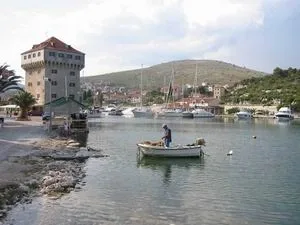
In the newest tourist history, the resorts of the Istrian peninsula were the first to enter: Pula, Rovinj, Poreč and Umag. In addition, aristocratic Opatija and the rest of the Kvarner coast have been actively developed by our tourists. In recent years, the turn has come to the resorts of Dalmatia: travel agencies offer Šibenik, Split, or the homely cozy places Brela and Baška Voda, which have quickly gained popularity.
Tour
A week-long tour to Croatia (airfare, insurance, accommodation in a three-star hotel, breakfast) will cost 620 euros.
Transport
It is easy to get from city to city by bus or minibus. The fare is about 0.2 euros per kilometer. If you board not at the final stop, do not forget to "flag down" the bus driver, otherwise he may simply pass by you. When using route taxis, remember that the fare in a private minibus is twice the state tariff. Taxi drivers charge about 0.9 euros per kilometer.
Bicycle rental
Bicycle rides are also a good pastime. You will discover special routes laid through picturesque surroundings. A pleasant addition to the ride will be a road map, which is given to the tourist together with the rented bicycle. By the way, keep in mind that if a minor mishap happens to the bicycle, such as a flat tire, no additional payment will be required from you. A bicycle rental for a whole day will cost 7 euros. Hourly payment is about 2.5 euros.
Car rental
The cheapest car is a Fiat Uno. Its rental will cost 35 euros per day, Opel Combo - 45, diesel GOLF IV - 65 euros. Insurance is another 5 euros for each day of rental.
Total: active travel on public transport, a one-day bicycle rental, and using an inexpensive car for three days will cost 120-125 euros.
Restaurants
Croatian cuisine is simple and hearty. Local delicacies include pršut (cured ham) and sheep cheese from the island of Pag with an unusual taste and aroma, made using a special technology. Goat milk and cheese can be found everywhere. It is hard to call them delicacies: their taste is too specific, or rather aftertaste.
Continental breakfasts at the hotel are notable perhaps only for tasty pastries. Croats are especially good at puff pastry things. In konobas - local restaurants - they feed simply and without much fuss. A lunch of a large dish with meat and potatoes, a portion of oysters, and a half-liter jug of wine will cost 15 euros. A portion of spaghetti with shrimp, mussels, octopus, and oysters costs 13 euros. Grilled octopus - 5 euros, vegetable salads - about 1.5 euros per large portion. It must be said that salads are rather monotonous and consist of coarsely chopped cucumbers, tomatoes, bell peppers, and cabbage. Oil and vinegar are offered as dressing.
Drinking (mineral) water is served free in restaurants. The exception is restaurants at hotels. There, water can cost 0.5-0.9 euros depending on the season. Water coolers can also be found in hotels. Fruits at local markets are not cheap: plums and grapes - about 2 euros per kilogram, peaches and nectarines - 2.6 euros. Draft wine can be purchased for about 1.3 euros per liter.
Beer lovers should know that in a store, when first purchasing bottled beer (0.7-0.8 euros), you pay for both the drink and the glass container. On subsequent trips for beer, empty bottles are returned, their cost is taken into account, and only the beer is paid for. Returning containers, only in our view, is the prerogative of asocial elements. In civilized countries, this is an absolutely ordinary matter.
Total: a sum of 180-200 euros is quite enough for more than decent food.
Beach
Our tourists have already stopped being surprised at the abundance of German tourists at most resorts. Nevertheless, if you find yourself in Croatia before or after the official high season (beginning of June or end of August), you will notice an abundance of sprightly "old folks" of German origin. The fact is that peers of our war veterans improve their health at the resorts of the gentle Adriatic at the expense of state pension funds.
And everything would be fine, if not for the dubious pleasure of daily contemplating the bare torsos of respectable German fraus on the beach.
What can we say about nudist beaches, for which Croatia is famous. By the way, the "orientation" of a beach is indicated by a blue sign with a crossed-out image of a swimsuit.
An indispensable attribute of beach leisure is flip-flops (7.5-8 euros). In addition, flip-flops are a defense against vile sea urchins, the indispensable inhabitants of the coastal strip. Also be prepared for the fact that the local pebbles sometimes resemble rough "ankle-breaking" crushed stone.
However, all these minor troubles are forgotten at the sight of unnaturally transparent, purest water. The fee for a sun lounger and canopy can be 2.5-3 euros per day. A catamaran rental will cost 4.5 euros per hour, a motor boat will be provided for 9 euros per hour or 28 euros for four hours.
Total: you will need about 20-25 euros.
Excursions
The Plitvice Lakes National Reserve is a unique natural system of multi-level lakes, waterfalls, dense forests, mountains, and meadows. An entrance ticket to the territory costs about 10 euros. In order to avoid total trampling of the reserve, tourists are required to move along dirt paths and specially constructed wooden boardwalks. Their width is about one and a half meters, so at the height of the season it is clearly crowded on the paths. Another downside is a tiny cafe that can barely cope with tourist groups, rapidly working up a serious appetite in the fresh air.
Entry to Krk National Park costs 6.5 euros. The feeling of untouched pristine nature typical of Croatia arises despite the presence on the island of an ancient, well-known European resort of Malinska and even a modern airport. The uniqueness of the national park lies not only in the many ancient monuments of Slavic culture and writing. Of great interest is also the island's richest flora, which, among other things, counts several dozen endemic plants that grow only on Krk.
The largest city of the Istria peninsula, Pula, was a Roman colony in antiquity. That is why here you can admire monuments of ancient Roman architecture. A mandatory item of the excursion program around Pula is a visit to the ancient amphitheater "Arena", which is not inferior to the Roman Colosseum. The city panorama is best viewed from the hill where the city archaeological museum is located. The cost of a museum ticket is 1.3 euros.
From July 10 to August 24, the annual international arts festival "Dubrovnik Summer Games" is held in Dubrovnik. On these days, the ancient city turns into a grand stage. Tragedies, operas and ballets, poetry evenings and classical music concerts - all of this can be watched in the city's parks, palaces and squares. This tradition, which arose more than half a century ago, attracts art lovers from all over Europe to the resort town for a month and a half. The downside of the coin is that an already busy resort turns into a buzzing hive.
Miscellaneous
Usually, the offered excursions include tastings of local wines, cheeses or honey. The traditional tourist performance, to the delight of sellers and the guide, usually takes place in a small picturesque village through which the bus passes. As a rule, after tasting truly amazing honey - flower, forest (they say there is even pine) - tourists willingly buy a few jars for themselves and as souvenirs for relatives.
However, disappointment may await you at home: the contents of a sealed jar sometimes differ for the worse from the honey you tasted. A small jar costs about 3 euros.
On average, for a week in Croatia at the height of the season, you should take about 400 euros with you. This amount is enough for an extremely eventful and varied leisure. Overall, the holiday budget will be about 1,000 euros.