
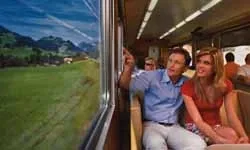
Especially convenient for travelers on a tour to Switzerland are the new generation ICN high-speed expresses. The trains have so-called family cars with spacious compartments for games, as well as special "quiet" cars where loud conversations, use of mobile phones and players are prohibited.
On some routes, seats do not need to be reserved; on others - especially for groups - it is mandatory. At major Swiss train stations, special TicketsCorner booths have appeared, where tickets are sold for almost all cultural events taking place in the country.
Swiss trains run strictly on schedule, which does not change for many years. These circumstances largely determine the specifics of the Swiss variant of tourism.
About 25 transport tourist routes have been laid in the country. Eight are considered classic: "Glacier Express", "Bernina", "Golden Pass", "Wilhelm Tell", "Palm Express", "Romantic Road", "Mont Blanc/San Bernard", and "Préalpes". Other routes are also interesting. For example, the "Swiss Chocolate Train", which goes from Montreux to Broc to the Cailler-Nestle chocolate factory. Along the way, there is a stop in medieval Gruyères, famous for fondue made from the cheese of the same name. And on the "Wine Train", which passes through places where the Rhone River flows into Lake Geneva, you can admire vineyards whose terraces descend along mountain slopes to the water. On the "Golden Pass" route, for an additional fee, you can reserve front seats "Grand vue" in the front car and feel like a driver.
Specially for foreign tourists, the Swiss Travel System is in effect in the country. It provides significant discounts and benefits for traveling around the country by train, bus, and water transport, visiting attractions, museums, and many other services. Depending on the length of stay in the country, the number of travelers, and the places they plan to visit, six types of travel passes are offered. They allow you to choose a travel pass based on the duration of stay in the country, the number of travelers, and the places they plan to visit. Ticket prices have remained unchanged for several years.
The Swiss Pass travel pass is valid all year for unlimited travel throughout the country, including legendary panoramic routes, and on all types of public transport in 37 Swiss cities. It can be purchased for 4, 8, 15, 22 days or for a whole month. Its holders also receive discounts on mountain funiculars, visits to various attractions, museums, and many other services.
The Swiss Flexi Pass differs from the Swiss Pass in that it is valid only during a specific month and can be purchased for 3, 4, 5, 6, or 8 days, which do not have to be consecutive.
The Swiss Youth Pass for young people up to 26 years old is sold at a 25% discount from the full fare, providing all the benefits of the Swiss Pass.
The Swiss Transfer Ticket is designed for short stays in the country and is intended for trips from the Swiss border or from any of its airports on a round-trip basis. Valid for one month. The trip from the starting point to the final destination must be completed within one day and along the shortest route with the minimum number of changes.
The Swiss Card differs from the Swiss Transfer Ticket in that, in addition to a round trip to the final destination, it also entitles the holder to a 50% discount on all rail, bus, or boat travel and most mountain excursions during the period between arrival and departure.
The Family Card is issued upon the traveler's request and allows children up to 16 years old to travel around Switzerland with their parents for free.
All the above travel passes are not sold to Swiss citizens. Foreign tourists must present a passport when purchasing them. A detailed description of the travel pass options, rules for selling them to tourists, and a list of travel agencies that sell them can be found on the Switzerland Tourism website.
_