
Feng shui in Singapore is sacred. Everything is subject to the laws of the Chinese teaching on the harmony of man and nature. No business is possible without a feng shui consultant. I was told that a certain bank relocated a slum quarter located near its own skyscraper office. Otherwise, according to the feng shui consultant, the bank would never see financial success. Now it is one of the leading banks in Singapore and Southeast Asia. Or, for example, one of the luxurious hotels on prestigious Orchard Road was a loss-making enterprise for several years. The owners changed the entire hotel management a couple of times until an old Chinese man, a great expert in the teaching of harmony and success, explained that the hotel doors should be turned 32 degrees to the right... What do you think? They had to completely rebuild the facade, changing the location of the entrance door. The forces of nature reacted correctly, and now, to stay in this hotel ($350 per night), you need to reserve a room 14 days in advance!
Water holds a special place in feng shui, as it symbolizes wealth. Thus, fountains in Singapore do not spray water, but rather "collect" it. It is no coincidence that the largest fountain in the world, the Fountain of Wealth, is also located here. Those seeking prosperity line up near it, usually ignoring a modest sign with instructions explaining that the fountain does indeed bring wealth, but... a special kind, the wealth of the soul.
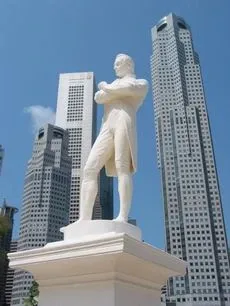
Many believe Singapore is a real image of the city of the future - even a metro ticket can only be bought via a computer terminal. Despite such intensive development, no one forgets its glorious past. Historically, Singapore is dominated by Chinese who settled there since the times of the East India Company, under the leadership of Sir Raffles in 1819. However, the far-sighted Englishman also provided for the settlement of other peoples in the then small village and allocated places for Indians (how could one do without them!) and Malays. Today, all of them constitute the main groups of Singapore's residents. In gratitude for his wise leadership, a monument was erected to Sir Stamford Raffles in an excellent location - on the river embankment near Chinatown, overlooking a row of Chinese restaurants and two English pubs: Harrys and Black Penny.
The location is not accidental, since Sir Raffles was a great food lover and respected Chinese cuisine. Here, at any Chinese restaurant, they will gladly foist upon you "Sir Stamford Raffles' favorite dish," adding a couple of lobsters from Sri Lanka to the seafood. The bill will match the status of the dish. And what did you expect - Sir Raffles did not like cheap things! Any Chinese or Indian will confirm this.
For fans of "simple" exotic food, Singapore is an extremely fruitful place. Chinatown sizzles and perfumes the air all day long. I confess I myself could not resist the magical sight: an old Chinese woman, deftly picking up a pot black with soot, placed it on the fire. Splashing oil into it, causing the flames, as if rejoicing, to leap upward, throwing out strange black soot; after waiting a second for the oil to boil, the old woman threw into the pot a generous pinch of red chili pepper, salt, some seasonings, and something very reminiscent of dried noodles. That's a clear illustration, I thought: that's what awaits the souls of sinners in heaven... Having paid the Chinese woman my honestly earned $5, I, according to feng shui, turned my face to the setting sun and dined on freshly prepared noodles with shrimp. That there were shrimp had to be taken on faith: under the guise of shrimp could be anything, because the English word "shrimp" can be used by the Chinese to denote the most unimaginable seafood. It was delicious.
Sinners, by the way, are dealt with quickly in Singapore: the fine for smoking in an unauthorized place can exceed 1,000 Singapore dollars; it is better to throw away chewing gum before arriving at the customs terminal; and as for lovers of the weed of the cannabis family that is legalized in Holland, everything is simple: the discovered herb is weighed on scales. If the needle crosses the red line, the offender's earthly sojourn is over. Relatives will be sent personal belongings and a one-line obituary in the "crime" section. All guests of Singapore are honestly warned: on the immigration card, in red letters, it is highlighted: "for drug trafficking under Singapore law - death penalty." Even for hooligan acts, the punishment cannot be called symbolic: an American schoolboy tourist was publicly flogged by court order for spitting in a public place and insulting a police officer.
Nevertheless, complying with the laws here is very easy, and living in a clean city is pleasant, and being a citizen of Singapore is very prestigious. Any resident will first say: "I am Singaporean," and only then clarify - Chinese, Malay, Indian, Arab (delete as appropriate). I spent half an hour questioning my driver: where are you from, lad? The black "lad" held firm and answered like a first-year soldier: "Singaporean, your honor!" Only toward the end of the trip did he admit somewhat embarrassed that he lives in a Malay district. And like a recruit before a general, he immediately "poured out his soul": he recently got married, they rent an apartment for $600 a month, his wife works as a salesperson in a supermarket, and they cannot afford to have children yet.
Chinese, Malays, strict laws, skyscrapers, feng shui, equator, high-tech, computers in the metro, Buddhist monasteries and Hindu temples with Veera-makaliamman and Vadapatrakaliamman (I'm not lying!)... Feeling an overabundance of information, I took the Singapore metro to the peaceful station "Chinese Garden," got off, and couldn't believe my eyes: everything is like in Moscow. The Strogino district on the Moscow River, and Mitino can be seen in the distance... Something stung my eyes... Time to go home!