
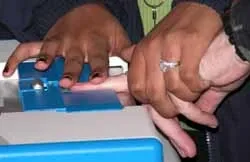
Last week, the European Commission proposed taking fingerprints of all foreigners arriving in or leaving Europe on trips abroad. The Washington Post obtained a draft law presented by European Commissioner for Home Affairs, Justice and Security Franco Frattini. "If approved by the European Parliament, this measure would mean that in the coming years, precise identification information on tens of millions of citizens will be added to databases that can be shared by friendly governments worldwide," the newspaper notes.
According to Frattini's idea, all foreigners without exception would have to provide their biometric data (for now, only fingerprints) in any of the 27 EU countries at every entry and exit. This scheme mirrors the security regime already introduced in the United States. Biometric data is also collected from those entering Japan and the UK. It makes it much easier to track people and identify potential terrorists, European officials say. Beyond security issues, fingerprinting helps control the flow of migrants from third-world countries. Moreover, parliamentarians plan to deal with thousands of immigrants who entered Europe on a valid visa but did not leave the country when it expired.
In addition, Frattini proposes another border control measure: collecting and freely sharing among EU member states information about all flights taken by a foreigner, including details of the bank account used to pay for the airline ticket. The collected data will be stored for 13 years, the Washington Post notes.
European human rights activists, after reviewing such a harsh bill, said that the right to privacy could be forgotten. Lawyers, advocates, and even law enforcement officials believe that the EU is blindly copying the U.S. system of biometric data collection without a clear goal or guarantee of data security. "Boys are playing. And now they want to have toys that the American comrades have," assessed the bill Gus Hosein, senior researcher at the London-based human rights organization Privacy International. "They are licking one method after another from the US without a single piece of evidence that it will work. It's time to stop and think," Dutch Member of the European Parliament Sophia in 't Veld told Reuters.
Privacy International believes that by 2015, a global database could emerge containing information on more than 1 billion people. "Inevitable leaks from any large data repository. Data is stolen or used for criminal purposes," Hosein warns.
According to civil rights activists, access to biometric data at airports will allow the formation of a system for monitoring people's movements on a global scale. Moreover, Hosein warns, using this information, any country could create its own surveillance system, claiming it is fulfilling its international obligations. As a result, total surveillance could be established by states that do not respect human rights.
"This new trend, which the US, Australia, and the EU are crazy about, is to register every detail of our lives," said Sophia in 't Veld. "We are all tagged. They can follow us everywhere. They always know who we are and where we are. The main question is: why? Does it really make the world safer?"
The European Commission is confident that it does. "The innovation is necessary to protect the bloc's external borders from terrorists: after all, within Europe they can already travel without any checks. It is a strange and naive omission to live without a system where one can know who has entered or left the EU," Friso Roscam Abbing, a representative of the European Commission, told the Washington Post. "In this fantastic Schengen area, there is not a single border; here a person is freer than anywhere else in the world... Is it really so strange that we want to compensate for this by strengthening the external borders?" Abbing promised that the EU would soften the ultra-strict security measures by obliging governments to set up special fast registration systems at airports for passengers who voluntarily agree to be entered into the database, for example, by scanning their iris.
These measures will not affect Europeans, but they too have reason to worry about possible leaks of personal data from the common database: last year, more than 80% of EU residents provided fingerprints and photos for new biometric passports. Moreover, in the last six months alone, there have been several large-scale data leaks in the UK.
In the fall of 2007, officials lost a disk containing data on 25 million child benefit recipients. Tax authorities sent disks with information to the National Audit Office, but they never reached the addressee. Their whereabouts are still unknown. Later, a database with personal data from the UK Ministry of Defence disappeared: a laptop with files about future recruits was stolen from a Royal Navy officer. The computer contained comprehensive information – from passport data to all bank account numbers. The circumstances of the incident are not disclosed, and the laptop has not been found. Given this state of affairs, it is hard to believe in the security of biometric data accessible to the intelligence services of 27 countries.
"The Union is creating one database after another without any protection against hacking. It's not good to have a rapidly growing data repository without securing it with proper safeguards," Jan Velleman, a police representative from EU countries, told the newspaper. "It's generally wrong to make a decision without public discussion. The terrorist threat has not gone away, but we need to better explain to people why such a tool is being introduced," added the MEP.
"Anyone who has been following it for the past three years has seen that the European Commission has been consistently building up its powers and decision-making procedures," said a representative of the European Parliament.
In the US, the European Commission's actions are approved. 'We not only support the EU initiative, we applaud it,' said Ross Nock, a representative of the Ministry of National Security. The US Department of Homeland Security already has 85 million fingerprints in its collection. Along with foreigners detained at the border for various violations of the criminal code, it stores data on Americans who have adopted children from other countries.
Olesya GERASIMENKO.
Gazeta.Ru er="0">