
One of the countries richest in seas is Italy. Actually, there is only one sea, but thrifty Italians have sorted it into shelves and become owners of the Mediterranean, Adriatic, Ionian, Tyrrhenian, Ligurian, and even Sardinian Seas. There are also many Italies, and they are all different. Hot and noisy Rome is located some distance from the sea, but the port of Civitavecchia helps cruise ship passengers explore the Eternal City. All roads from Rome lead to the sea: to Calabria, Apulia, Venice, to the Rivieras of Liguria and Amalfi.
On the Adriatic
The Adriatic Sea offers a lovely coastline that stretches from Trieste through Pescara and Bari to Cape Santa Maria di Leuca in Apulia. It begins from the Alpine foothills in Friuli-Venezia Giulia, where traditions of Italian and Slavic cultures and Austro-Hungarian imperial mores are mixed. The region is adorned by the town of Aquileia - a center of early Christianity and an ancient Roman colony.
Rimini is considered the geographical center and capital of resort Adriatic – the city of Federico Fellini and the Malatesta dukes. Here, near Rimini, is the toy republic of San Marino, which tourists from all over the coast come to see.
South of Emilia-Romagna lies the Marche region, continuing the carefree coast of resorts. The most popular resorts are San Benedetto del Tronto, Grottammare, and Pesaro.
The south of the Adriatic coast is a land of ancient ruins and ancient olives. It differs from the north as if another country begins from Abruzzo, poorer and more temperamental, hospitable and frank.
The Venetian Riviera is not really a Riviera at all, since the mountains are located far from the sea. Endless sandy beaches stretch from Venice to Trieste, delighting adults and children with a gentle warm sea. The main resorts of the Riviera are the toy town of Bibione, known for its Thermal Baths, and the expensive Lido di Jesolo and Sottomarina Lido, which shares a narrow spit with little Venice - the town of Chioggia.
Ionian Italy
The south of Italy, washed by the Ionian Sea, is called Mezzogiorno - Land of the Midday Sun. Here the sun shines brighter, and orange gardens yield several harvests a year. Three regions converge on the Ionian coast: Apulia, Basilicata, and Calabria. Apulia is a succession of endless hills receding to the horizon, and amazing round trulli houses, which are found only in these parts. The city of Lecce, built in Baroque style, is worth visiting. The city of Matera is famous for its unique cave dwellings.
Pollino National Park with a mountain 2,248 m high is the most tourist-free place in Italy. Here ancient villages have been preserved, where people live as they did 500 years ago. These places attract lovers of pristine nature.
Calabria faces two seas - the Ionian and Tyrrhenian. It occupies a long peninsula - the 'toe' of the Italian boot. Unlike the somewhat murky Italian Adriatic, the Ionian Sea is distinguished by crystal clarity. This is a protected corner, mysterious and wild places, preserving traces of many civilizations and cultures, the birthplace of Horace. Here cuisine is its own - more piquant, spicy, and abundant than in the north. And more seafood-oriented, with many dishes of fish and marine creatures. Southerners hold in high regard king prawns and lobsters, swordfish and tuna, accented by eggplants and zucchini. Southern wines are not inferior to more famous northern ones. And this is understandable: there are no bad wines in Italy, only red and white.
Calabria is called the land of centenarians. There, sea, sun, mountains, and pines converge; there in a week you regain health, and in two weeks you become 10 years younger.
Tyrrhenian Italy
On the Tyrrhenian coast are located the most elegant seaside resorts in Italy. They are on the famous Amalfi Coast in the Gulf of Naples, on Sicily and Sardinia, Ischia and Capri. The south of the 'boot' in its Tyrrhenian part is much less inhabited by tourists, although there is where to relax and what to see. High mountains, pristine nature, clean beaches and the purest water make these places fabulously beautiful. One of the main resorts remains Tropea - an ancient city where modern buildings have not spoiled the landscapes, and beaches, hotels and restaurants are of high quality service.
The main magnet for curious travelers is the ruins of the ancient Greek and Roman city of Paestum not far from Agropoli. This amazing archaeological park has preserved three greatest temples of antiquity: of Neptune, Hera, and Ceres.
The Gulf of Naples and the Amalfi Coast deserve a separate story. Famous resorts from Sorrento to Salerno with luxurious hotels and villas of all the world's stars stand on almost vertical cliffs, on mountain spurs and in tiny coves. In August, all beaches are full here, and there are not too many of them anyway.
To the west of Rome on the shore of the Tyrrhenian Sea is Versilia - the Tuscan Riviera. Its resorts smoothly blend into one another, competing in elegance and fashionability: chic Viareggio, democratic Lido di Camaiore, Forte dei Marmi with an increased content of movie stars. A very, very wide endless beach of marble sand combines with a very, very clean sea. The mountains are high and also marble - the Apuan Alps. All hotels are located not on the beach, but along the promenades. The promenades are luxurious, and the beaches are paid.
In Liguria
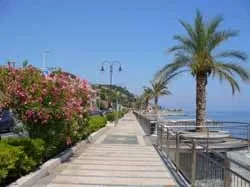
The part of the Mediterranean from Corsica and Elba to the Italian shores is called the Ligurian Sea. In fact, it is only a bay - the Gulf of Genoa. But it is not about names at all! There, where the skies are eternally blue, where roses bloom and lemon trees perfume the air all year round, nobody thinks about names.
The Ligurian Riviera is considered the most prestigious coastline in Italy. And one of the most beautiful: here the Alps meet the Apennines, come right up to the sea, and protect the resorts from northern winds. The Ligurian Riviera continues the French Côte d'Azur, starting from Menton, or rather, from its Italian sister Ventimiglia.
South of Genoa lies the Riviera di Levante: cliffs, coves and bays, pebble beaches, towers, palaces and abbeys, white yachts in fishing villages with colorful houses. The most beautiful and most expensive place on the coast is Portofino, more democratic and family-friendly is Rapallo.