
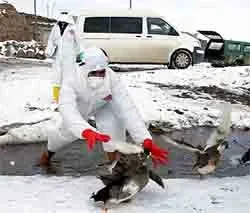
Bird flu reaches Turkish resorts
Mass bird deaths have been recorded at the Turkish seaside resort of Kusadasi on the Aegean coast. According to preliminary data from experts, the death of poultry, doves, and pigeons was caused by bird flu, Turkish television reports. By order of the local authorities of the city of Aydin, the administrative center of the province of the same name, the culling of poultry has begun in the Kusadasi district.
If the H5N1 virus infection in birds in Kusadasi is officially confirmed, it would be the first case of the spread of the deadly disease to the country's resort areas, where about 20 million foreign tourists vacation every year.
The World Health Organization (WHO) confirmed on the eve, based on laboratory tests, 14 cases of bird flu infection in people in Turkey. WHO press secretary Christine McNab made a corresponding statement in Geneva. A similar statement was made on Monday by the head of the Turkish Ministry of Health, Recep Akdag, during a visit to the city of Van in the east of the country, where in the first days of the new year three teenagers from the Kochigit family died from the H5N1 virus.
At the same time, WHO announced that it had not detected signs of human-to-human transmission of the bird flu virus in Turkey. "The World Health Organization has officially confirmed four cases of human infection with the H5N1 virus, two of which were fatal," WHO official representative Genel Rodier told CNN-Turk in an interview. "To date, no cases of transmission of the dangerous disease from person to person have been recorded in Turkey," he noted.
According to the Turkish Ministry of Agriculture, the presence of the bird flu virus has now been confirmed in 16 provinces of the country, mainly in the east and southeast. Istanbul and Ankara are also on the list. In special laboratories, blood samples from about 100 people who went to hospitals with symptoms of H5N1 infection are being tested. In Istanbul alone there are more than 60, the Turkish Ministry of Health reports. In Istanbul, a city of 14 million, following Ankara, by order of the local governor, the sale of chicken meat at markets has been banned and quarantine has been partially introduced. In three districts of the Turkish metropolis, where the H5N1 virus has been detected in poultry, culling has begun in a three-kilometer zone.
Overall, RIA Novosti reports that more than 100,000 head of poultry have been culled in Turkey over the past few days. It is being destroyed in all areas from which reports of bird flu detection come.
Citizens are advised to be vigilant in Turkey
Lithuania's Foreign Ministry recommends that Lithuanian citizens traveling to Turkey take additional security measures. This is reported by IA Regnum with reference to the press service of the country's foreign policy agency.
The Foreign Ministry recommends that Lithuanian citizens in those regions of Turkey where bird flu has been confirmed avoid visiting bird markets and poultry farms, not touch live or dead birds, not eat undercooked poultry meat, and observe personal hygiene rules.
The head of the Russian Federal Service for Supervision of Consumer Rights Protection and Human Welfare (Rospotrebnadzor), Chief State Sanitary Physician of the Russian Federation Gennady Onishchenko, stated the need to strengthen control over the health of people arriving from Turkey. "In connection with the epizootic of influenza among domestic and wild birds in the Republic of Turkey, and also the registration of cases of influenza A(H5N1) with fatal outcomes among people, Rospotrebnadzor proposes to strengthen control over the health of people arriving from Turkey and neighboring countries at border checkpoints," the official letter of the head of Rospotrebnadzor to the chief sanitary doctors of the republics of North Ossetia and Dagestan says, published Tuesday on the agency's official website. In addition, it is necessary to pay special attention to the health of people returning by land transport through Turkey from the hajj in Saudi Arabia, the letter emphasizes.
Bird flu may not be so terrible
Cases of human infection with bird flu are probably more common but less lethal than previously thought, scientists from Vietnam and Sweden believe. An article about their research in this area was published in the January issue of the international medical journal Archives of Internal Medicine.
"Confirmed cases of infection with highly pathogenic avian influenza in Vietnam may represent only a small sample of the most severe cases," notes Anna Thorson from the Karolinska Institute in Stockholm. This conclusion was made based on a study conducted in Vietnam, where in 2004 a significant number of people infected with bird flu were recorded. At the same time, Thorson believes that this study cannot prove that all these patients were actually infected with this particular virus. She believes that the number of infected people in Vietnam could have been higher.
The publication notes that even in developed countries, half of those who die from respiratory diseases do not receive an accurate diagnosis, and in developing countries this is even more rare.
As Interfax reports, the dangerous to humans type of bird flu virus H5N1 was first detected in Hong Kong in 1997, and later spread to many Asian countries. Since then, 93 cases of human illness have been recorded in Vietnam, 42 of which were fatal.