
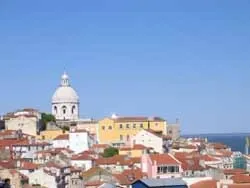
The capital of Portugal is multinational Lisbon. As «Voyage et Loisirs» notes, everything is mixed here - hot Africa, passionate Latin America, and respectable old lady Europe. Perhaps it is precisely because of this «exotic cocktail» that the locals are remarkably beautiful: tall, dark-eyed, and most importantly - Europeanly intelligent. Moreover, the Portuguese are creative natures. The penchant for art is felt everywhere - from the playful graffiti on containers in the port to mystical organ music concerts in ancient cathedrals.
And, of course, the main national trait of the population is ardent patriotism. The Portuguese flag flies on almost every balcony. Of course, the most successful occasion to demonstrate one's patriotism is a football match; this spectacle deserves a separate story.
A Bit of History
Initially, the capital of Portugal was not Lisbon at all, but the humble city of Coimbra, now considered a province. In 1147, after the expulsion of the Moors from the country, the first king of Portugal with the sonorous name Afonso moved the capital to Lisbon, considering its location strategic. Indeed, the city is located at the mouth of the river with the mysterious name Tagus and is reliably protected from the whims of the ocean, turbulent currents, and unpredictable storms. This was understood even before King Afonso by the Phoenicians, who named the area Alis Ubbo, which means «beautiful harbor» in translation.
Over the centuries, who hasn't encroached on this piece of land - Lisbon has been in the hands of the Roman Empire, the Moors, the Spaniards, and survived the invasion of Napoleon's troops. But despite the city's respectable age, there are not so many ancient buildings here. The reason was a terrible earthquake that «shook» the surroundings on a cold November night in 1755, on All Saints' Day. Much of Lisbon was destroyed, and more than 60 thousand of its inhabitants died.
Thanks to the zealous chancellor Marquis of Pombal, a passionate admirer of Lisbon, the city center was rebuilt quite quickly after the earthquake. The Marquis decided not to restore the old streets; he ordered new ones to be laid out and the commercial and craft center of the capital placed on them. The new streets were named after representatives of various professions. Now there is no trace of craftsmen here, and their place has been taken by banks, investment, and law firms.
City Routes
It is best to start getting acquainted with Lisbon with a leisurely walk along the main avenue, Avenida da Liberdade, from Marquês de Pombal Square to the very center - Rossio Square. In the Middle Ages, there was a building of the Inquisition here, and right in front of it, on special platforms, they dealt with witches. Belonging to the evil spirit was determined quite simply - the suspect was thrown into the water, and if she did not drown, the witnesses had no doubt that they were facing a real witch. Then she was impaled and burned. A huge number of spectators gathered to gawk at this sad spectacle. Now the square looks quite peaceful - rows of clothing shops coexist with coffee houses and a bus stop. The Inquisition building does not look gloomy, rather the opposite - elegant. It houses the city theater, where world premieres take place.
To the right of Rossio Square is the charming neighborhood of Alfama, founded by the Moors back in 711 and miraculously surviving the earthquake. Narrow cobblestone streets go up here almost at a right angle to the Castle of St. George, and the walls of the buildings are decorated with ceramic tiles «azulejo». You can admire the exquisite patterns and scenes from medieval life endlessly, and each time you encounter another masterpiece, you feel a sense of belonging to ancient history.
The name Alfama comes from the word «al-ham», which in Moorish means «hot». The area got its name for a reason - thanks to a hot spring that in the Middle Ages gushed right from the wall of a building. To avoid quarrels between representatives of different social strata, several taps were installed in the wall - one for slaves, another for sailors, a third for service people. But fights still occurred, sometimes ending in bloody stabbings. Ethiopian slaves, known throughout the Mediterranean for their tough temperament, were especially fond of picking fights.
If you don't want to walk, you can take a thrilling hour-long ride on a bright red tourist tram, which departs from the same Marquês de Pombal Square. All the most interesting places in Lisbon will appear before your eyes, and the funny, almost toy-like tram will bravely climb up the cobblestone streets, then quickly go down the slope. The streets are so narrow that by sticking your hand out the tram window, you can touch the rough walls of buildings.
After a walk through the center of Lisbon, it is worth visiting the ancient suburb of Belém. It was from here that 15 caravels of Vasco da Gama once set off in search of legendary India, and in the local chapel the famous navigator prayed for the success of the journey. Now Belém is the Mecca of sailing in Portugal. In an extremely picturesque place directly opposite the Monastery of the Hieronymites, the royal sailing club Naval Association of Lisboa is located, founded in the 19th century by Prince Luís. Sailing regattas are held here, and the instructors of the club's skipper school represent Portugal in leading world competitions. The «elephant» that cannot be missed in Belém is the huge Abril Bridge, connecting the two banks of the Tagus, and very similar to its counterpart in New York.
Eshternados is another famous suburb of Lisbon, which was specially built for the Expo '98. It feels like there was a competition among architects for the most unique building design. The charming business center is shaped like a rhinoceros pointing its horn toward the river, the casino is designed as a sail gleaming in the sun. It also houses the largest aquarium in Europe and a futuristic lift, from the window of which a romantic view of the royal palace opens.
And now – 'ooh-la-la'
With the onset of evening, colorful lights come on in the streets of Lisbon, and a completely different, glittering nightlife begins, filled with an atmosphere of carefree fun and light flirtation. In Belém there is a branch of the famous Parisian Buddha Bar, the establishment is full of oriental exoticism, hookah smoke and gilt. The world's best DJs consider it an honor to perform here with their musical compositions.
The Bairro Alto district is loved and visited by young people thanks to the huge number of student bars located there. Most of them were designed by fashionable designers, and the interiors look exquisite and futuristic at the same time.
Moreover, it was here, in Bairro Alto, that in the 18th century the traditional Lisbon songs 'fado' were born. Mariza, the most famous singer in the country, calls them 'Portuguese blues', or 'urban romance'. These songs have something of bossa nova, blues and jazz at the same time. The vocals are accompanied by double bass, acoustic and Portuguese guitar – a twelve-string instrument shaped like a mandolin. Fado is sung by both women and men with extraordinarily strong and soulful voices. These are songs about love and jealousy, happiness and sadness, passing time and nostalgia for a lost homeland.
Local Riviera
Lisbon successfully combines resort and city life. But still, if you are tired of the hustle and bustle and crave the stormy ocean currents and natural beauty, it is definitely worth spending a few days exploring the 'Lisbon Riviera' – the chic Cascais and Estoril.
These cozy towns are located thirty kilometers from the urban paradise, two kilometers apart. Strong winds blow here, and you can clearly feel all the power and grandeur of the ocean with its water surface stretching for thousands of kilometers. Millionaires from all over Europe come to the Riviera to moor their yacht in the charming port of Cascais, play a game of golf, try their luck in the luxurious Estoril casino, and soothe their shattered nerves in one of the lavish spa salons.
Immediately after Cascais begins a protected area that UNESCO has taken under its wing. Here is the westernmost point of Europe – Cape Roca with a lone lighthouse standing at a height of 140 m above mean sea level. High waves crash against the coastal cliffs with a gloomy roar, and gusts of wind sometimes make it quite difficult to stand on your feet. There is not a soul around, and there is a complete feeling that the whole world lies at your feet.