
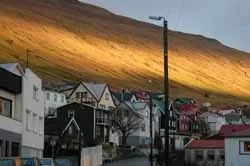
The Faroese Dream
Saying "I'll go" was easy; doing it was harder. Travel agencies didn't offer trips to the Faroe Islands, and if they did offer mediation, it was expensive and unreliable. There is no direct connection from our country to the archipelago; only Russian fishermen on trawlers often appear in Tórshavn. As a result, several years passed, and only at the beginning of 2007 did I develop a plan and save enough money for the trip.
You can reach the Faroe Islands by air and by sea. Flights to Vágar Airport regularly arrive from Copenhagen and Iceland, and slightly less regularly from the UK and Norway. Atlantic Airways has one of the highest safety ratings in the world; at Vágar Airport, despite its extremely short runway, there has never been a single incident. However, all this comes at a cost, and a significant one at that.
By sea, the giant car ferry Norrona runs between Bergen in Norway, Tórshavn in the Faroes (Danish), Iceland, and periodically calls at Scotland. Tickets for the ferry are handled by Smyril Line.
The Faroese Capital
I traveled by plane. Of course, I was warned about the prices, but by buying tickets a couple of months in advance, I managed to find a decent deal. In total, it came to no more than €300 one way, which is quite good for this destination.
So, you are in Vágar (a little over two hours' flight from Copenhagen), go through a rather formal customs check, get on a bus, and after an hour you find yourself in the capital of the archipelago - Tórshavn (locals call the city Tórshavn or simply Havn, "harbor", but in Russian the pronunciation Tórshavn has become established). Despite its compact size, Tórshavn has everything. True, often in a single copy: one large shopping center, one tourist office, one cinema, one nightclub, and so on. But there are quite a few cafés, various hotels and hostels - not that many, but enough for everyone.
But let's step away from advice on transport and infrastructure - we need to talk about why the Faroe Islands are so loved by people from various countries around the world.
The Faroese Nature
Of course, first and foremost, the Faroe Islands have unique geographical and climatic conditions. The archipelago consists of 17 large islands and numerous small ones, with fantastical cliffs, crevices, waterfalls, valleys, lakes - all breathtaking. Adding to the atmosphere are wooden churches, small villages, bird colonies, flocks of sheep, low shaggy horses, winding roads. Honestly, it is impossible to describe; here you experience a completely new level of freedom.
The Faroese Weather
Unique, of course, is the weather. Here it is necessary to warn that you need to have a disposition for such weather: the Gulf Stream is the Gulf Stream, but the Faroes are still not a southern resort. It is never too cold here, but the number of sunny, windless days a year can be counted on one hand. Sometimes it can rain lightly for days, or clouds just drift back and forth, and sometimes the weather changes three times in an hour. However, those who are not thrown off balance by rain and wind will be rewarded - sunny hours and days provide utterly unique opportunities for photography, which is easy to see by visiting any of the sites with photo galleries from the Faroe Islands (I was unlucky in this regard; it was cloudy the whole time).
The Faroese Roads
Within the islands, it is best to get around by renting a car (or using your own if you arrived by car ferry). However, bus service is also well developed; twice a week a relatively inexpensive helicopter flies between all important points, and a ferry goes to the southern island of Suðuroy, which I also highly recommend taking - the views are stunning. There are many tunnels on the islands; the two largest, under the Atlantic Ocean, are very originally lit (they are toll). There are also "single-track" tunnels with passing places, and even tunnels to villages where only a few people live.
In the summer season, each large island has a tourist office that offers various excursions: hikes through caves and grottos, bird colonies, rock climbing, boat trips, mines, walks in places that ordinary tourists do not see, and so on. In winter and early spring, there are significantly fewer offers, but that, by and large, is not so important.
Faroese Character
Atmosphere is very important. The Faroe Islands are a fragment of classical Northern Europe (sometimes somehow reminiscent of northern Japan). Everything happens slowly, everyone knows each other, everything is very neat and polite. There are few immigrants, and only those who have managed to at least to some extent feel like a Faroese settle down. The Faroese are generally a proud people and constantly try to separate from Denmark, which they don't need at all, but so far the income from the fishing industry is not enough for a full-fledged state. "If they find even a little oil on the shelf, we'll separate immediately," the locals say.
Three Faroese Sports
An important component of life on the Faroe Islands is sports. The football team, which includes teachers, police officers, border guards, is very much loved. It's hard to believe, but at the beginning of June, the Faroe Islands national team, whose central defender works as a primary school principal in a small village and simultaneously a teacher of all subjects there, played a worthy match against the world champions - stars from Italy. The Faroese lost 1:2, but made the giants nervous. True, in this qualifying cycle, the team is playing generally poorly, but fans are confident that victories will come and their team will at least show the proud Faroese character.
Two other sports that are actively developing on the islands are handball and chess. True, in handball the Faroese, unlike their neighbors from Greenland, have not achieved great success yet, but at chess Olympiads they usually perform quite strongly. Other sports - even such "logical" ones for islands as rowing, running or rallying - the Faroese prefer not to develop, focusing on their three favorites.
Faroese tips and warnings
What difficulties should be kept in mind when planning a trip to the Faroe Islands? Despite their attentive attitude towards tourists, the Faroese believe that the main task of their country is to make sure every resident feels comfortable. Therefore, it is not customary here to keep shops, banks and internet cafes open until late at night. At first this is somewhat annoying, but then you realize that people have the right to live for their own pleasure, you readjust yourself and start living in their rhythm. And you can always find some cafe in the evening: in the Faroe Islands, first of all, the beer is amazingly tasty, and secondly, dairy products. However, almost all products are tasty here - it's hard to find more ecologically clean places.
Among the souvenirs, various items made of sheep's wool catch attention - there are very beautiful, very warm and very comfortable ones, but not cheap. In addition, the Faroese are excellent at all kinds of waterproof and windproof gear, so the jackets and jumpsuits here are of truly outstanding quality. Among smaller items, I mention toy puffins (this bird is the symbol of the islands), and overall in Tórshavn there are several very nice family souvenir shops.
The conclusion is simple: to visit the Faroe Islands once in a lifetime is a duty of every person. To some extent, my life is divided into 'before the Faroes' and 'after the Faroes' and this, believe me, is not without reason.
Dmitry Kryukov.
Gazeta.Ru er="0">