
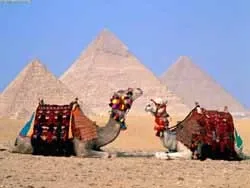
Egypt: The Most Ancient Mysteries
Everyone knows everything about Egypt; it has been studied and thoroughly examined. In the life of a modern person, Egypt occupies a place somewhere between a souvenir shop and visits from aliens. There is even an illusion that we have a good understanding of its ancient culture, that we know the names of kings and gods. Only in the presence of the pyramids do we stop and fall silent, stunned by our own insignificance and the transience of our earthly life.
Today on Earth there are pyramids ranging in height from 9 to 120 m, in length from 30 to 700 m, smooth and stepped, round, square, and elliptical at the base, made of stone and brick, decorated and without any markings, with internal chambers and solid, with small structures on top and without them.
The first pyramids that Europeans encountered were Egyptian. Upon discovering these structures, people immediately began to wonder — how could the peoples of antiquity build such colossi? And why, in fact? Over the past century, many discoveries have been made in Egypt, numerous finds have been unearthed, six famous scholars have paid for their curiosity with their lives, but we have not come an iota closer to unraveling the secrets of the pyramids.
In fact, there is only one mystery: why were the pyramids needed? The simplest explanation is as tombs for pharaohs. But sarcophagi have been found in only four of the ten largest pyramids, and all without lids and without mummies. Only in the pyramid of Mykerinos was a complete set found, but it soon turned out that the lid and mummy had been "planted" there at a later time. Moreover, the great pyramids have ventilation shafts, which the dead hardly need.
The presence of these shafts and internal chambers led Egyptologists to think of an ideal bomb shelter capable of withstanding even a nuclear explosion. However, this hypothesis is not very plausible. Another claim, widespread from Egypt to Peru, is that the pyramids served for meetings between gods and people. And perhaps they still do.
Disillusioned with archaeology, researchers turned to mathematics. Then it became apparent that each pyramid contains the "golden ratio," the "magic square," and the "sacred triangle." The magical numbers three and four symbolized perfection for the Egyptians. Other ancient peoples also loved these numbers. "In those ancient times when the sages created the Book of Changes, they assigned the number three to Heaven and four to Earth, and in accordance with this calculated all other numbers..." — so says the Book of Changes, compiled in China in 1200 BC.
Then it came to astronomy, and it immediately turned out that the pyramid is an encrypted model of the cosmos, because it is built according to cosmic proportions and in most cases oriented by the North Star. The three great pyramids on the Giza plateau and the pyramid complex in Mexico also replicate the position of the stars of Orion's Belt or the arrangement of the planets of the solar system. And the attentive gaze of the Sphinx is directed at the point of sunrise on the day of the vernal equinox.
As for biology, in the pyramids food products do not rot but mummify. Local guides are happy to demonstrate this phenomenon to visiting tourists for a few small coins. And theorists with a mysterious air recall the mysterious deaths of archaeologists and the fact that locals never go into the pyramids. On the other hand, why would they go there?
The oldest pyramid is the Step Pyramid of Pharaoh Djoser at Saqqara, begun in 2640 BC by the vizier-architect Imhotep. His name means "He who comes in peace." Its base is an ordinary mastaba 63 m long. Above the mastaba, a step pyramid 40 m high was built, which was later rebuilt into a six-step pyramid almost 60 m high. The base of the pyramid is 125 by 110 m.
The three pyramids on the Giza plateau near Cairo are called the "great pyramids." They are the pyramids of Cheops, Chephren, and Mykerinos. Archaeologists claim that they were first built as step pyramids and then faced to become smooth. The great pyramids are open to tourists. No more than 300 people can enter each of them per day.
The great pyramids have one secret: the pyramids of Cheops and Chephren appear the same, although objectively Cheops is almost 10 m higher. The whole trick is that Chephren is built on a natural rock outcrop about 9 m high. And the small Mykerinos is not only modest in size but also looms somewhere off to the side.
The New World: Stairways to Heaven
There are many pyramids in South America. They exist in Peru, Mexico, Guatemala, Honduras, El Salvador, Bolivia. All local pyramids are stepped. In fact, there are many more stepped pyramids than smooth ones. They are found on different continents, in different parts of the world, under different names. But the largest and most impressive are the South American ones.
MEXICAN STEPS. Mexican pyramids differ greatly from Egyptian ones. They have staircases, and their shape is irregular: the side faces are steeper than the front and back — the angle of ascent of some reaches 75 degrees. They all seem to have served as pedestals for temples. Every 52 years, a new pyramid was built on top of each one — the Indians believed that at such intervals the end of the world occurs and the world is renewed.
The focus of Mexican mysteries is the dead city of Teotihuacan, built at an unknown time by an unknown people and abandoned for unknown reasons a thousand years ago. Its name translates to 'Place where the gods live'. The Aztecs gave the city this name, appearing in the region 700 years after the inhabitants had left. The Aztecs believed the city was built by giant gods to impart their knowledge to humans. The Toltecs believed that the sun was born here. And modern Mexicans speculate that in ancient Teotihuacan there was a base for alien spacecraft. The arguments are simple and based on architectural features: the city plan mirrors the structure of the solar system, and its main street, straight as an arrow, is oriented strictly north-south. It stretches 2.5 km, is 40 m wide, and leads to the Pyramid of the Moon. The Aztecs called it the Avenue of the Dead. Mexicans believe it could well have been a runway for spaceships on which the city's inhabitants flew straight to the Moon.
The 'Great' pyramids of Teotihuacan – of the Sun, the Moon, and Quetzalcoatl – replicate the positions of stars in the constellation Orion, like the Great Pyramids of Egypt. Local guides claim that the Pyramid of the Sun provides a charge of energy, while the Pyramid of the Moon cleanses sins. Tourists wishing to connect with the divine lie in neat rows on the flat platforms atop the pyramids, recharging.
The largest pyramid of Teotihuacan is dedicated to the Sun. It is a five-tiered structure with a flat top where a temple once stood. The pyramid is made of adobe bricks and faced with dressed stone. Its height is almost 64.5 m, the length of the base sides is about 200 m, and the total volume is 993 thousand cubic meters. It has been calculated that building the pyramid required the labor of at least 20,000 people over 20-30 years. But according to other sources, both pyramids were built over 400 years.
As with the Great Pyramids at Giza, the Pyramid of the Moon is lower than the Pyramid of the Sun (its height is 42 m), but it stands on an elevation, so it appears equally huge. Steep narrow steps lead to the flat top. The staircase is so steep that from above it seems to lead nowhere, into a different silent space from which there is no return.
Another mysterious ancient city is Chichen Itza on the Yucatan Peninsula. It was the former capital of the Maya empire. The most famous pyramid here is called the Castle, over 1500 years old. This 60-meter pyramid is a stone calendar. Its four sides rise in nine terraces, each terrace divided by a staircase, resulting in 18 terraces – the number of months in the Maya calendar. Each of the four staircases has 91 steps, with one additional common step at the top. In total there are 365 steps, like the days in a year. At the top of the pyramid once stood a statue of the jaguar god, where human sacrifices were made.
But the main miracle of the pyramid is not that. The base of one of the pyramid's faces is guarded by a stone Serpent – the feathered god Quetzalcoatl. On the spring equinox and the autumn equinox, precisely at 4 p.m., a sunlit path descends step by step along the pyramid's edge to the Serpent's head, creating the complete illusion of a solar serpent slithering down the pyramid. Thousands of tourists come to the pyramid in spring and autumn for this stunning spectacle.
The last Mexican pyramids were built relatively recently: the Aztecs constructed them in their capital Tenochtitlan, which existed from 1325 to 1550 and later became Mexico City.
PERUVIAN STEPS. Peru is a terribly distant country: about 12,000 km separate our capital from Lima. There you can see not only the cyclopean structures of the ancient Inca country, but also the Incas themselves – in the last 500 years the locals have not changed at all, especially in the Andes. Modern Incas call themselves Quechua Indians – actually, that was always the name of the main people of the empire, while Inca was the title of the leader.
The main deity of the Quechua was Pachacamac, a powerful son of the Sun. The sacred city of the same name, whose ruins can be seen 31 km south of Lima in the Lurin Valley, was also named after him. The earliest pyramid was built here around 200 AD, and the city reached its peak in 800-1470. The main Temple of the Sun stands on top of a rocky promontory. It is a giant four-tiered pyramid with a zigzag entrance, painted red and yellow.
The Chimu Indians worshipped not the Sun but the Moon. Their civilization existed in northern Peru, with the capital city of Chan Chan. To see Chimu monuments, it is best to come to the coastal city of Trujillo, cheerful and colorful. On Huanchaco Beach, where a port once was, there are still reed boats. Nearby lie the ruins of Chan Chan – an amazing city whose main buildings were faced with gold. The gold is long gone, but wonderful colored ornaments remain on the adobe bricks. The city consisted of seven citadels, with the pyramidal temple-fortress Tshudi rising in the center. The Emerald Temple is a two-tiered pyramid decorated with bas-reliefs of marine animals.
The largest complex of Chimu pyramids is on the ocean coast, 33 km north of the city of Chiclayo. This is the famous Valley of the Pyramids of Tucume. Excavations at Tucume were conducted by Thor Heyerdahl, after which he built a raft and sailed to Polynesia. In the valley, 26 pyramids have been preserved, similar to Egyptian step pyramids. Some of them are about 40 m high. The pyramids in Tucume are temple- 'huacas', made of blocks of clay with straw. The earliest date back to 700 AD. Near Mount La Raya is the most impressive structure – Huaca Larga. This is a stepped pyramid with narrow and high faces, 700 m long!
From the same Trujillo you can go to the Moche Valley. The mysterious Moche civilization existed about 1200 years before the Incas. The Moche used an irrigation system and were talented potters. In the middle of the valley rise several pyramids – the Temple of the Sun 'Huaca del Sol', and the Temple of the Moon with remarkable frescoes on which weapons take on human form.
Canary Islands: Pyramids of the Cave Dwellers
Not many European countries can boast of having pyramids. But Spain can! On the Canary Islands, six modest but ancient pyramids have been preserved. Their authorship is attributed to the Guanches, the Canary aborigines.
Pyramids are not found on all the Canary Islands, but only on Tenerife, and only in one place - near Guímar, in the area of La Chacona. It is believed that they were built by the mysterious Canary aborigines - the Guanches. This is quite strange in itself: the Guanches were not the most advanced inhabitants of the planet. Even 500 years ago, they lived in caves, knew no iron, wheel, plow, or potter's wheel.
No one knows where these people came from in the Canaries - archaeologists have found no remains of ancient ships or boats. Moreover, the islands were inhabited by different tribes, even outwardly unlike each other. On Tenerife lived tall people with white skin and blue eyes. One hypothesis is that they were Vikings who forgot seafaring as unnecessary. The Canarians themselves believe that the Canaries are a remnant of Atlantis, and the Guanches were descendants of the Atlanteans, but anthropologists tend to consider them Berbers from North Africa.
The Guanches grew grains, raised sheep, goats, pigs, and huge dogs, from which modern mastiffs descended. The Guanches dressed modestly: some went naked, some in skins. They lived in caves, mummified the bodies of deceased relatives. They embalmed them just as in Ancient Egypt, and buried them in open caves. On Gran Canaria, by the way, people still live in caves - there are entire cave villages in the mountains.
In 1494, the archipelago was conquered by the Spanish. The last to be subdued was Tenerife, where most of the Guanches died: the survivors leaped into a chasm to avoid capture. The language of the Guanches was lost, rock inscriptions have never been deciphered. For a long time, it was believed that no structures remained from the indigenous inhabitants. Then pyramids were discovered. The pyramids in Guímar are built of lava, rectangular and modest in size - their length does not exceed 50 m. Therefore, locals paid no attention to them. It was thought that these "piles of stones" were stacked by the first Spanish settlers, clearing fields on the mountain slopes.
One of the first researchers of these mysterious structures was Thor Heyerdahl. He was so fascinated by this discovery that he bought a plot on the mountain slope, brought his beloved "Ra" there, and built himself a house. After excavating several pyramids, Heyerdahl set up a museum. Its territory contains a whole complex with six pyramids, squares, roads, and ruins of buildings. The Guanches' pyramids are stepped, like ziggurats; some have internal passages. The purpose of these structures is unknown. However, Heyerdahl noticed that they lie on the same latitude as the pyramids of Egypt, Mexico, ancient Mesopotamia, and China. He created an entire theory that pyramids are something like landmarks for aliens. It also turned out that the pyramids are oriented by the stars; three main ones replicate the arrangement of Orion's stars, and the upper platforms are positioned so that the ray of the setting sun on the summer solstice visually connects them in one line, continued by a staircase, and points to something that no one has yet dug up to.
The Guanches' pyramids have had a very positive impact on the life of Guímar: since Heyerdahl got them declared a national park and opened a museum there, all bars and restaurants in the town began to be called "Pyramid", and the business of local taxi drivers and restaurateurs has taken off.
Polynesia: Marae of the Maori
Perhaps the most unexpected structure on the paradise islands of Polynesia is pyramids. Nevertheless, they are there: stepped, like the Peruvian ones. They stand on the islands of Tahiti, Samoa, and Tonga. It is difficult to say who and when settled the Polynesian islands. Scientists suggest that this occurred between the 10th and 5th centuries BC. Some navigators from Asia and South America reached the Marquesas Islands, and then developed nearby archipelagos. Thus arose the state of the Maori. The Maori had a fairly high culture, and ancient traces of it have been preserved on the islands - carved stone "tiki" and sanctuaries "marae". These marae are fairly large stones, either standing vertically in a line or stacked into pyramids. The most notable structures are the temple pyramid on Tahiti and the stepped one in Tauhalá.
It seems that before the Maori, Polynesia was inhabited by the Lapita people - navigators and empire builders. They traveled between the islands of modern Samoa, Fiji, and New Caledonia. The capital was the city of Mu'a on the island of Tongatapu in the Tonga archipelago. In these places, modest stepped pyramids remain.
Japan: Underwater World
Japan also has pyramids. True, they are hard to see - they rest on the sea floor. In the mid-90s, off the coast of Okinawa Island, divers discovered at a depth of 12 m a structure reminiscent of the pyramids of South America. Immediately in the vicinity of Okinawa, other stone buildings were found. And three hundred miles away, near the small island of Yonaguni, at a depth of 24 m, a real pyramid was found, rising 18 m above the bottom. Soon divers counted seven pyramids near the island. After that, scientists recalled ancient Japanese legends that spoke of a large island from which gods came to Okinawa. The pyramid near Yonaguni is strikingly reminiscent of the structures of Peruvian Pachacamac. On this basis, pyramidologists conclude that there existed a certain intermediate cultural center in the region of Japan that determined the development of civilization on the shores of the Pacific Ocean. This, of course, refers to the legendary sunken continent of Lemuria.
A couple of years later, near the small islet of Okinoshima in the Korea Strait, separating Japan from South Korea, divers spotted at a depth of 30 m four round stone towers rising 27 m above the bottom. One of the towers was wrapped with a spiral staircase. And this already resembles nuraghes - mysterious structures of an unknown civilization on the island of Sardinia in the Mediterranean Sea.
Bermuda: The Lost Atlantis
A few years ago, American oceanographers explored the depths of the Atlantic in the area of the infamous Bermuda Triangle. Right in the center of this anomalous zone, between Puerto Rico, Florida, and the Bermuda Islands, they quite unexpectedly discovered a pyramid. After processing the data, scientists suggested that the surface of the underwater structure is very smooth, possibly glass. This sensation was announced in Florida at a press conference, and research materials were shown to journalists. After that, the discovery was immediately silenced. However, seekers of Atlantis did not forget about it. They concluded that it was here that the great civilization of the Atlanteans was buried underwater.
Researchers claim that pyramids affect all people. Some pyramids kill, some grant health and longevity. In Mexico, there is the Pyramid of the Count, where a French Count Voldeck, known for his extravagant actions, once settled and lived for two years. During his life on the pyramid, the count had a passionate romance with an Indian woman, and then returned to his homeland. It is said that after his return, Voldeck enjoyed excellent health. He died at the age of 109: he was run over by a carriage on the Champs-Élysées while trying to catch up with a pretty lady.
England: for soul and body
In England, there is a place called Peña de Bernal. The mountain there resembles a pyramid in its outlines. Next to it is a village where people live to be a hundred or more years old, never get sick, and are amazingly resilient. In the neighboring village, however, there are no long-livers. Dowsing specialists have determined that the mountain emits beneficial energy, but inside it there is an unfavorable energy vortex. There used to be mines there, but people noticed that miners who went inside the mountain died within a year.
Another English pyramid is considered to be Glastonbury Tor. At its top, at the intersection of ley lines, stands an ancient tower, exposed to all winds, where members of some sect occasionally gather. Judging by their behavior, the Glastonbury pyramid has a negative effect on the human psyche. But the earthen pyramid Silbury Hill, which is forbidden to climb, seems to awaken all the best qualities in people. When a multinational group of scientists climbed it, a strange metamorphosis occurred. As soon as they reached the top, obeying an impulse that seized everyone, they sat in a circle, embraced, and began to say nice things to each other.
China: legacy of aliens
At the very beginning of the 20th century, two Australian traders found themselves on a large plain in Sichuan, in central China. There they discovered over a hundred pyramids! The Australians turned to the abbot of a local monastery, and he told them that these pyramids are very old - records of them were made more than 5,000 years ago, so the age of the pyramids themselves can only be guessed at. The abbot said that ancient Chinese emperors claimed to be descendants of "sons of heaven who descended to Earth on iron dragons with a roar." The aliens from space were supposedly the builders of the pyramids.
In 1994, Austrian Hartwig Hausdorf made a trip to the same areas, now closed to foreigners. During this trip, he discovered six legendary pyramids and filmed them on video. At home, he examined the footage with magnification and saw many more pyramids in the background. Some of these pyramids are now in a sorry state, as they were built from clay and soil, which peasants have carried away. The height of the pyramids on the plains of Sichuan ranges from 25 to 100 m. The only exception is one located north of the others, in the valley of the Jialing River. This is the so-called Great White Pyramid. Witnesses claim that the height of this structure is about 300 m! However, it is difficult to verify: the Chinese government has declared the area adjacent to the Great White Pyramid a restricted zone because a spaceport has been built there.