
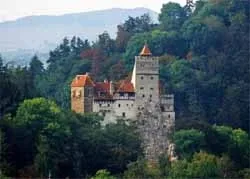
It took the Romanians four years to finally lose hope of making millions of dollars by speculating on the memory of the gruesome hero of countless films and books – the ubiquitous Count Dracula. Prime Minister Călin Popescu-Tăriceanu recently put an end to the long-standing dispute between churchmen and the local tourism ministry by announcing the termination of the contract with "Dracula Incorporated" – a company that was going to build the sinister Dracula Land covering 460 hectares in the town of Snagov, near Bucharest. True, the reason for abandoning the tourist project turned out to be not at all supernatural. There is no devilry or fear of dark forces in the government decree. The document simply states that technical violations were found in the amusement park project that were not corrected on time.
The idea of building an entertainment vampire park was first voiced by Romania's tourism minister Matei Dan. In January 2002, he announced that he had found investors, certain magnates of the beer and tourism business from Austria, ready to invest €7-8 million in the reconstruction of an ancient fortress overlooking the medieval Transylvanian town of Sighișoara. Here in 1431 was born the real historical figure – Prince Vlad Țepeș, later nicknamed Dracula for his cruelty. And here, according to the English writer Bram Stoker, was the "nest of vampires". It was planned that on an area of 130 hectares there would be sports facilities, hotels, restaurants, attractions, arts and crafts, and other facilities for a full-fledged holiday. According to promises in the Romanian media, visitors would be able to experience all the key attributes of the dark Middle Ages: see witches, ghosts, sinister executioners, get into torture chambers, get lost in underground labyrinths – in short, have a pleasant time.
According to Minister Dan's calculations, the successful operation of the tourist attraction would bring $20 million annually to the state treasury, not counting income from souvenir sales. It was expected that the first part of the park, called "Vampire's Cave", would welcome visitors as early as 2002, and the entire complex was planned to be put into operation in 2004.
However, the tempting project had several influential opponents. The Romanian Orthodox Church categorically opposed the construction of the vampire park. According to the clergy, the unhealthy hype around the topic of vampirism would lead to an interest in Satanism among young people. But the opposition of environmentalists and art historians was more significant. The former spoke about the damage that could be done to the environment, while the latter felt sorry for the historical landmark – the ancient castle, which would have to be substantially remodeled and renovated, thereby violating its museum integrity. Under pressure from the international public, which even included British Prince Charles, the Romanian authorities decided to abandon the construction of Dracula Land in the historical area, for which they received official gratitude from UNESCO.
Under the new plans, it was decided to place Dracula Land near Bucharest. And it was this new project that was withdrawn a couple of years later by the Romanian Prime Minister. The Romanian Orthodox Church believes that "God saved us". "It would be wrong for us to evaluate economic arguments," the official representative of the Romanian Church, Constantin Stoica, told journalists the other day. "But from many points of view this project was a mistake. The myth of Dracula has nothing to do with Romanian history, and many historians share this view."