
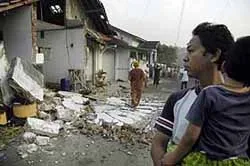
The authorities of the Indonesian island of Java have released data on those killed as a result of the earthquake that occurred on the island on the night of Saturday, May 27. The epicenter of the earthquake struck the ancient capital of Indonesia, Yogyakarta, the second most populous city in the country. As reported by Gazeta.Ru, by Monday morning the official list of victims already contained more than 5,100 names. And this list is far from complete – the earthquake destroyed to the ground approximately 35,000 residential houses and administrative buildings in Yogyakarta and the surrounding areas. Rescuers have almost no hope that live people still remain under the rubble. A large number of those rescued are dying in overcrowded hospitals without ever receiving medical care.
It is even more difficult to count the number of wounded. According to official data, more than 2,150 people received various injuries and wounds during the earthquake, while the UN Children's Fund (UNICEF) counted more than 20,000 victims and more than 100,000 island residents left without a roof over their heads. Tens of thousands of people, including the wounded, spent the first two nights in the courtyards of hospitals and mosques or in shelters hastily erected from what were formerly buildings. Temporary first-aid stations have been set up directly in the squares of Yogyakarta, and the field of the city stadium has also been converted into an infirmary, even though the stadium building itself also collapsed. In addition, on Sunday it rained in Yogyakarta almost without stopping. Medics do not rule out that in the near future the number of requests for medical assistance will increase – now with complaints of colds and exacerbation of chronic diseases.
The Indonesian government has introduced a state of emergency on the island of Java. It will last for three months. The authorities have already calculated that at least $107 million will be needed to help the victims and restore the island's infrastructure. They intend to complete the "restoration and rehabilitation" of Yogyakarta and its suburbs by the end of the year. Indonesia's Vice President Jusuf Kalla stated after a cabinet meeting that the three-month state of emergency would make it possible to provide food, medical care, and housing for people left homeless by the earthquake.
Condolences to the president of the republic and the Indonesian people were expressed by UN Secretary-General Kofi Annan, Pope Benedict XVI, Patriarch of All Russia Alexy II, and the presidents of the world's major powers, in particular Russia and the United States. UN Secretary-General Kofi Annan said the organization is ready to send humanitarian aid and international rescue units to Java, while the UN Children's Fund called for focusing efforts on caring for the wounded. The leaders of Russia, the United States, Britain, France, Italy, and Spain also confirmed their countries' readiness to assist in eliminating the consequences of the earthquake.
The United States allocated $500,000 to Indonesia, and Britain - 3 million pounds sterling. The affected republic will also receive 3 million euros from the European Union. Asian neighbors did not stand aside either - China provided $2 million, Japan and Malaysia sent their doctors, rescuers, and humanitarian cargo. In addition, Kuala Lumpur provided $3.8 million to help the families of the victims.
Saturday's earthquake has been called one of the worst in the history of modern Indonesia. According to seismologists, the first underground tremor of more than six on the Richter scale was followed by about 450 more tremors of up to 5.2. Their epicenter was in the sea about 50 km south of Yogyakarta. True, recently local residents seem to have begun to get used to the fact that all possible misfortunes are befalling them. As Associated Press notes, over the past 17 months, the current earthquake has been the fourth with such serious consequences for the residents of Indonesia. The earthquake in December 2004 and the ensuing tsunami claimed the lives of approximately 170,000 people.
Volcanologists also warn that the earthquake increased the activity of Mount Merapi, which is located 30 km north of Yogyakarta. The volcano, even without that, had been periodically erupting red-hot lava and poisonous gases over the past few weeks; now more significant action can be expected from it.
The world's largest island nation, Indonesia is located in the so-called Pacific Ring of Fire - a chain of seismically active zones and volcanoes, including underwater ones, stretching from the coast of Mexico south to the islands of New Zealand. Therefore, earthquakes are not a curiosity for these places - they occur on average five to six times a day.
According to the Russian Embassy in Indonesia, writes Gzt.ru, there are no Russians among the victims. The Ukrainian Foreign Ministry also does not confirm the presence of Ukrainians among the victims. Although theoretically tourists could have been in Yogyakarta - a visit to the ancient capital is often included in the program for travelers visiting the island of Bali. True, the tourist season on the islands of the Indonesian archipelago, according to the head of the Russian diplomatic mission, falls in the winter months.