
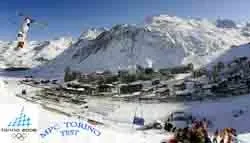
Last week in Sestriere, in the building of the local television center, from which Olympic broadcasts are to be made, part of the floor collapsed. Fortunately, no one was injured in the incident. However, the press center, which houses 80 television studios, was closed for repairs. According to representatives of the organizing committee, the building was supported by metal structures, part of which collapsed. It is worth noting that earlier in Turin itself there was another similar incident. Right in the city center, under the weight of snow, a tent folded up, in which security service employees were to be located. There were also no casualties. At the same time, repairs and construction, according to eyewitnesses, are going on everywhere in the Olympic capital. Rush.
On the eve of the Olympics, the organizing committee of the Games is experiencing other problems, in particular financial ones. A number of large Italian companies, for various reasons (both political and economic), refused to become sponsors of the Olympic tournament. According to some data, the budget deficit of the Games threatens to reach a critical level of 20 million dollars, which could affect Turin's readiness to host the sports festival. In Italy itself, for example, there are serious concerns that during the Olympics, employees of the Alitalia airline could organize a mass strike to attract the attention of the whole world to their problems. Such actions, as a kind of rehearsal, were already carried out in January in Turin. However, on January 31, the "Protocol on Social Peace" came into force in the country. According to this document, trade union organizations pledge, from January 31 to March 23, 2006, to refrain from any strikes in transport, the service sector, fire, rescue, and medical services. That is, not to interfere with the normal conduct of the Olympics, which will be attended by 2,500 athletes from 88 countries, 10,000 journalists, and 1.5 million spectators.
Another problem faced by the organizing committee is doping control. It is still unclear which agency will be responsible for carrying out this procedure – the Ministry of Health or the Ministry of... Culture, which formally oversees sports. Some argue that doping control should be carried out in accordance with Italian laws, while others – according to Olympic rules. If supporters of the first option win, then athletes caught using banned substances will face not only disqualification, but also a real prison term. Such is the law of Italy.
Television viewers may also be left out. The fact is that in the selection of Olympic TV broadcasts, for some reason, the tastes of the American public will be taken into account first. In other words, those sports in which Americans can win medals will probably be a priority.
And finally, not everyone in Italy itself is interested in the Games being successful and at a high organizational level. The problem is that the right is still in power in the country, while in the Piedmont region, whose capital is Turin, the left is in power. New parliamentary elections will be held as early as April 9. And the ruling party really doesn't want competitors to gain an advantage by playing the Olympic card.
In general, there is a risk that the Olympics could turn from a world festival into a way for Italians to solve their local problems. Someone will demand a salary increase, and someone will fight for their political rating.