
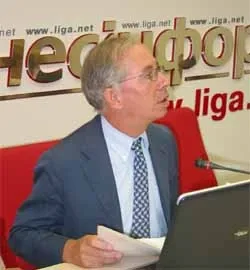
Photo from the archive of "Zagranitsy"
According to him, the countries have a lot in common, which is why there is a strong interconnection between them. "Our relations have a long, centuries-old history, because back in the 17th century, residents of two Swiss settlements moved to Ukraine and founded the village of Zolotoye Pole in Crimea. In addition, a group of Swiss settled in a village in the Odesa region," the ambassador emphasized, adding that the Swiss are beginning "to gradually discover Ukraine," just as Ukrainians "do not forget about Switzerland."
He also noted that the Swiss embassy in Ukraine is making every effort to facilitate obtaining a visa to Switzerland and this procedure takes only one or two days. Last year, the embassy issued 16,000 visas. "We have a visa-free regime for representatives of certain professions. We aim to eventually have free visas for journalists, schoolchildren, and students. We also strive to ensure that Ukrainian businessmen who frequently visit Switzerland receive long-term visas rather than single-entry ones," he emphasized.
Christian Fessler also reported that the embassy is considering options to solve the problem of queues. In particular, the possibility of making appointments via the Internet or phone. "But in that case, the visa procedure could drag on for several weeks," the ambassador noted.
Touching on the issue of education in Switzerland, Christian Fessler noted that, unfortunately, there are not many government-level educational programs in the country. "We offer Ukrainians a certain number of scholarships, but these scholarships are for those who already have a higher education. Usually, there is not much interest from the Ukrainian side in such scholarships," the ambassador emphasized, adding that there is also a student exchange between the countries.
According to him, one must remember the existence of private educational institutions in Switzerland. "There are many private schools that provide a good education and are very serious," said Christian Fessler, noting that studying at such schools "is quite expensive," and this means that only wealthy people can afford such an education.
In turn, the executive director of the educational agency "DEC" Alexander Tarchenko noted that studying at private educational institutions in Switzerland will cost approximately €30 thousand or more per year including accommodation. The cost of studying at a higher education institution in a bachelor's program will be about €10 thousand per year, and studying in a master's program at universities will cost from €12.5 to €26 thousand.
Based on materials from LIGABusinessInform.