
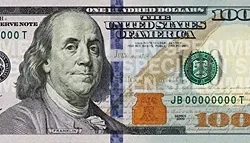
Fragment of the new $100 bill
The new design of the $100 bill was unveiled to the public on April 21 on the American website Newmoney.gov. However, U.S. authorities began promoting the site with the new design in advance – back in March.
It must be said that the American government approached the information campaign about the new bill on a grand scale. On the site, you can not only watch a video dedicated to the innovations in the design and security of the 'hundred' but also 'turn it over' in your hands and even take part in a quiz and educational games to test your knowledge of American currency. Supporting materials on the new design are available in 25 languages.
There are two main security features on the new $100 bill. One is a blue stripe next to Franklin's portrait. When looking at the stripe from different angles, images of bells and the number 100 appear. The stripe, as reported on the site, is not printed on the banknote but is rather 'woven' into the bill itself.
The second security feature is an image of the Liberty Bell in an inkwell near the lower right corner of the 'hundred'. When moving the bill, the bell changes color from copper to green, sometimes completely 'dissolving' into the inkwell.
When the bill is issued, additional security features will also be used. For example, to the right on the bill will be a portrait of Franklin as a watermark. To the left of the image of the Founding Father will be a security stripe that glows pink under ultraviolet light. On the back of the banknote, the number 100 will be written in large gold, which will help people with low vision distinguish the denomination. The number 100 in the lower right corner of the front of the bill will change color from copper to green.
In addition, the right shoulder of Benjamin Franklin will feel rough due to a special printing technology. The banknote will also feature inscriptions in miniature letters – for example, 'The United States of America' on Franklin's collar, 'One hundred USA' on the tip of the pen, and 'USA 100' around the watermark. Designers also updated the vignette on the reverse side of the banknote with an image of Independence Hall, depicting not the main facade but the rear facade of the building.
As stated by the head of the macroeconomic department of the U.S. Embassy in Russia, John Stepanchuk, the bell, inkwell, and pen depicted on the $100 bill are 'symbols of American freedom.' The pen and inkwell were used in signing the U.S. Declaration of Independence. The Liberty Bell was the main symbol of the U.S. struggle for independence from Great Britain.
The new bill will start being issued on February 10, 2011. According to Fed Chairman Ben Bernanke, the introduction of the updated hundred will be gradual. Americans will still be able to use banknotes of the old design, of which a total of 6.5 billion were issued.
Over the past seven years, banknotes of other denominations have also been updated in the United States. In 2003, a modified $20 bill was issued; in 2004, a $50 bill; in 2006, a $10 bill; and in March 2008, an updated $5 bill entered circulation.
The $100 bill was first issued by the U.S. government in 1862. During its existence, its design has changed more than ten times, the last time in 1996. It was expected that the next update would occur at the end of 2008, but that did not happen: the crisis intervened. According to Stepanchuk, production of the old hundred cost 11 cents, and issuing each new banknote will cost 14 cents.
The $100 bill is the largest denomination in free circulation. About two-thirds of all such bills circulate outside the United States. While in the United States itself, counterfeiters prefer to forge $20 bills, abroad the 'hundred' enjoys the greatest 'popularity.' However, currently, according to U.S. authorities, counterfeits account for less than 0.01 percent of the total volume of dollars in free circulation.
Russia, by the way, is the largest holder of cash dollars outside the United States. Deputy Head of Mission of the U.S. Embassy Eric Rubin noted that dollars have 'been used in Russia for many years as a savings instrument' and are also very popular among Russian tourists. So our citizens definitely should familiarize themselves with the new design of the 'hundreds'.
Irina RYABOVA.
Lenta.ru