
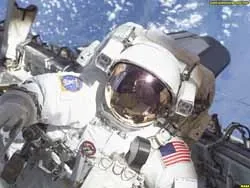
However, as with the first five openly commercial passengers of the Soyuz spacecraft, such a whim will require not only a solid bank account and good health, but also a willingness to undergo serious training at the Cosmonaut Training Center. Even a simple flight required certain technical knowledge and skills from applicants. Those wishing to experience weightlessness in its 'pure form,' that is, to go outside the ISS, will, according to Space Adventures, have to 'undergo a special training course in the hydrolaboratory of Star City.'
Despite the fact that due to the tight schedule of launches to the ISS, no tourist flights are planned in the near future, and among all potential candidates, only Japanese Daisuke Enomoto has even hinted at a spacewalk, space marketers have already drawn up a price list for this additional service. According to Space Adventures President Eric Anderson, a spacewalk will cost $15 million, which is only a quarter less than what orbital tourism pioneer Dennis Tito paid. Apparently, this amount includes the cost of additional training, the production of a special spacesuit that is necessarily tailored to the specific user, and the payment for a mentor. Naturally, no one will send a non-professional outside the ISS alone; a station crew member will have to accompany the tourist. However, they will be able to take photos of the guest in such exotic conditions.
It is noteworthy that the marketing strategy of Space Adventures, which was the first to ensure a tourist's flight into space, is fundamentally different from the plans of companies that have to play catch-up. While the latter, including Virgin Galactic owned by British billionaire Richard Branson, are striving to reduce the cost of space tourism to make it more accessible and, consequently, a mass entertainment for wealthy Earthlings, Anderson, on the contrary, is not shy about raising prices for his services. Even the prices for a 'simple' orbital tour are now incomparably higher. Recently, the company announced that in 2009, when 'free' seats for tourists may appear on Russian spacecraft, pre-flight training and a week-long stay in orbit will cost $30-40 million. The financial details of the first contracts were not disclosed in detail, but neither Russian specialists nor the tourists themselves refuted the established opinion that a space flight costs about $20 million. Eric Anderson explains the price increase both by the change in the ruble-to-dollar exchange rate and by the desire to conclude a 'futures' contract with Roscosmos, buying up seats for tourists in advance for 2009-2010. According to him, the corresponding proposal has already been communicated to the Russian side.