
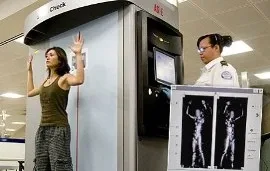
Testing of full-body scanners begins at German airports
Objections from opponents of full-body scanners were circumvented through new technologies that depict the body only schematically. However, an unexpected complication arose: it turned out that the scanners were purchased from an American company that is part of a conglomerate producing banned cluster bombs.
The debate over the legality of using full-body scanners is not new; it has been disputed in the EU for several years. As often happens, security considerations clashed with notions of human rights. As early as autumn 2008, the European Commission proposed installing body scanners at all EU airports to prevent terrorist attacks, but this initiative was rejected by the European Parliament.
German authorities also spoke out against it: politicians, church representatives, and trade unions declared such a violation of human dignity and intrusion into privacy unacceptable, since scanners allow not only the body to be seen but also all physical flaws, including prostheses hidden under clothing, stomas, and so on. "I can tell you quite frankly that we do not intend to take part in this outrage," said the spokesman for Interior Minister Wolfgang Schäuble at the time.
However, Schäuble himself nevertheless agreed in principle with the need to use such devices, which, in his words, needed to be improved and refined. And as early as December 2008, work began in the scientific laboratories of the federal police in this direction.
The dispute over the necessity of scanners flared up again at the end of 2009, after the al-Qaeda-linked Nigerian terrorist Umar Farouk Abdulmutallab attempted to blow up a Northwest Airlines plane flying from Amsterdam to Detroit. He smuggled the explosive - pentaerythritol tetranitrate (PETN) - onto the plane in his underwear, but was unable to detonate it and only suffered burns. It later turned out that if the terrorist had gone through a special scanner, the explosive would have been detected.
Germany's new interior minister, Thomas de Maizière, after this incident openly spoke in favor of introducing full-body scanners, stipulating, however, that this would not happen until all doubts about the health safety of these devices were eliminated and citizens' rights guaranteed. De Maizière specified that this would be done no later than 2010.
Society's reaction was quite nervous. For example, members of the recently formed Pirate Party of Germany, who advocate for the protection of personal data on the internet and for limiting the state's attempts to intrude into citizens' private sphere in one way or another, held protest actions at the airports of Berlin, Frankfurt, and Düsseldorf, stripping down to their underwear and displaying placards reading "You don't need to scan us—we're already naked."
Nevertheless, de Maizière kept his promise: as of the end of September 2010, two full-body scanners will appear at Hamburg Airport. The choice of Hamburg airport is simple: it is located closest to the laboratory of the Police Academy in Lübeck, where development work on the use of scanners was carried out.
As Tagesschau notes, full-body scanners come in two types: those using X-ray and terahertz radiation (so-called millimeter waves, the frequency spectrum of which lies between infrared and ultra-high frequency ranges). Terahertz scanners are divided into those using passive and active radiation. Active is preferable because it gives a more detailed picture. German authorities lean toward the latter option. The scanners currently installed at German airports only react to metal objects, while millimeter waves can detect non-metallic weapons, including ceramic knives and explosives.
Of course, both X-ray and terahertz scanners make it possible to see flaws in the human body, prostheses, urine bags, catheters, and so on. This is essentially the main thing opponents of intrusion into personal privacy object to. However, this difficulty has been partially circumvented.
The scanners to be installed in Hamburg are configured so that if nothing suspicious is found on a passenger's body, no image will be displayed on the screen at all. Instead, the word "OK" will appear. If the scanner detects suspicious objects, only a schematic depiction of the body will be displayed—"drawn little people," according to de Maizière—and the location of the suspicious objects will be marked with colored dots. After that, the passenger will be sent for a personal search carried out by airport security personnel.
True, it is not clear how, with such a schematic image, airport staff will distinguish a catheter from a knife, but on the other hand, no one will be staring specifically at your buttocks, so this option can be considered a compromise. The German Interior Ministry also notes that using millimeter waves for scanning poses no threat to health.
It would seem that the discussion around body scanners is over, but unexpectedly a new complication has arisen, this time of a political nature. As journalists from the Frankfurter Rundschau have established, the very two scanners that will be installed at Hamburg airport at the end of September were purchased by Germany from the American company L3 Communications Security and Detection Systems. And this company is a subsidiary of the American defense concern L3 - one of the seven manufacturers of cluster bombs, which, we recall, are banned from use under the UN convention that entered into force on August 1, 2010. Germany, unlike the US, Russia and China, ratified this convention back in 2009, which gave human rights and pacifist organizations reason to accuse Angela Merkel's government of hypocrisy.
Representatives of the German branch of Handicap International (an international humanitarian organization engaged in helping disabled people injured by munitions and fighting against the use of mines and cluster bombs) noted that even if such a deal is legally above board, from a political and moral standpoint it is unacceptable, because thereby the German state provides indirect support to a manufacturer of cluster munitions.
The German Federal Ministry of the Interior responded that the scanners were not purchased from L3, but from an Austrian company, which in turn - and the Ministry admitted this - buys scanners from L3. The German authorities explained their choice by saying that scanners from other manufacturers are not suitable for use in the pilot project. 'At the moment, there is no other scanner manufacturer whose products could compare in technical characteristics with those of L3 Communications Security and Detection Systems,' said ministry spokesperson Philipp Spauschus.
However, the ministry noted that the final supplier has not yet been determined. If the testing of body scanners at Hamburg airport is successful, over time body scanners will appear at other German airports. In the EU, according to Spiegel, terahertz scanners are already in use in Amsterdam, London and Zurich. In Russia, Moscow airports are equipped with them.
Alexei DEMYANOV.
Lenta.ru