
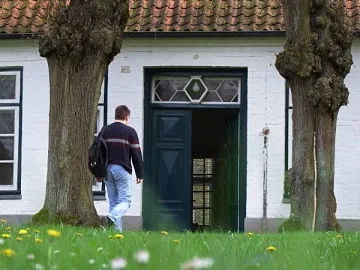
Ancient monasteries invite you to live in Germany, learn German, and take a break from work.
Religious communities in the country are actively involved in organizing programs such as the Voluntary Social Year (Freiwilliges soziales Jahr) and the Voluntary Ecological Year (Freiwilliges Okologisches Jahr). They also offer the opportunity to complete shorter internships (from a week to several months). According to Deutsche Welle, anyone interested, including from abroad, can live within the walls of ancient monasteries while providing力所能及的 help to monks and those in need.
Monasteries invite
Such experience can be useful not only for prospective students. Sometimes a career choice turns out to be unsuccessful, work is not satisfying, and one wants something different. In a monastery, there is time for reflection and searching for new ideas. One can stay from a few days (as a guest for a moderate fee, or as a helper for free) up to a year. And, if necessary, stay longer.
"Mitleben im Kloster" (temporary residence in a monastery) or "Kloster auf Zeit" (monastery for a time) – this is what this form of laypeople's stay in a Christian monastery is called. Those who agree to help the monks with daily chores and duties receive room and board for free. "In return, we give time, the opportunity to talk about what is troubling you, gain new experience, learn to perceive the world differently," explains Brother Benedict, a Benedictine monk from Kloster Nütschau, located near Hamburg.
In the monastery, prospective students and students can do career orientation internships (minimum one week), for example, working in the household, kitchen, garden, or participating in the preparation of church mass and other events. Those who decide to spend several months or a year in the monastery (as part of one of the volunteer programs) take part in educational activities, organizing projects for children and teenagers, and get acquainted with office work, lists Brother Benedict.
In some monasteries, the focus is on working with teenagers and families (e.g., in Nütschau), in others, on helping the disabled and infirm, as in Kloster Ebernach in western Germany. Monasteries have libraries, museums, workshops, manufactories, their own shops and cafes serving homemade pastries – the list is endless. All need the help of volunteers, emphasizes Father Felix Rehbock, a priest of the Oblate order at Nikolauskloster near Düsseldorf.
Who can intern
For an internship in a monastery, knowledge of German at least at a basic level is mandatory. However, there is no doubt about further development of language skills during the stay in Germany, assures the monk from Kloster Nütschau. Foreign interns live together with other volunteers in a dormitory, several people per room, explains Brother Benedict.
"In our monastery, interns usually work daily from 8 a.m. to 2 p.m., but an individual schedule can also be arranged," he says. Anyone of any denomination, as well as those with no religious affiliation, can become an intern. The main thing, according to the Catholic monk, is to share Christian views. Very important qualities that future interns should possess are conscientiousness and reliability. "The purpose of the internship is to prove yourself, to be convinced of the necessity and usefulness of what you are creating," believes Brother Benedict.
Depending on the monastic order, sometimes only representatives of one gender are invited for internships. However, in most monasteries in Germany, everyone is welcome.
Diploma thesis in a monastery
Students can go to Kloster Volkenroda in Thuringia not only for self-discovery and getting to know a new world – they can write their diploma thesis within the walls of the holy monastery. In that case, there is no need for help with housework, but a modest fee for staying in the monastery must be paid. However, financial support can be sought from one of Germany's charitable foundations.
Moreover, Felix Rehbock hopes that the time spent in the monastery can help the intern become involved in the work of a clergyman. At Nikolauskloster, there is also the opportunity to obtain the appropriate (possibly missing) education necessary for ordination, he explains. And during preparation, future priests are guided by mentors who provide practical support to their charges.