
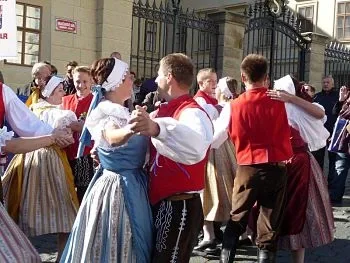
Volyn Czechs were only allowed to the festival
The fact is that as part of the program for the resettlement of compatriots to the historical homeland of their ancestors, launched at the beginning of this year, some Volyn Czechs hoped to start a new life in the Czech Republic, but a number of them were denied relocation. According to Radio Prague, those who were refused wrote another letter to the President of the Czech Republic, Miloš Zeman, which they intend to hand over to him in the coming days.
One of the festival organizers, the chairwoman of the movement Sedm paprsků ('Seven Rays'), which maintains ties with Czech compatriots abroad, Věra Doušová, back in September 2014 handed over to the presidential office a long list of ethnic Czechs from Ukraine who had already repeatedly appealed to the head of state for assistance in relocation. The government eventually decided to implement the compatriot resettlement program at the end of last year. Starting from March 2015, under a simplified administrative procedure, about a hundred Ukrainian Czechs received permanent residence permits in the Czech Republic. The residents of Zhytomyr, however, were left 'on the sidelines'.
'I don't quite understand this,' says Věra Doušová. 'The government made a decision last autumn, on the basis of which the Ministry of the Interior and the Ministry of Foreign Affairs were to facilitate the relocation of compatriots from Ukraine to the Czech Republic. As a result, so far two groups from Odesa and Melitopol have arrived, while the initiators of the request for relocation to the Czech Republic from Zhytomyr and villages such as Malynivka, who were asked at the Czech consulate to fill out the relevant forms and were offered the possibility of departure, are disappointed by the unexpected refusal. I think that if we knew that we were not going to accept these ethnic Czechs, we should not have given them unfulfillable promises, hope for relocation. All these people believed that resettlement awaited them. They quit their jobs, informed schools that their children would no longer attend, started selling their homes, and those who were engaged in farming did not sow their fields. And about a week ago, they all received the same letter. It said that they were not classified as persons who would be resettled in the Czech Republic.'
Despite this circumstance, the Volyn Czechs still decided to come to the compatriot festival – in the hope that the situation might be changed for the better.
'The current Compatriot Folklore Festival is much more modest compared to previous ones. The reason is that we are preparing a more extensive program for the next, anniversary year, when the festival will celebrate its 10th anniversary,' says Věra Doušová. 'This year, compatriots came to us only from European countries. Traditionally, most participants are from Ukraine – representatives of six compatriot societies arrived. Among the guests are also compatriots from Bosnia and Herzegovina, Slovakia, and Hungary. Almost every year, compatriots come from North and South America, Australia, and other countries, and I hope that the anniversary festival will involve Czech societies from all over the world. They will have many cultural and social events, meetings, and conferences.'
The arrival of compatriots is organized by the civil society Sedm paprsků in cooperation with the Czech Ministry of Foreign Affairs and the Permanent Commission of the Senate of the Czech Republic.