
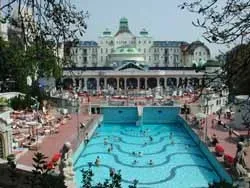
Tokaj wine, hot paprika, thermal waters and fiery csárdás are now firmly associated with Hungary. If long garlands of red pepper pods adorn almost every retail outlet in Hungary, and Tokaj is invariably present on the wine list of any Hungarian restaurant, then thermal waters give Hungary a special appeal, and Budapest the status of a spa city (the only capital in the world). The Romans were the first to discover the healing properties of thermal springs on the territory of modern Hungary. This is evidenced by the remains of ancient baths, images on frescoes and mosaics. Today, more than 1,200 thermal springs have been discovered in the country. The small country is literally "stuffed" with them: thermal waters fill swimming pools, flow into lakes, and fill niches in caves.
Hungary's thermal waters are effective in treating diseases of the musculoskeletal system, skin and gynecological diseases. Good results are achieved in treating kidney diseases, gastrointestinal tract disorders and metabolic imbalances (course of drinking water therapy). Observing the residents of Budapest, one can notice that thermal springs have become a very pleasant part of the daily life of Hungarians. The city has 130 sources of mineral or medicinal water and 12 therapeutic baths. The Gellért, Széchenyi, Lukács, Rudas, Rác and Király baths are world-famous landmarks of the city, along with Buda Castle, the Royal Palace, the Parliament building on the Danube embankment and the Pál-völgyi stalactite cave.
In the baths, which outwardly resemble palaces, citizens relax, play chess, and exchange news. Each has its own features and specifics. The architectural solutions are unique (the Rudas bath has a dome with a diameter of 10 meters and an octagonal pool), the organization of work is specific (the Gellért bath has a children's pool, while the Rudas bath is only accessible to men), as is its place in the city's cultural and historical space (the Gellért bath is located at the foot of Gellért Hill near the Citadel and a chapel carved into the rock; the Lukács bath, on the site where the Knights of the Order of St. John treated the sick in the 12th century, is located near the Royal Palace and Margaret Island).
After visiting a bath, one becomes especially grateful to the builders. The pools in many of them are equipped with jets for underwater back massage, devices that create waves and currents, and there are saunas and rooms for physiotherapy procedures. Each Budapest bath has a specific specialization: in Gellért they treat respiratory diseases; in Széchenyi, gynecological diseases; Lukács, Rudas and Széchenyi offer a course of treatment for gastrointestinal diseases with drinking water.
Budapest's wellness hotels, in accordance with the wellness philosophy (which is based on a person's sense of responsibility for their own health and quality of life), are located in quiet green areas of the city, where nature guarantees the restoration of psycho-emotional tone. The Wellness Hotel Margitsziget (4*) is located in the northern part of Margaret Island. Here they treat diseases of the musculoskeletal system, provide dental and periodontal services, and cosmetic surgery. The Wellness Hotel Helia (4*) is located in Pest on the banks of the Danube; in addition to a pool and fitness rooms, it offers effective weight loss procedures (hypoxytrainer).
The baths wonderfully complement the list of city attractions. Meanwhile, popping into a café or restaurant is a must for every guest of the Hungarian capital. Goulash (beef soup with potatoes and vegetables), paprikash (beef stew with sour cream and peppers), Tokaj wine, coffee and dessert (coffee will be served with a chocolate, and a great variety of pastries to choose from!) can not only lift your spirits but also "refresh" your taste for life. Budapest's museums are a special story. You can go to Aquincum and contemplate ancient ruins, or to the National Gallery or the Gresham Palace.
Fans of bathing in thermal waters, upon arriving in Hungary, most often choose a resort according to their tourist interests. Meanwhile, the waters of Lake Hévíz (near the northwestern shore of Lake Balaton) attract true connoisseurs of thermal waters. This resort is a leader in the national tourism industry.
Hévíz, the largest thermal lake in the world, is surrounded by protected forests. Every second, underground springs release 420 liters of hot (36°C) mineral water containing sulfur, calcium, magnesium and radon into the lake. In winter, the water temperature in the lake does not drop below 22°C. The mud from the lake bottom is used to treat joints, musculoskeletal disorders, rheumatic, skin and inflammatory diseases. This body of water has been used for medicinal purposes since 1795.
A covered bathhouse has been built on the lake - an elegant structure surrounded by water lilies. Several balneological hotels, from the four-star Hotel Europa to the Hotel Aquamarine (2*), welcome guests from all over the world, providing them with medical care and an interesting excursion program. The extensive national park located on the northern shore of Lake Balaton contributes to the good ecology of this region.
The surroundings of the resort are interesting and very picturesque. In Balatonfüred, where the region's oldest hospital is located (for 300 years, patients have been treated at the local cardiac sanatorium with local water), villas of celebrities have been preserved.
In summer, a holiday on Lake Hévíz can be combined with a visit to the Badacsony wine region or the open-air ethnographic museum, which features 18th-century village buildings. Medieval knight tournaments are held at the Sümeg Castle for resort guests. Extreme sports enthusiasts can fly a glider over Lake Balaton, while fans of antiquity can visit the Festetics Palace Museum in Keszthely.
In Hungary, thermal springs are located near almost all of the national landmarks. A bathhouse, pool, or wellness hotel can be found in the most attractive tourist spots. Therefore, combining sightseeing with a visit to thermal waters is not a problem.
Thus, exploring the Danube Bend - a picturesque area where Hungarian kings shaped the country's history during the Middle Ages (in 972, the first king of Hungary, founder of the state Saint Stephen, was born in Esztergom; in Visegrád, the palace of King Matthias is located) - can be combined with a stay at the Wellness Hotel Visegrád (4*) (pool, salt chamber; 'Kneipp therapy' is offered - treatment with contrast water procedures that improve metabolism) or at Villa Vita (4*) in Szentendre (with pool and sauna).
While getting acquainted with the 'Hungarian Versailles' (Esterházy Palace in Fertőd, Western Transdanubia), tourists can use the services of the balneological sanatorium in the village of Bük (the 14 pools here are used to treat diseases of the musculoskeletal system, digestive system disorders, and circulatory problems).
The protected steppes of Northern Alföld (Eastern Hungary) are a world where one can observe the traditions of Magyar culture firsthand. Here, in Hortobágy National Park, herds of horses graze under the watch of colorfully dressed csikós (herdsmen), along with herds of cows, buffalo, and sheep. At the horse ranch (Máta), one can learn the intricacies of the csikós' work, and in a local restaurant, taste traditional local cuisine.
About 70 years ago, thermal waters were discovered in the region (in Hajdúszoboszló): hot water (75 degrees) burst to the surface from a depth of 1,100 meters. Today, the local bathhouse is the largest balneological complex in Hungary (pool area - 10,000 sq m). The sanatorium offers more than 40 types of procedures (including mud therapy). Usually, a two- or three-week course brings relief to patients suffering from chronic joint inflammation, gynecological and skin diseases. Gastrointestinal ailments are also successfully treated (drinking course of mineral water). Iodine-salt vapors rising above the pool surfaces create a unique microclimate here.
In Hajdúszoboszló there is also a lake with a boat station, an aqua park (equipped with a 113-meter water slide and a 'crazy river'), a beach, and pools for children. The resort is served by seven balneological hotels (3* and 4*).
Fans of surrealism strive to visit Northern Hungary. In Bükk National Park, there is the largest stalactite cave in Europe, and a unique - the only one in Europe - thermal bath (in the cave of Miskolctapolca). This bathhouse (in the suburb of Miskolc) has been known since the 16th century. The resort is recommended for those suffering from diseases of the musculoskeletal system, skin diseases, and gastrointestinal ailments (drinking course of mineral water). While bathing in the cave, light effects create a surreal feeling.
Hungary's landmarks guarantee an interesting vacation for all guests. Only here, traveling through the country, can you see the colorful costumes of the csikós, taste Tokaji 'the wine of kings and the king of wines' in its historical homeland, and in the wine cellars of the town of Eger, sample the world-famous 'Bull's Blood'.
Hungarian doctors do not recommend visiting therapeutic bathhouses during pregnancy, tuberculosis, thyroid diseases, high fever, hypertension, acute varicose veins, hemophilia, as well as within six months after a myocardial infarction, in case of infectious diseases, cardiovascular insufficiency, epilepsy, mental illnesses, and malignant tumors.