
At the stage of its formation, the MBA program literally fought for the right to its legitimate existence. Representatives of many universities considered the very idea of teaching such down-to-earth subjects as, for example, commerce or business management unacceptable and contrary to high university principles. By the end of the 20th century, more than 900 higher education institutions offering MBA programs were already awarding over 90.000 diplomas annually in the United States alone, making business education the second most popular after general academic education.
Today, an MBA is the most prestigious diploma in business education, recognized worldwide. The main goal of the program is to prepare specialists for effective work in managerial positions. In other words, it is training universal... no, not soldiers, but rather business generals - those whose skills determine the outcome of competitive battles.
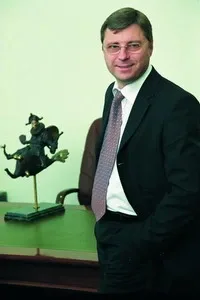
Valery Dmitrievich SUKSIN, Chairman of the Management Board of CJSC "Insurance Group TAS", shares his impressions of the MBA program with readers of "Zagranitsa".
- Valery Dmitrievich, why did you become interested in the MBA program?
- I believe that studying advanced business experience is a necessary condition for the successful development of our economy. As a rule, everyone who has work experience in business has certain knowledge and skills. The value of the MBA program is that it is a comprehensive educational program that includes a wide variety of knowledge elements.
I have familiarized myself with Russian and Baltic analogues of foreign MBA programs, talked with those who completed the program in Ukraine, and came to the conclusion that it is best to turn, so to speak, to the primary source. The fact is that in Western business schools, those who are the authors of the latest research in a particular field teach. They are the ones who develop practical assignments, and they are the ones you should ask questions that interest you. Here, however, we can obtain this knowledge only through the prism of the perception of a teacher who completed training under this program in the West a couple of years ago.
Why did I choose IEDC - Bled School of Management in Slovenia? According to international experts, IEDC is recognized as the best small business school (small business schools are those where the number of students studying at the same time is small. - Ed. note). Already during the learning process, I was able to get acquainted with several business schools, including those that are partners of IEDC, and I can say that IEDC is truly the best of them. It is worth noting that 90% of the teaching staff are leading professors from Paris, Cambridge, Harvard, and Barcelona.
- What requirements are imposed on candidates?
- In addition to formal requirements - an application, two recommendations, etc. - you need to pass two serious exams for admission. First, there is the so-called GMAT (Graduate Management Admission Test) - a general education test that identifies the mathematical, verbal, and analytical abilities of candidates for business schools. The test is conducted in English and, accordingly, requires a very good level of proficiency. It lasts four hours and includes questions on various fields of knowledge - from mathematics and trigonometry to writing essays and answering questions on history and geography. The questions change annually; each candidate has their own version of the questions. The second exam is a check of the required level of English proficiency. In addition, the candidate must have practical work experience in business. The fact is that the knowledge gained through the MBA program is useful specifically for practical application today, not in the distant future. It is not theoretical baggage, but a real tool for improving your business.
- And what could you say about the program participants?
- The composition of participants is international. For example, last year, when I studied, there were 67 participants from 13 countries. By the way, it is customary to communicate in English within the school's walls - both during the learning process and during free communication hours. The average age in our group was 34 years, and the average work experience was nine years. I would like to note that the MBA program is a unique opportunity to meet and communicate with business representatives from around the world, to understand the mentality of a particular nation, and to acquire business partners.
- What are your impressions of the academic program?
- As for the academic program, I would like to note several interesting points. First, there are no unnecessary subjects. All disciplines are arranged in a certain logical sequence and answer one question: how to make your business successful? Second, the entire program has a pronounced practical orientation. It is not just the study of certain theoretical principles; it is the so-called case study - an analysis of practical business situations. For example, we examine the 40-year business history of a Spanish sweets company, initially small. Participants work through the initial data of the "case" in advance, and in class everyone together tries to answer the question: what led this company to success in the international market? After all, we are talking about the famous company "Chupa Chups". They say that business has no nationality. Nevertheless, we analyzed "cases" not only of Western companies. For example, a case study based on the story of a Moldovan shoe factory's entry into new sales markets turned out to be very interesting.
- I studied a one-year program consisting of four modules of five weeks each. It's a fairly intensive learning schedule. This year the school offers two- and three-year programs. The number of study hours is the same, but, for example, the two-year program consists of seven to eight modules of two to three weeks each. Classes run from 8:30 to 18:00. Plus independent work on an individual schedule. As a rule, everyone attends lectures, while practical classes are held in groups of six or seven people. Each module ends with exams. By the end of the entire course, each group of students defends a business project. Project assignments are given by well-known Slovenian companies. Our group developed recommendations for changing corporate culture at the request of one of the largest banks in Slovenia - Nova Ljubljanska banka. By the way, we defended the project brilliantly, so I think our recommendations will be implemented.
- Valery Dmitrievich, what was the most interesting part of the entire program?
- The Olympic law of business is one: you must deliver your product to the consumer faster, better, and cheaper than your competitor. So, all MBA program classes are devoted to how to do this. Our professors had a term - the helicopter view. As an illustration, we looked at three pictures. One showed a street artist drawing an ordinary intersection. In another, the same artist at the same intersection, but standing on a small hill. And finally, in the third picture, the same artist was looking at the intersection, but from a helicopter! He saw a completely different world - the boundaries of his perception expanded! That's how it is in business - a problem should be considered spatially, taking into account many different factors. It is precisely this view that the MBA program develops.
Well, the strongest impression from the training was what the professors call the breaking of the ice of consciousness. Indeed, during training, established stereotypes are destroyed. You learn to be more flexible, more receptive to change, which ultimately helps business survive and develop. Just as Darwin said: it is not the biggest and strongest that survives, but the one that adapts best to changes in the environment.
- What would you advise those representatives of Ukrainian business who are today thinking about studying in an MBA program?
- Don't waste time thinking - start learning!