
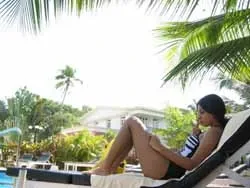
A hot tan can be found even in winter
GOA
The Indian state of Goa is one of the most democratic resorts in the world. For $10 a day, you can get everything you need for a carefree life. Average temperature in winter: + 24.
Almost the entire coast of the state is clean, sandy beaches little spoiled by civilization. Goa is divided into Northern and Southern parts. The border is considered Fort Aguada. The southern part is designed for wealthy tourists. The North is a party Mecca; the most cheerful and penniless characters prefer to settle here: numerous European backpackers, hippies, ravers, and our compatriots. Among the latter, it is common to work as extras during the filming of Bollywood movies - European faces are highly valued in Indian cinema.
In the evenings, various dance parties, circus performances and fireworks are organized on the shore. All beaches are municipal, but those areas assigned to specific hotels are guarded. Around there are many shops and 24-hour bazaars where you can buy amazing ethnic items for pennies. There is no shortage of cheap cafes and restaurants with Indian national cuisine. The basis of Goan cuisine is fish. And this is not surprising, given that more than 100 edible varieties live in the local waters. Many local restaurateurs do not even go to wholesale fish markets, but early in the morning they meet fishermen right on the shore, help sort the catch and select the specimens they need right there.
It is customary to live in Goa in ancient Portuguese villas, colorful coastal guest houses or huts standing on stilts right in the sea. For $5 a day you can rent a motor scooter and travel all over the state. Instead of a motor scooter, it is interesting to ride an elephant or go by boat deep into the jungle along a winding river. In case Goa still gets boring before spring, you can always go to other parts of India - Delhi, Bombay or the Himalayas.
THAILAND
The "Kingdom of Smiles" is invaded by tourists precisely in winter. The massive tourist landing begins in mid-December. People come here for wild nightlife, all-encompassing cheapness, excellent beaches and winning hospitality. Average temperature in winter: +28.
A dinner in a good Thai restaurant will cost no more than $20. Lovers of spicy culinary sensations can be offered to drink fresh snake blood (Thais assure that it is good for men).
Fixed prices on goods are only in department stores and some large shops. In markets, shops and other small stores it is customary to bargain.
Most hotels do not have their own beaches. On civilized beaches, flags are hung indicating the state of the sea. If a red flag is flying in the wind, swimming is prohibited in that place and lifeguards have the right to prevent a tourist from entering the water. Sunbathing and swimming without a swimsuit is not allowed - you can be fined.
One of the most interesting and visited places in Bangkok is the Grand Royal Palace. On its territory you can see the statue of the Emerald Buddha (the most revered relic of Thailand) and the statue of the Golden Buddha, weighing 5.5 tons. If you wish, take a look at the world's largest crocodile farm Samut Prakan.
But still, the real fame of tourist Thailand came from its seaside resorts. The oldest of them are Cha-am and Hua Hin (198 km south of Bangkok), with the purest and uncrowded beaches. There is also the summer residence of the royal family - the Klai Kangwon Palace and the Wat Neranchararam temple with the world's largest statue of a six-armed Buddha.
VIETNAM
For winter idleness, the Vietnamese resorts of Nha Trang, Vung Tau and Ha Long are excellent. A bungalow without special pretensions for a long term can be rented for $10-12 per day. Average temperature in winter: +26.
As for hotels, many large chain operators are represented in Vietnam. Moreover, despite the low cost of rooms, the quality of service often exceeds the hotel category.
For nightlife, go to Ho Chi Minh City - there it is interesting and lively: from clubs with diverse music to gatherings of street breakdancers. Alcohol in Vietnam is sold around the clock, especially popular among Europeans is "Soviet champagne". But most restaurants close at 11 pm. However, at any time of day you can have a snack in street food stalls. A plate of any local dish will cost no more than $1, but before eating, try to find out exactly what was served to you.
A separate problem in Ho Chi Minh City is motorcyclists. Here you can daily see traffic jams of various two-wheeled vehicles. The skills of crossing busy streets are not developed immediately: you need to learn to step onto the roadway boldly, with confidence that drivers will go around you.
In Haiphong, and now in Ho Chi Minh City, a Vietnamese bullfight is regularly held - fights of specially trained bulls. Before the battle, the animals are forced to listen to radio and television so that they get used to the noise.
On the coast, besides round-the-clock splashing in warm water, you can go surfing, and recently also diving. In the mountains, mountain biking and river trips into the jungle are interesting. In the Dalat area, famous for its mountain forests, picturesque lakes and mild climate, new trekking routes are laid every year.
CUBA
Fidel Castro's illness only spurred tourists. You need to go to the island of Freedom now, while it has preserved its socialist identity and has not bristled with faceless hotels with a standard set of services. Average temperature in winter: +21.
Cuba is loved for its extreme friendliness, unrestrained fun, cheapest rum and cigars, for beautiful women and for the warm ocean. The ocean is the main asset of everyone who finds themselves in Cuba: both locals and visitors.
The cost of a room in a small guesthouse or private house starts at $10. Lunch at a restaurant starts at $5. The crime rate on the island is very low; you can safely walk at night without fearing for your life or wallet.
The most famous beach is Varadero, considered the best in the Caribbean region. Adherents of the beach lifestyle, besides Varadero, choose Pelican Island - Cayo Largo, and the beaches of Playa Esmeralda. Cayo Largo is often called the only Caribbean island that has preserved the peace and charm of the 19th century. Divers have taken a liking to the most beautiful stretches of coastline near María la Gorda (in Pinar del Río province). In Varadero, there are more than 20 diving complexes and many rental centers for boats, yachts, scooters, paragliders, and other delights for active recreation enthusiasts.
Officially, US dollars are not in circulation in Cuba. They must be exchanged for convertible pesos at a rate of $1 = 1 peso. These are not the Cuban national pesos, but a special currency for tourists. Cubans, of course, do accept payment in small US bills, but they do so reluctantly.
DAHAB
The small town of Dahab on the Sinai Peninsula has gained a reputation as the Amsterdam of the East. Partygoers from all over Europe flock here to dance on wild beaches, smoke marijuana, drink smuggled vodka, dive into the clear waters of the Red Sea, and surf. Average winter temperature: +21.
Dahab captivates with its atmosphere of freedom and total relaxation. Many people buy houses here and come as if to a country dacha.
In Dahab, cheap bungalows with thatched roofs and plastered guest houses predominate. The beaches are untidy and consist of rocky-sandy areas from which it is simply convenient to enter the water. There are no usual sun loungers, but instead many cozy mats and pillows are spread out. Instead of a fancy promenade, there is a well-worn rocky road along the sea. On one side are eateries and cafes, on the other are small shops and tourist accommodation. Along this road stroll lively euro-backpackers, muscular surfers, dark-skinned Arabs, Rastafarians, and Black people from Sudan. Nearby stretches a Bedouin village with camels and grimy children.
A decent bungalow for a long-term stay will cost $8-10 per day; in the worst case, you can always find a bed for $2-3. For those who prefer more comfortable recreation, there is also a respectable Dahab - 5 km from the old town on the lagoon shore, several hotels of major chain operators have appeared.
It is impossible to come to Dahab and not go scuba diving, because the town lies on a coral reef. It is here that the famous Blue Hole is located - a huge coral 'glass' with sheer walls, ideally suited for underwater contemplation. Another charm of Dahab is the nearly constant steady winds and gentle shores, attracting windsurfers, kite surfers, and other surfers here. Thanks to all these delights, in democratic Dahab you can not only relax endlessly, but also be known as a proponent of active recreation.