
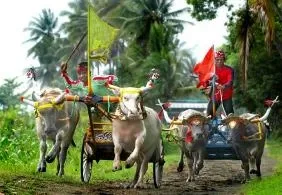
During the crisis, tourists began to pay more attention to exotic destinations
The largest British tour operators Thomson and First Choice identified several main trends for 2010. Tourists will value their vacation money and reduce the duration of tours: instead of the usual two-week vacation, demand for ten-day trips is growing and will continue to grow. This is especially noticeable in the segment of mid-range and long-haul destinations. "A week seems too short a vacation for tourists who have spent four hours or more on a flight, while they lack the funds for a full two weeks," analysts note.
The length of flights is also decreasing. Closer countries are becoming more desirable because tickets there are cheaper. Demand for all-inclusive vacations and cruises is growing. "Included meals and accommodation on cruises, with a relatively small increase in ticket price, allow you to worry about nothing and enjoy your vacation," researchers explain. That is why cruises in Russia are becoming popular among domestic and foreign tourists.
But it is not only the crisis that dictates the rules of vacation in 2010. New interesting destinations are entering the market. The travel guide publisher Lonely Planet has published a list of countries that are most attractive for travel right now.
First on their list, the publishers mention El Salvador. According to experts, the country, 20 years after its civil war, is finally ready to receive tourists properly. Germany also made it to the list of recommended countries, where "you can witness history in the making," for example, by exploring the port center of Hamburg—the largest urban development project in Europe. Greece is traditionally recommended, maintaining its position on the list of the most fashionable countries.
Malaysia, according to Lonely Planet analysts, is undeservedly overlooked by tourists who choose Thailand or Indonesia. It is a new destination, and prices there are attractively low. The publishers mention King Muhammad IV's Vision-2010 plan, which aims to increase the number of tourists in the country to 10 million per year. To achieve this plan, all appropriate conditions for vacationers are being created in the country.
Nepal in the coming year should be chosen by those who planned to vacation in India: to climb the highest mountain on Earth, Everest, and reach the mythical country of Shangri-La. The guidebook compilers also recommend Suriname—because it is "like visiting several countries at once."
Key events in 2010 will also certainly affect interest in new destinations. According to a British Airways study, the list of popular destinations this year is topped by Cape Town (South Africa), where about half a million fans want to go to attend the FIFA World Cup. The Olympic Games in Vancouver also attract tourists.
Also in the top ten most popular destinations where travelers plan to go in 2010 is Stockholm—thanks to being named the "Green Capital of Europe 2010." Tourists are also heading to Orlando, Florida, where the Harry Potter theme park is set to open in the spring.
The list of most promising destinations includes Las Vegas and New York, the beaches of the Dominican Republic, the Maldives, Croatia's Dubrovnik, and Delhi, which has become popular in part due to the growing demand for tiger safaris in the Bandhavgarh and Kanha reserves.
According to Vice President of the Russian Tour Operators Association Boris Samaryanov, the number of fans of "event tourism" is also growing in Russia: "In 2010, more people will be able to afford to travel abroad for specific events, be it a concert or the FIFA World Cup." The interests of the Russian and European, and even more so the American tourism market, differ somewhat, notes Stanislav Pegushin, Deputy General Director for Tourism at Inatur. Samaryanov expects a revival of demand for destinations requiring long and, accordingly, expensive flights.
"The Dominican Republic, Cuba, the Maldives—exotic destinations will become accessible again to a wider range of Russian tourists," the expert believes. This is also explained by the difference in exchange rates. "Last year, because the euro was much more expensive than the dollar, flying to Cuba was even cheaper than to Europe," says Victoria Kizimova, Director of Sales and Marketing at Megapolus Tours. It is possible that this will happen again this year.
There is a trend of converting already known destinations to year-round basis, Kizimova believes. Russians understand that Thailand or Indonesia, which are common for winter vacations, can welcome them at any time of the year. For example, last year, according to the tour operator, the first summer tours from Russia to the Dominican Republic appeared.
Russian tour operators also predict the popularization of educational tours, demand for which was highest during the crisis. "According to our forecasts, growth in this segment could exceed 30% this year. During the economic downturn, many tried to spend money on foreign trips profitably, for example, investing in combined language courses abroad that combine vacation and study," Samaryanov explains. Among the most popular countries where Russians go to study and also travel and relax are the UK, Malta, the USA, and Canada, as well as Germany, France, Italy, and Spain.
Russians can expect an increase in trips to the Adriatic Sea basin countries such as Montenegro and Croatia. "Last year, operators played it safe and reduced flight programs to these destinations, so there was a slight shortage of transportation. Accordingly, there were no last-minute deals for these destinations—consumers had to fly at real prices," says Kizimova, suggesting that operators will reassess the market this year.
However, according to Samaryanov, the maximum increase in sales, as abroad, can be expected in the economy segment – these are Egypt, Turkey, Bulgaria, as well as Thailand, which, due to a large number of special offers, is already attracting many Russians. A further increase in the popularity of tours to Israel, which is becoming more and more affordable, should be expected.
Overall, the top 10 most popular destinations for Russians will remain roughly the same as in 2009, Pegushin predicts. Egypt will take first place, Turkey with its seasonality will be second. Thanks to tourist flow from the regions of the Russian Far East, China will enter the top five. The top ten will traditionally include Tunisia, Indonesia, Greece. "And, of course, three excursion and beach countries should not be discounted - Spain, France, Italy," Pegushin concludes the list.
Overall, in his opinion, the tourist flow will continue to decline, and tourists themselves will become more economical. Moreover, if in 2007 and 2008 there was a trend towards an increase in "sales depth", then this year, in pursuit of an attractive offer, tours will be booked at the last moment.
Igor BAKHAREV,
Andrey KOVALEVSKY.