
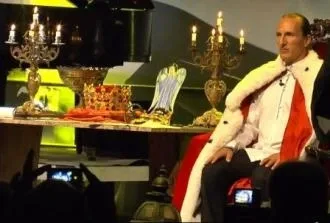
Ceremony of the Creation of New Germany
A few days ago, "King" Peter Fitzek appeared before a court: he had to answer for multiple traffic violations (in recent months, the traffic police had stopped him 24 times). Among these violations, for example, was the use of a fake driver's license.
According to Fitzek's case file, he renounced the regular German driver's license, which the country's authorities issue to everyone who passes the relevant exam, back in 2012. Moreover, it was voluntary — no one confiscated his documents. The fact is that Fitzek decided to replace the standard state license with another — a document he wrote out for himself (and, of course, having no legal force), stamped with the seal of his own kingdom, the so-called New Germany, which Peter founded in the state of Saxony-Anhalt.
He wrote it out and drove with them. The police tried to fine Fitzek eight times for using a fake license (the fine is 2,400 euros), but each time he refused to pay, arguing that his documents were perfectly in order because his kingdom also exists quite well, and therefore has the right to issue any documents to its residents, let alone sovereigns.
However, official German justice refused to heed these arguments, and eventually the "king's" case went to court. Commenting on Fitzek's offenses, judge Torsten Steffert stated that the self-proclaimed monarch not only repeatedly violated traffic rules (in particular, speed limits) but also created his own fantasy world.
The "king," apparently accustomed to such statements, did not argue, but just in case reminded again that he has a driver's license issued in the kingdom, and also stated that "the jurisdiction of the Federal Republic of Germany does not extend to heads of other states."
But victory remained with German justice: the judge, having first laughed at Fitzek, soon impassively sentenced the "monarch" to three months' imprisonment. When exactly he will begin serving the sentence is not specified.
There is no information on how the "ruler" reacted to the verdict, but one can assume that he most likely was not too upset. First, the head of New Germany, Peter, who calls himself nothing less than "we, the king" and does not consider himself a natural person, already has experience with the German judicial system (he has been repeatedly fined and punished for various violations over the past years). And second, Peter is philosophical about the need for discipline, dedication, and self-sacrifice.
According to the "king" himself, he was made an outstanding person by all sorts of life's troubles, trials, and difficulties. From childhood, at his father's insistence, Peter practiced sports — wrestling — and even achieved some success. At the same time, the future king dreamed of becoming a teacher, but he lacked the ability. So Fitzek had to engage in a variety of activities: he learned to cook and worked in several establishments, then opened a video rental store, a game arcade, traded jeans, founded a martial arts school, sold shoes, and even managed a tattoo parlor.
But at a certain point, namely in the early 1990s, he met a certain man who told him about spiritual practices. Peter began to study intensively, developing spirit, strength, and will, and by the 2000s, he was ready to open his own small store selling books on spirituality as well as applied art objects from Asia.
At the same time, Fitzek did not abandon his quests and aspirations for something greater, and by 2006 he decided to reorganize the German healthcare system (in 2010 he tried to create his own health insurance company, but the authorities prevented this), as well as the system of distribution of public finances (Peter invented his own currency, the so-called "angel money"). A few years later, Fitzek's ambitions grew so much that he planned to create a new state altogether.
In 2009, our determined hero founded "New Germany" near Wittenberg — initially an organization whose main purpose, Peter said, was the unification of Germany within the borders of December 31, 1937. At that time, he planned that his brainchild would be a direct democracy in the form of a council republic with elements of a constitutional monarchy. Later, however, it occurred to him that the new "state" could only exist under a monarch, and Fitzek hastened to declare himself as such in 2012, without waiting for "New Germany" to spread to the entire territory of the FRG.
To gain supporters, Fitzek held meetings with potential residents of "New Germany" and organized seminars. By September 2012, he had managed to "recruit" about three thousand people, six hundred of whom attended the coronation of "King" Peter, which took place a year earlier.
Currently, the residents of Fitzek's country live on the territory of "New Germany," which covers an area of nine hectares. The "kingdom" issues passports as well as license plates for cars. However, they are not valid in the rest of Germany. For this, by the way, Peter Fitzek was brought to administrative responsibility — as a true example to his subjects, the "king" drove around "old" Germany with "new" license plates, for which he paid. He was ordered to pay 150 daily rates of 12 euros, which he, being a clairvoyant and God's messenger, ignored.
And yet the German legal system caught up with Peter. Had he decided to reform it in his time, perhaps nothing of the sort would have happened. But now the king without a kingdom will have to go behind bars in good old Germany.
Lena AVERYANOVA.
Lenta.ru