
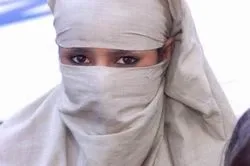
As Verdonk said, "the time for cozy get-togethers with Muslims is past, and it is time to find the courage to critically examine one another." So, not long ago the minister herself cancelled a meeting with one of the leaders of the Muslim community after he refused to shake her hand because she is a woman.
It is quite likely, writes The Times, that the government's proposed bill will be approved by parliament, since it is popular among right-wing parties. However, as the publication notes, the integration policy minister herself is well aware that, according to the law on freedom of religion, it will hardly be possible to completely eradicate the Muslim dress, so in the near future the "Iron Lady" intends to draw up a list of places where a Muslim woman, covered from head to toe, will not be able to appear. Obviously, these will be public places, shops, cinemas, airports, railway and bus stations, as well as the buses and trains themselves.
Let us recall that relations between native Dutch people and the million-strong Muslim community were overshadowed when, in November of last year, director Theo van Gogh was brutally murdered in Amsterdam in broad daylight; he had more than once criticized the traditions of radical Islam. The killer turned out to be Mohammed Bouyeri, a dual Dutch-Moroccan citizen, who confessed to the crime and stated that he acted according to his religious beliefs. The 'burqa' fell out of favor for one, but substantial, reason: the police investigating the murder of the director reported that the criminal used this garment for disguise.
In Europe, they have long looked askance at the fact that Muslims remain faithful to their traditions in choosing clothing. So, last year in France, a law came into force banning the wearing of religious attributes in educational institutions. According to the authorities, this law was supposed to protect the French tradition of separating all churches from the state. A wave of protests swept across the country and beyond; thousands of Muslims took to the streets of French and Belgian cities demanding the repeal of the ban, but the French government was adamant. As a result, from the new school year, French students stopped coming to classes wearing Muslim headscarves, Sikh turbans, Jewish kippahs, and large Christian crosses around their necks.
A ban on wearing Islamic clothing in public schools was also introduced in four German federal states. In Britain, a 15-year-old Muslim girl was expelled from school after she refused to change her traditional clothing for the regular uniform. Later, Shabina Begum first lost and then won a court case against the school administration, proving that her right to freedom of religion had been violated. In the Netherlands last year, two Muslim women lost a case against a college, whose administration banned them from wearing burqas while working with children, stating that children need to see those with whom they interact.
And now the Netherlands, which has always amazed the world with the extreme liberalism of its laws (light drugs smoking, prostitution, gay marriage, and euthanasia are legalized in the country), may become the first European country to ban Muslim women from hiding their faces.