
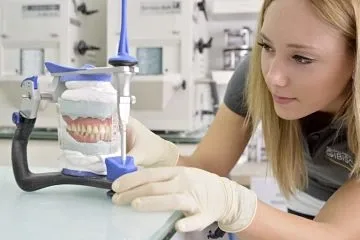
In Germany, dental technicians are taught to create Hollywood smiles
In Germany, dental technicians are classified not as medical workers but as precision mechanics specialists, much like jewelers and watchmakers. But how does one master such a profession? To find out, Deutsche Welle turned to Uwe Breuer, chairman of the Association of German Dental Technicians.
Manufacturing dentures and crowns, maxillofacial appliances and implants, painstaking selection of designs and materials — the work of a dental technician requires absolute precision, manual dexterity, a good eye, as well as the ability to distinguish colors well and aesthetic taste.
In Germany, the profession of dental technician is taught through a dual system. "The main time is devoted to practice, which usually takes place in a dental laboratory or a dental clinic. Theory is learned at a vocational school or in the same dental laboratory," explains Uwe Breuer. Those who pass the journeyman exam (Gesellenprüfung) after graduation can continue their studies at a university. "For example, at the Osnabrück University of Applied Sciences, which has a good reputation," says the expert.
He himself followed this path: first, he studied for three and a half years as a dental technician in a Munich dental laboratory, where he passed the journeyman exam, and then studied for two more semesters at a university to obtain a master's degree.
In the first two years of study, an analog model of training is used. "At this stage, students learn the intricacies of making artificial teeth from wax. Moreover, they learn to make crowns and implants based on the individual characteristics of a particular patient — their physique, face shape, age, gender, type. This is very important," emphasizes Uwe Breuer.
In the subsequent one and a half years of training, the analog model is replaced by a digital one. The program is designed so that the student becomes familiar with the computer. With its help, they must be able to build a virtual model of the future structure of the ordered prosthesis and send this data to an automated milling center, where the framework of the prosthesis is made.
And when the blank arrives at the dental laboratory, the future dental technician, under the guidance of a mentor, manually veneers the prosthesis (for example, with ceramic) and adjusts some details — so that the patient has a perfect smile. A machine can never be taught this. And therefore, "sculptors in the field of dentistry," as dental technicians are often called, will not be replaced by robots, Uwe Breuer is confident.
For graduates of German gymnasiums, the period of vocational training is reduced by six months. And top students can become dental technicians in just 2.5 years. "Our profession is very complex, we work with many materials. So knowledge of physics, chemistry, and anatomy is essential. Even the basics of Latin must be known to navigate medical terms," explains Uwe Breuer. And since the study of all these subjects is included in the curriculum of gymnasiums, their graduates are exempt from attending such classes.
Those from other countries who wish to master the profession of dental technician in Germany can also do so. Uwe Breuer explained what is required of candidates. "The most important thing is to know the German language and have a general secondary education. If these conditions are met, you can safely submit a request to the professional association," the expert advises. The request should be sent either to the head professional association (Verband Deutscher Zahntechniker-Innungen) or to one of the state associations. The professional association, in turn, will forward your documents to laboratories or dental clinics in need of specialists.
In Germany, those who study as dental technicians under the dual system receive a stipend: in the first year, from 430 to 550 euros; in the second, from 480 to 600 euros; in the third, from 530 to 650 euros; in the fourth, from 580 to 700 euros. Upon completion of the vocational training, the salary of beginning specialists is modest — just over two thousand euros per month. But after several years of work, one can expect salary growth. Specialists who regularly attend advanced training courses and successfully pass the exam for master dental technician earn particularly well.
Incidentally, with such a title in Germany, one can open their own dental laboratory — as the head of the Association of German Dental Technicians and master of his craft, Uwe Breuer, once did. Foreign specialists who have received education abroad will have to undergo a qualification check for compliance with German standards to engage in entrepreneurial activities in this field in Germany.