
Last year, the University of Szczecin celebrated its 20th anniversary. But this is not the first, but the second youth of a well-known educational institution. The fact is that the university's academic age is actually much older: it was founded as a result of the reorganization of the “older” Pedagogical Institute, the Faculty of Engineering and Economics of the Polytechnic Institute, and the Academy of Commerce, which was founded back in 1946. The University, having inherited the best features from its “ancestors,” is now the largest institution of higher education in West Pomerania. The University constantly expands its research potential, as well as the sphere of educational services. It has seven faculties providing education in the most sought-after specialties. These are the faculties of economic sciences and management, humanities, law and administration, management and economics of services, natural sciences, as well as the faculties of physics and mathematics and theology.
Currently, more than 1,200 teachers work at the University of Szczecin, including 250 professors. Students who prepare themselves for activities in the multicultural European community of the information period, who want to work successfully in a united Europe, receive good training.
Achieving this goal is facilitated by cooperation with European universities: on average, during the year about 250 employees and 200 students of the University participate in foreign internships, scientific scholarship programs, international conferences, and about 150 scientists and students from leading European universities come to the University of Szczecin.
Since the task of continuous development of the teaching staff is of the highest priority, the University supports and encourages the successes, scientific and professional growth of people actively engaged in research activities, which, in turn, contributes to the rapid improvement of the University's own level. Over the 20 years of its existence, the University has acquired full academic independence: four faculties (the Faculty of Humanities, the Faculty of Economic Sciences and Management, the Faculty of Management and Economics of Services, and the Faculty of Natural Sciences) have the right to confer the degree of habilitated doctor, and the Faculty of Law and Administration also has the right to confer doctoral degrees, in addition to those listed above.
Onward and upward
In the academic sphere, the University's priorities are associated with improving the quality of teaching at all levels of education and with expanding the range of educational courses by introducing a two-level system of education (three-year bachelor's programs, followed by two-year master's studies). This system has already been implemented at the departments of German philology, history, pedagogy, sociology, mathematics and physics, as well as in areas related to economics. In addition, there is the possibility of parallel study in two subject areas simultaneously. The University's administration considers it a vital task to improve curricula by introducing new areas of study, in order to adapt academic programs to the requirements of the modern market and bring them into line with European standards.
The introduction of the European Credit Transfer System (ECTS) began in 1998, and since then it has been used to credit courses taken by students abroad during one year or one semester. The implementation process is complete, and the system is continuously optimized.
The University of Szczecin, the largest educational institution in northwestern Poland, strives to take as high a place as possible in the hierarchy of Polish universities. The range of research programs is constantly expanding, with special attention paid to regional problems. In addition, the University's structures are gradually being improved and the teaching staff is being developed.
Make a date at the Maiden's Tower
The advantages of studying in Szczecin include its unique location. The historical capital of Pomerania, this city is located in the geographical, political and informational center of Europe, at the crossroads of the most important transport routes connecting east with west and north with south. Communication with the whole world is ensured by the largest port on the Baltic Sea. The city is comfortably situated in a valley bordered to the north by wooded hills. This natural barrier to the winds ensures an extremely mild climate. Favorable atmospheric conditions make it possible to grow a number of exotic plant species rarely found in this climatic zone (for example, magnolia is one of the symbols of Szczecin; in addition, a huge number of plane trees grow here).
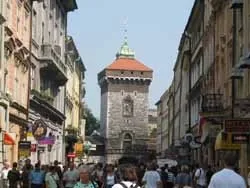
Szczecin, thanks to its many parks and abundance of greenery, stands out noticeably among many Polish cities. Green areas occupy almost 3,000 hectares in the city, and more than 50% of the green area is forest-park zones. Near the city there are two large forest areas: Puszcza Goleniowska to the east and Puszcza Wkrzanska to the northwest. Among the unique sights of the city are the Pomeranian Dukes' Castle and the Maiden's Tower.
All this ensures the high attractiveness of Szczecin both for foreigners and for local residents, whose number is 400,000. Almost 40,000 of them are students of sixteen universities, the largest of which is the University of Szczecin. Its doors are hospitably open to everyone who wants to get a quality modern education.