
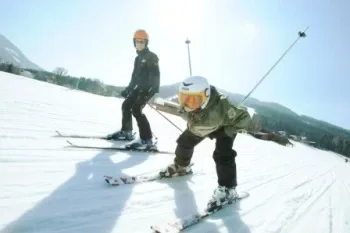
When you first ski a run without falling once – and that will definitely happen – the only thing you will regret is that you lost so much time without experiencing true happiness.
Why should you plan such a trip as early as possible? Because millions of people have already fallen into the sweet captivity of skiing, and with each passing day (especially in our peculiar times) plane tickets are getting more expensive, and the cost of the vacation itself is starting to strain due to currency fluctuations. The clever ones traditionally buy tickets and book hotels or apartments in the spring, saving a fair amount. By the way, it's still far from certain that you'll save money on a ski vacation by going to Sochi this winter instead of Europe.
It seems that this season in Krasnaya Polyana (with Alpika closed) there will be a fantastic "sold-out" with all the ensuing consequences like hour-long lift queues, hotels and restaurants packed to the brim, and the traditional Russian service quality, which definitely won't improve with such high demand. This doesn't mean you shouldn't try a Russian-style vacation, especially considering the incredible new Olympic infrastructure in Krasnaya Polyana. Perhaps it would be better for you to do it in a year, when the post-Olympic hype has died down, among Sochi hoteliers and restaurateurs, and, as much as one can hope, various sanctions have eased.
So, here are a few tips for those who are just about to take up skiing in its homeland – the Alps. Experienced skiers will find all of the below obvious, but I hope it will be useful for beginners.
When to go?
The question is a bit more complicated than it seems at first glance. At the peak of the season – a week before New Year's and two weeks after – prices for plane tickets, hotels and apartments, equipment rental, and ski passes nearly double. It's more economical to plan a trip for late January to March; then the snow is guaranteed, the tan is darker, and skiing is warmer, but… what to do at home during the long ten days of non-stop New Year's drinking?
You should decide in advance how many days you will spend in the mountains. Typically, travel agencies specializing in ski holidays offer a choice of 7 or 10 days. With a seven-day package, you get 5 days of skiing – just right for beginners, but for confident skiers it seems a bit too little. Just as you start to get into shape, as skiers say, it's time to go home. With a ten-day trip, you get 8-9 days on the mountain, which for many is already a bit more than needed. I know people who choose the second option but take a day off: instead of the mountain, they go on an excursion to a nearby town, to a pool or an ice rink – these are available at many resorts.
Goggles or mask?
I personally use both. Dark ski goggles for bright sun. A light-enhancing yellow mask for foggy weather and strong wind. It happens that without such a mask in a blizzard you won't find your way home and will freeze like a puppy. In your place, I would be picky here, go to ski shops, ask for advice on how to choose a ski mask and try different options.
Skis: buy your own or rent?
Your own are, of course, better. Ladies choose skis or a board guided by the main principle – that they match the color of their outfit. Men, on the other hand, try to delve into the subtleties of construction, turn radius length and other nuances… which are completely irrelevant for the first few years of skiing!
Once I was seized by a passion to own the then most fashionable and very expensive "Atomic" skis, painted in a red-black checkerboard pattern. I even went to the store with a firm decision to give myself a little happiness. Thanks to the French salesman who talked me out of the purchase. After detailed questioning and a critical look at my not-too-athletic physique, he firmly said: "You will never ski in a way that uses all the capabilities of these skis. Take something simpler!"
To start skiing more or less decently, you will need at least three years. Only after figuring out what you like more – board or skis, groomed slopes or powder, high speeds of giant slalom or calm carving, and trying different brands and models, will you be able to approach purchasing equipment thoughtfully.
Considerations of economy are also not the best helper in the difficult dilemma of choosing between your own equipment and rented. The amount of money spent on rental over 4-5 years equals the cost of new skis, which you will just want to replace by then. Every year developers improve designs and compete in design, and you, already practically a ski "ace," will certainly want to follow fashion, try something new. So decide for yourself – buy or rent.
With or without a helmet?
After the tragedy that occurred in the mountains with multiple Formula-1 world champion Michael Schumacher, who was an excellent skier, this question has been definitively resolved for many.
Safer, of course, with a helmet. Especially in the first years of skiing, when almost the most common cause of accidents on the slopes is a collision with other inexperienced skiers like yourself. If ten years ago a person in a helmet looked exotic in the colorful crowd at the lifts, now it's the opposite.
Skis or snowboard?
This is an irresolvable debate – like blondes vs brunettes, chicken vs egg, cognac vs vodka. No matter what arguments the supporters of "boards" and "sticks" bring, the discussion is pointless. Neither age, nor physique, nor even gender matters – the choice is only yours.
Hotel or apartment?
Both options have their pros and cons. For example, I prefer apartments. There you are more left to yourself than in a hotel. Apartments are usually more spacious than hotel rooms, equipped with everything necessary for housekeeping. And the main thing – I love to cook!
Ski lifts usually close around four to half past five in the evening, leaving a lot of time after skiing, and in the supermarkets of even the smallest ski villages there is always room for culinary imagination to treat yourself and your loved ones to something tasty. Choosing unfamiliar products becomes a small and very pleasant adventure. Moreover, a trip to a ski resort is not cheap in any case, and the option of cooking yourself is more economical than daily visits to a restaurant.
If you are not ready to take on the temporary duties of a mountain cook, then the choice between a hotel or an apartment may be determined by the opinion of your companion. For her, tired of cooking at home, the option of wandering around local restaurants may seem tempting.
And the very atmosphere of family Alpine hotels is simply charming! I fondly remember one of them, where a young German head chef did such things in the kitchen every day that I had to say goodbye forever to the dream of losing a little weight. Some of my friends prefer hotels of the international chain Club Med, where it is fun and noisy, where the stay includes everything, even the cost of instructor services, and where younger children can always be dropped off for a couple of hours under the responsibility of charming animators.
In any case, whatever your choice – hotel or apartment – the main thing to worry about is the proximity of your accommodation to the lift. Everything else is secondary.
What to bring?
I will disappoint the dandies and fashionistas: at ski resorts (perhaps except Courchevel – I haven't been, I don't know) there is no one to admire your evening gowns. Everyone dresses very casually: a sweater, jeans. If you see a person in an expensive suit with fur trim, feel free to address him in Russian: Europeans do not spend money on such things, they prefer understated outfits. The only thing to take care of is footwear. Winters in Europe are mild, but most resorts are at snow level, and walking in light boots in the evening will be uncomfortable.
Bring thermal underwear; it won't take up much space, but it will be very useful when it gets cold. You will also need ski socks, which are sold in all specialty stores, and gloves. Gloves are also a very personal matter. For example, I get hot skiing in thick ones, and finding a comfortable lightweight spring version is not so easy.
Also bring lip balm: many people's lips crack in the mountains. And in addition to the medications you personally need, it will not be superfluous to put a tube of Troxevasin in your suitcase – it is good for bruises and hematomas. Also Artrosilene if your knees ache. You can also bring something like Fastum gel: many 'newbies' have sore muscles from unaccustomed use in the first days, atrophied after months of sitting in an office.
What you can't skimp on
If you sincerely believe that any person is born on skis and can teach any Frenchman to ski, just forget it. This is a misconception that cost me dearly. Without humbling my pride, I somehow learned to descend on my own, and it took several years of relentless work on myself to finally do it properly. An instructor is the only expense on which you absolutely cannot skimp! Only he can show you the basics of carving technique, which you will then improve for the rest of your life – on your own or with the help of more experienced friends.
And I sincerely envy you: you still have ahead that sweet moment when you suddenly discover that skiing is perhaps the best of the entertainments invented by humanity over the long millennia of civilization! Not counting travel, of course.
Read the continuation of the topic:
WHERE TO LAY YOUR SKI TRACK?
Mikhail KOZHUHOV,
traveler.