
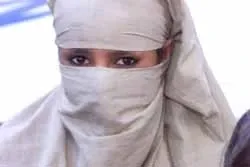
Last Friday, the Dutch government approved an initiative by the Ministry of Migration to ban the wearing of the burqa in public places: on trains, buses, in schools, district court buildings, and even on the streets. According to Dutch ministers, the burqa 'causes serious damage to national security.' 'We consider it undesirable for a person to appear on the street in any clothing that covers the face, including the burqa. This violates public order and the safety of residents,' said Minister of Migration Rita Verdonk. 'People should be recognizable: this helps them not only to be safe but also to communicate with each other.'
Muslim garments that cover not only the body but also the face have been a subject of debate in the Netherlands for several months. In the end, Verdonk's bill, known for her tough policy towards newcomers, was decided to be adopted, sparking a storm of indignation from the public. The Dutch population, considered in Europe one of the most friendly nations towards political refugees and immigrants, does not share the government's hostility towards newcomers and its desire to forcibly convert them to Dutch culture. The opposition calls the ban on the burqa a 'political trick.'
'A blanket ban goes beyond reasonable limits. I am extremely afraid that the Muslim community might see it as an attack on Islam,' Labor politician Jeroen Dijsselbloem told the Associated Press. Representatives of the Muslim community, which makes up 6% of the population in the Netherlands, called the authorities' decision 'a big law for a small problem': in the country, according to their estimates, only 100 or 50 Muslim women wear the burqa. Therefore, as reported by the BBC, local Muslims see the ban on the burqa as a hint at the question of the very expediency of their residence on Dutch soil. In turn, the mayor of Amsterdam, whose residents are known for their liberal mores, has already warned the country's government that paying too much attention to this issue could 'run into return fire.'
Muslims living in the Netherlands call the migration minister's idea 'simply ridiculous.' 'Go out into the streets – who will you meet in a burqa? No one! This is either a political provocation or outright stupidity. Mrs. Verdonk should occupy her time with something more useful,' one local Muslim told Associated Press reporters. But the authorities insistently emphasize that the main reason for introducing the dress code was precisely concern for the safety of citizens, not political intrigues. As Verdonk explained, speaking on national television, it will be forbidden to wear not only the chador and burqa, but also helmets that completely cover the face, and ski masks.
The government announced its decision after a final meeting in the office of Prime Minister Jan Peter Balkenende five days before the parliamentary elections. Western political analysts note that this decision will strengthen the alliance of democrats with the liberal party, which has taken a course of 'tightening the screws' in immigration laws. If they are re-elected, experts say, the Dutch government may go further than other European officials in bans on traditional Muslim clothing.
The disputes in the Netherlands are just part of a heated European debate about how far authorities can go in dictating what people, especially Muslim girls and women, can and cannot wear. In October, British Foreign Secretary Jack Straw sparked a wave of unrest in the country by expressing dissatisfaction with a Muslim woman's face being covered by fabric. 'Your burqa so provocatively emphasizes the disunity and differences of nations that it threatens the harmony of British society,' he said. Subsequently, Straw was supported by Prime Minister Tony Blair himself.
This year, the UK High Court ruled that secondary school management has the right to ban Muslim students from wearing the jilbab – an ultra-strict Muslim garment (a long dress to the feet) – instead of school uniform. In French schools, wearing the hijab – a wide scarf that many Muslim women wear on their heads along with other religious symbols – is prohibited. Italy also joined the debate. 'You cannot cover your face; you must be visible. This is a matter of common sense and is very important for our society,' said Prime Minister Romano Prodi.
This week, according to Mrs. Verdonk, she learned that the persecution of the burqa could only begin after the bill was approved by legal experts. And she immediately added that they, having already consulted with the government, see no violations of the freedom of religion law adopted in the European Union in the ban on the burqa.
Olesya Gerasimenko.
Gazeta.Ru er="0">