
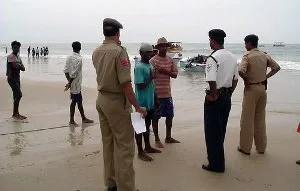
Authorities of the Indian state have taken a stand against Russian tourists
“Taking tough measures against those who do not wish to leave even after the expiration of their permits is necessary, because they are the real bandits,” said a police representative.
Meanwhile, some residents of Goa would like the authorities to go further and not only clear the state of illegal immigrants, but also ban Russians from doing business related to attracting and serving tourists. Such a demand, for example, was put forward at a recent meeting by residents of the small town of Morjim, located on the coast, 25 km from the state capital, Panaji.
“Russians have all possible vices. When Russian tourists come to a place, all other tourists flee from there. This is bad for the residents of Morjim. We have had tourists from other countries, but never had such a problem,” said Laxmikant Parsekar, head of the regional branch of the Indian People's Party, speaking at the meeting.
He also noted that the influx of a huge number of Russian tourists is turning into a real cultural invasion, as Russians begin to behave defiantly. “We should not encourage them too much, so as not to become helpless before them,” the politician emphasized. According to him, it is time for local authorities to call to order Russians conducting illegal business in the state and to check the legality of their advertising, reports The Times of India.
The reason for such a militant attitude among Indians was the recent scandal involving Russian businessman Konstantin Borovskoy, who is accused of killing a taxi driver. The businessman came to India on a work visa – he owns a restaurant business in Morjim.
According to investigators, on the evening of February 11, the Russian entrepreneur, while driving a car, at some point interfered with a group of taxi drivers sitting idle by the road with the bright light of his headlights. After a verbal altercation between the Russian and the taxi drivers, a fight broke out. As a result, one of the locals was hospitalized with serious injuries, and after a while the victim, Rohidas Shetgaonkar, died in the hospital. The Russian also suffered injuries during the fight, but they were only minor bruises.
According to a police representative, after the incident Borovskoy was taken into custody, and now he has been charged under Section 302 of the Indian Penal Code (murder). “Initially, Konstantin was detained for causing grievous hurt. The locals involved in the fight were also taken into custody,” the police added.
Russians are most often accused of ties with the drug mafia, which, according to local authorities, is largely controlled by Russians. Goa has been a transit point for drugs in India for several years now. The resort is famous for its rave parties, where buying drugs is often not a problem.
The resort is popular among Russian tourists. Many come on a tourist visa and easily extend their stay in the country for a small fee in dollars.
With the growing popularity of the resort, the crime rate in the region has also increased significantly. The authorities became seriously concerned about this issue after the death of 15-year-old British girl Scarlett Keeling. Initially, the police stated that she died of a drug overdose, but an investigation conducted at the insistence of relatives showed that she was raped and killed on Anjuna beach. This crime, for which two locals – Placido Carvalho and Samson D'Souza – are accused, was committed back in February 2008, but Scarlett's body still remains in the morgue: the Indian police have not yet allowed the family to bury the girl.
Another mysterious death occurred in May last year: the mutilated body of Russian woman Yelena Sukhnova was found on the tracks near Tivim station. According to the main version of the investigation, the girl simply fell out of the train and was run over.
In December last year, a 25-year-old Russian woman working at one of the state's hotels stated that she was raped by local politician John Fernandes, who participated in the 2007 legislative assembly elections from the Goa Save Front party.
And after a nine-year-old girl from Russia was raped on the beach on January 26, 2010, Goa increasingly gained a reputation as a state where it is unsafe for women to travel.
Recently, the Travel and Tourism Association of the Indian state stated that Russians are causing its popularity to decline. Reports of a 'Russian mafia' that has settled in northern Goa and of conflicts between crime bosses and the local population harm the state and ordinary tourists, whose flow has recently decreased significantly. As a result, the resort is losing a significant portion of its revenue, which is the main source of funding for the budget of this Indian region.
President of the Travel and Tourism Association Ralph de Souza, speaking about the damage to Goa's reputation from the 'Russian mafia,' clarified that he means not only criminal authorities but also those who like conflicts on domestic grounds. 'Incidents between locals and Russians threaten the reputation of one of the most popular holiday destinations,' de Souza said.
'Russians constantly get into conflicts with local residents, and often they are under the influence of alcohol or drugs,' he said. The number of tourists has significantly decreased compared to last year, as reports of a 'Russian mafia' that has settled in northern Goa scare away potential guests, noted a representative of the local tourism industry.