
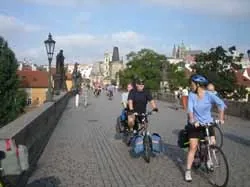
Prague recognized as a city of students
For every 100 residents of Prague aged 20-24, there are 150 higher education students. "The Czech capital ranks first in the European Union in terms of the number of students," reports the European statistical office Eurostat. Young people come to Prague for the opportunity to get free education. Both local students and foreigners also cite Prague's favorable location - as if in the "middle" of Europe - as a plus: it's convenient to get home.
New EU members face labor shortage
Eight out of ten Eastern and Central European countries that joined the European Union in May 2004 may face a labor shortage due to outflow to the "old Europe," World Bank (WB) experts believe.
To avoid these problems, WB experts suggest that the governments of Central and Eastern European countries reform their national social security systems to make working at home more attractive for their citizens, as well as ensure skills upgrading and labor mobility at the national level. In addition, the World Bank advises EU "newcomer" countries to import qualified specialists by opening their national labor markets to foreign workers.
The United Kingdom, Ireland, and Sweden were the first among the 15 former EU member states to fully open their markets to labor migrants from the new member countries of this regional organization. Most EU "veterans" protect their jobs from guest workers from the East using various restrictions that will remain in effect until 2011.
Most Germans happy with German reunification
Three-quarters of Germans view the country's reunification positively. This conclusion was reached by staff of the sociological service Emnid in a public opinion poll commissioned by the N24 television channel.
The survey was timed to German Unity Day, celebrated on October 3. Almost every fifth German (19%) would like to have the Berlin Wall back. In the east of the country, that figure is 21%. In addition, it turned out that many eastern Germans feel like second-class citizens. 74% of residents of East Germany consider themselves disadvantaged compared to western Germans. At the same time, 73% of residents in the west of the country see no reason for such views.
Japan changes entry rules for foreigners
The Japanese government will, by November 23 of this year, require all foreigners arriving in the country to undergo facial photography and fingerprinting during passport control. This was announced by Ukrainian Foreign Ministry spokesman Andriy Deshchytsia, citing information from the Japanese Embassy in Ukraine.
The exact date for introducing the photography and fingerprinting procedure will be announced later. Exempt from this procedure will be: persons with a special permanent residence permit; those arriving in Japan on a diplomatic or official mission; those invited by the head of any Japanese governmental organization; persons classified by the Japanese Ministry of Justice as foreign national categories 3 and 4; persons under 16 years of age.
The photography and fingerprinting procedure is being introduced due to changes adopted on May 24, 2006, to Japan's "Refugee Law" and border crossing procedures with the aim of preventing terrorist attacks.
Every tenth employer in Russia refused migrants
About 10% of Russian employers have completely abandoned the use of migrant labor, and 15% are dissatisfied with the qualifications of foreign workers. As Kommersant writes, citing data from a survey by the Institute for the Economy in Transition (IET), this is twice as much as last year.
The gradual disappointment of Russian employers in migrants is not related to xenophobia. As the IET notes, only 2% of respondents said that the obstacle to using migrant labor is their "culture, mentality, work style." The vast majority of businessmen believe that the salaries of a migrant and a local resident should be equal if their qualifications are equal.
On the other hand, about 37% of employers noted that there are not enough labor migrants in their region, and 20% complained that foreigners do not approach them for vacancies. Migrants are most lacking in light industry. In this sector, 49% of respondents noted a shortage of migrants.
Britons to teach migrants fishing rules
UK authorities have developed a special memo for immigrants from Eastern Europe explaining the basic rules of conduct in the country. As the British newspaper The Daily Mail writes, a sample of the memo, which is to be handed to immigrants when crossing the British border, will be presented to the public at the beginning of next week.
According to the publication, the instruction particularly states that in the UK, drivers must observe speed limits and not drive under the influence of alcohol. It also states that fishing in water bodies without a special license is prohibited in the country. The authors of the guide also remind new UK residents that they should adhere to accepted social rules of conduct - respect the religious and cultural characteristics of other residents of the country.
The necessity of compiling such a guide, The Daily Mail explains, is justified by British authorities by the fact that people from Eastern Europe coming to the country are "in a different coordinate system." According to sociological experts, residents of Eastern European countries do not perceive speeding as a serious offense. The point about the fishing ban appeared due to the culinary preferences of Poland's residents, whose national cuisine includes a dish of stewed carp.
Special instructions will also be sent to regional organizations working with immigrants. They are now asked to minimize the number of documents translated from English into the languages of immigrants' home countries. According to the program developers, this measure should encourage them to learn the language of the host country and, as a result, speed up the adaptation process.
Over the past three years, at least 700,000 residents of Eastern Europe, whose countries are members of the European Union, have arrived in the UK. In connection with such an influx of immigrants from this part of the world, writes The Daily Mail, the government had to significantly revise existing programs for adapting new residents of the country to society, as the existing ones proved ineffective. About 50 million pounds have been allocated from the state budget for the new program.
In Europe, there are already more elderly people than children
In the EU member states, there are more elderly people than children, the European statistics agency Eurostat reported.
According to the data it published, the share of children under 14 years of age in the EU population is only 16.2%, and the share of elderly people aged 65 and over is 16.6%. Over the past 25 years, the total number of young people in EU states has decreased by 23 million (21%, of which 10% only in the last decade).
According to Eurostat, among EU countries the 'oldest' population is in Italy, where every fifth resident is over 65, and the share of young people is only 14.2%. The youngest population is in Ireland, where their share is 20.7%. Despite these figures, the total population of the EU, which today reaches almost 500 million people, has increased by 8.2% over the past 27 years.
Eurostat explains this primarily by population growth due to the influx of immigrants. Only last year, immigrants from third countries accounted for 75% of demographic growth in the EU as a whole. Among the members of this regional organization, only in France and the Netherlands does the rate of natural population growth exceed the rate of replenishment due to migrants.