
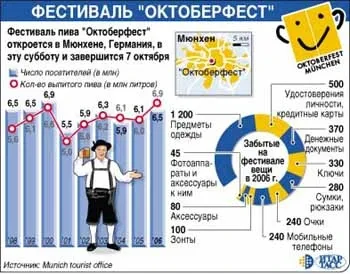
ITAR-TASS graphic
Oktoberfest starts in Germany
In Munich last Saturday at noon local time, the famous beer festival – Oktoberfest – kicked off. As is tradition, the first beer barrel was entrusted to the mayor of the city, Christian Ude, and the first mug went to the Prime Minister of Bavaria, Edmund Stoiber. A 12-gun salute signaled that beer was being served to ordinary festival guests in 14 large pavilions and 20 various 'beer gardens,' cafes, and restaurants. According to organizers' estimates, in 2007 Oktoberfest, held for the 174th time, will be visited by at least 6 million people, who will drink about 13 million pints of beer. The festival will last 16 days and will ceremoniously close on October 7.
Switzerland may enter Schengen in 2008
Switzerland should join the Schengen and Dublin agreements of the European Union on November 1, 2008, the Swiss Telegraphic Agency (ATS) reported, citing a statement by the country's Minister of Justice Christoph Blocher. According to Blocher, the ratification process of all necessary documents should be completed early next year.
Blocher also discussed in Brussels the issue of Liechtenstein joining Schengen, stating that Bern advocates for the simultaneous accession of Switzerland and the principality to keep their borders open. Recall that Swiss residents approved joining the Schengen and Dublin agreements in a national referendum in June 2005.
Joining Schengen will facilitate movement between countries, and the Dublin agreement will increase the effectiveness of cooperation between the European Union and Switzerland in fighting crime and illegal immigration, as it will allow the Swiss to access the 'Eurodac' database, which stores fingerprints of illegal immigrants.
Visas for third-country nationals will be free
At the meeting of the Visegrad Four countries last Friday, the issue of visa regimes for third-country nationals was discussed. The presidents of Poland, Hungary, the Czech Republic, and Slovakia decided that after joining the Schengen area, the fee for visa processing will be abolished.
In particular, it concerned citizens of Ukraine and Belarus, as well as other non-EU countries. Czech President Vaclav Klaus said that the republic does not intend to abolish visa requirements for third-country nationals, but is ready to issue visas free of charge. 'Despite the disagreements between us and the leadership of Belarus, they should not hinder ordinary Belarusians when traveling,' added Polish President Lech Kaczynski.
In a year or two Israel may abolish visas for Ukrainians
The visa regime between Ukraine and Israel could be abolished within the next year or two, said an official representative of the Israeli Foreign Ministry, Yaril Ovadya. The day before, a special interministerial commission of the Israeli government recommended abolishing entry visas for Russian citizens.
Israeli Tourism Minister Yitzhak Aharonovich, who initiated the reform, called the special commission's decision 'a triumph of common sense.' It can be expected that after the government approves the recommendations, the proposed changes will take effect as early as the beginning of the new year.
If the experiment with visa abolition for Russians proves successful, the next country with which a free movement regime will be established is Ukraine. At least, the Israeli Foreign Ministry from the very beginning of the discussions on the visa topic predicted the further inclusion of Ukraine in the 'visa-free zone.'
Israeli business reacted positively to the news of these innovations. In particular, as 'Ukrayinska Pravda' reports, business magnate, chairman of the Chamber of Commerce 'Israel-Ukraine' Lev Levayev stated that the abolition of the visa regime with selected CIS countries will allow at least doubling trade turnover between the states and make possible the creation of new jobs.
Czech population increased due to births and foreigners
In the first half of the year, the population growth of the Czech Republic amounted to 4.5 thousand people. Mortality was 51.5 thousand, and 56 thousand children were born. At the same time, 34 thousand foreigners arrived in the country. According to the Bureau of Statistics, the same number as in the entire previous year.
One-third of the arrivals are citizens of Ukraine, followed by Slovaks and Vietnamese, as well as residents of European Union countries. According to the Aliens Police, 356 thousand citizens of other countries are officially registered in the country. Foreigners make up 3.5% of the population of the Czech Republic.
United States renews five-dollar bill
The US government unveiled a new five-dollar bill with improved security features, which should enter circulation in early 2008. It will be followed by a new one-hundred-dollar bill. Previously, updated 10-, 20-, and 50-dollar bills have already been issued.
The new banknotes have two watermarks. To the right of the portrait, a large mark in the form of the number '5' (on old notes, the watermark depicts US President Abraham Lincoln). An additional watermark is a column of three numbers '5' printed in small font, located to the left of the portrait. Additionally, a vertical security thread is embedded in the notes to the right of the president's portrait. On it, the words 'USA FIVE' and the number '5' alternate on both sides. In ultraviolet light, the thread glows blue.
As noted in the Bureau of Engraving and Printing of the US Treasury, for the first time the renewal of banknotes is happening online. To transition to the new notes, a mini-site was created on the bureau's website in more than twenty languages. The Russian version of the resource can be accessed at Newdollar.ru.
All old banknotes issued after 1861 will retain their face value and will be accepted without restrictions.
Mexico - a pensioner's dream
Mexico has been named the best place in the world for retirees, taking the title from Panama, where housing prices have soared. The American magazine International Living Magazine, which traditionally publishes an annual ranking of the best vacation spots for retirees, writes that "Mexico managed to take first place thanks to its unique combination of modern infrastructure and old-world charm."
The study conducted by the magazine included 29 countries and was evaluated on categories such as housing prices, entertainment, additional benefits offered to vacationers, cultural programs, level of safety during stay, healthcare quality, climate, infrastructure, and finally, prices for food and clothing.
"Upon retiring and going to Mexico, you will find the whole range of technical delights that you would have, for example, in the United States: cable television, high-speed Internet, and modern hotel furnishings," says magazine editor Laura Sheridan. On the other hand, as noted in the study, Mexico is also very attractive to vacationers because of its healthcare system, diverse climate in different parts of the country, and very affordable housing prices. For example, real estate on the coast in Mexico can be purchased for as little as $100,000.
We should also name the countries that will appeal to retirees. Among them are Ecuador, Italy, Panama, Australia, Malta, Spain, South Africa, Malaysia, France, and Thailand. Panama dropped from first to fourth place not only because of the sharp rise in housing prices, but also because the country's authorities recently banned monthly visas.
The United States does not look very attractive for vacations and takes an honorable 19th place on the list, losing to those ahead in terms of special benefits. The United Kingdom even closes the list, mainly because of high prices for everything – from food to real estate.