
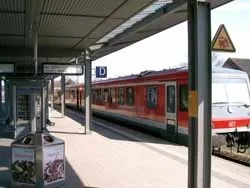
Smoking banned in regional German trains
Starting July 1, German railways are eliminating the last smoking compartments in regional trains – RegionalBahn (RB), RegioExpress (RE), InterRegioExpress (IRE) and S-Bahn (S). Until now, they remained in trains in the states of Berlin, Brandenburg and Mecklenburg. In the other German federal states, smoking compartments in regional trains had already been abolished earlier.
Now smoking compartments remain only in Germany's long-distance trains – InterCityExpress (ICE), Intercity (IC) and EuroCity (EC), as well as night trains. However, they may also be eliminated in the coming years. In addition, a smoking ban may be introduced at all train stations. Currently, smoking at stations is allowed only in special compartments on platforms.
Around 200,000 refugees found asylum in EU countries
In 2006, EU member states granted asylum to 199,850 refugees, 17% fewer than the previous year, reports the newspaper Libre Belgique.
The largest numbers of refugees in Europe come from countries such as Iraq, Afghanistan, Sudan, Somalia, Congo and Burundi. In France, Belgium, Great Britain and Finland, there was a significant decrease in the number of refugees in 2006 (25 to 50%). In Belgium, for example, the asylum grant rate in 2006 was the lowest since 1995, at 27%. Of the 11,590 people who applied for asylum from Belgian authorities last year, only three thousand received refugee status, according to the report.
At the same time, the asylum grant rate increased noticeably in Sweden, Poland, Hungary, Ireland and Slovakia. This year, the Swedish government is ready to receive 30,000 to 40,000 refugees. In 2006, 24,600 people received refugee status in this Scandinavian country, 9,000 of them Iraqi citizens, the newspaper notes.
Judith Kumin, a representative of the UN High Commissioner for Refugees, noted that in Europe there is a 'big difference in the practice of states in dealing with refugees.' 'For example, a person from Chechnya has a 60% chance of being recognized as a refugee in Belgium and none in Slovakia. A person from Iraq has a 100% chance of being recognized as a refugee in Sweden and no chance in Greece,' Kumin said.
Czech citizens increasingly dissatisfied with EU membership
The Czech Republic is among the countries whose citizens are increasingly dissatisfied with their country's membership in the European Union. According to the traditional Eurobarometer survey, which involved 30,000 people from 27 EU countries, only 46% of Czechs are satisfied with the situation in their country.
This is almost 5% less than last year. According to the survey, Czechs occupy the 'golden mean.'
The most satisfied with membership in the European family of nations are Spaniards, Irish and Luxembourg citizens. At the opposite end of the spectrum are the British, Hungarians and Austrians. In Austria, only three out of ten respondents showed positive emotions about EU membership.
Canada decides to create its own blacklist of air passengers
Canada has become another country where the passenger list of each flight will be checked against a government blacklist of people banned from boarding aircraft due to suspicion of terrorist activity. The verification procedure will be carried out during check-in.
If the name, gender and age match, police representatives at the airport will decide whether to allow the person on the flight. In addition, starting June 18, every passenger aged 12 and over must carry a government-issued photo ID.
A similar blacklist has existed in the US for several years. There, the operation of such a system has repeatedly been accompanied by scandals: in particular, infants and members of Congress were not allowed on flights when their data matched potential terrorists. The Canadian list currently contains about a thousand names, but Canadian passengers will also be checked against the much larger American list.
New currency declaration rules in Saudi Arabia
Starting June 2, 2007, new rules for declaring cash, securities and precious metals brought into or taken out of the country through all customs points (air, land and sea) came into effect in the Kingdom of Saudi Arabia.
According to the new rules, every tourist arriving in or leaving the country must submit to customs a declaration of cash, securities and precious metals whose amount or value exceeds 60,000 Saudi riyals or its equivalent in other currencies ($16,000).
Saudi Arabia is a Muslim state. The import of alcohol is strictly prohibited, and drug trafficking is punished by public execution. Until now, the import and export of foreign currency (except Israeli) was unrestricted; national currency was prohibited. In recent years, this largest country on the Arabian Peninsula has been paying attention to developing the tourism sector. Besides sea and sun, the kingdom can attract travelers with its rich historical and architectural heritage, as well as unique diving conditions. It was recently reported that Saudi Arabia is ready to allow the issuance of tourist entry visas, which it had not done before.
Britons report the most absurd visa refusals
Employees of consular departments of British embassies often deny visas to those wishing to visit the country, justifying their refusal with the most 'absurd reasons'. This conclusion was reached by independent researchers of the activities of UKvisas, the government body of the British Home Office and Foreign Office responsible for issuing visas.
Thus, embassy workers prefer not to issue a visa if the applicant did not specify exactly the places he plans to visit, if he has not been to any other foreign country before, or if he has difficulties with the English language.
Linda Baker, who prepared a report on the work of UKvisas institutions, notes that refusals to issue visas occur if the purpose of the visit to the UK is simply stated as «rest» or «sightseeing». In her opinion, refusing a visa in this case is at least strange, since British attractions are known worldwide.
For example, one woman was refused a visa when she said she was going to the UK to see her fiancé and would live with him for four months as a housewife. The embassy thought that she did not want to do anything else, so she had no particular need to stay in the country. Another refusal was motivated by the fact that a young man decided to settle too far from his friends living in the suburbs of London, which was suspicious.
At the same time, according to Linda Baker, in 2006 the work of UKvisas services significantly improved compared to previous years, and the number of unjustified and «absurd» visa refusals decreased.