
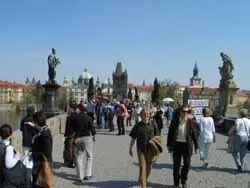
Charles Bridge in Prague to be restored over 10 years
In July of this year, it is planned to begin repairs on the famous Charles Bridge in Prague. Restoration work on the architectural monument of the Czech capital will commence after festivities marking the 650th anniversary of the start of its construction.
The bridge will receive new waterproofing, an improved ventilation system, and gas lighting. The pavement and stone railings will be restored. It is expected that the reconstruction of the bridge deck will take about a year and a half, and the stone part up to ten years. Each section of the railings will be carefully examined by specialists who will determine whether it can be preserved and cleaned or requires complete replacement. All work on Charles Bridge will be carried out gradually to maintain the possibility of movement across it. Total costs are expected to exceed 100 million crowns (more than $4.8 million).
Recall that the stone bridge over the Vltava River was laid by Charles IV on July 9, 1357. Initially it was called the Prague Bridge, but in 1870 it was named after its founder. Currently, Charles Bridge, which features 30 sculptures, is a unique work of medieval art.
Illegals promised permanent residency for assisting police
The Czech Foreign Ministry has prepared a new program to combat illegal migration. Illegal refugees who have used the services of a smuggler across the border will not be prosecuted if they report the smuggler to the police.
Currently, caught illegals face deportation from the country. In the future, if they provide the smuggler's name, they will become participants in a special program leading to permanent residency in the Czech Republic. A similar project already protects people who have been victims of international abductions.
Toys banned on Ukrainian planes
The Ukrainian government has approved new rules for baggage transportation on planes. Passengers are prohibited from bringing into the cabin sharp and cutting objects: manicure scissors and files, syringe needles, knitting needles, table knives, corkscrews. In addition, the list includes toy weapons and lighters in the shape of pistols. Passengers must check such items in their luggage.
All types of electroshock devices are prohibited on board aircraft, except for medical resuscitation equipment. Passengers are not allowed to bring signal and illumination flares, landing flares, blaster matches, firecrackers, sparklers, fireworks, and other pyrotechnic products. Compressed and liquefied gases are also not permitted on board, except those used by medical teams for emergency care. Passengers are forbidden from carrying flammable solid items - phosphorus and nitrocellulose.
Firearms can be transported in luggage, but only with a special permit; taking them into the cabin is strictly prohibited.
Fingerprints to appear in German passports
Starting November 1, 2007, German citizens will be required to provide not only biometric photos but also fingerprints to obtain a foreign passport. By passing the corresponding law, the Bundestag implemented the EU directive on introducing uniform biometric passports.
The bill was the subject of disputes between the ruling factions for a long time. Coalition partners could not agree on whether biometric data would be accessible to law enforcement and transport police. The conservative CDU and CSU insisted on this. They also demanded that the home addresses of applicants be stored in the database.
The Social Democrats believed that biometric data could only be used for its direct purpose - during border control. In the end, the parties agreed that police could use the online database in emergency cases. During the working hours of the agencies responsible for collecting and storing biometric data, law enforcement must submit a request there.
German citizens will be able to use passports issued before November 1 until their expiration date.
Smoking to be banned on European railways
Representatives of the Austrian Federal Railways (OBB) made an official statement that from September 1, 2007, smoking will be completely banned on all trains operating within the country. The main reason for the innovation is passenger wishes. Additionally, giving up cigarettes on railways is a tribute to European fashion. In Switzerland and Italy, for example, smoking has been banned on trains and electric trains for 10 years.
A recent survey showed that 93% of respondents were against smoking on trains, and 81% approved the idea of banning smoking in dining cars. Two-thirds of respondents in neighboring Germany also supported the new rules.
From the point of view of optimizing passenger transportation, the existing practice of selling tickets for special smoking cars has not justified itself, as such cars are often empty and rarely booked by customers. It seems that the fashion for giving up smoking is erasing all borders. According to preliminary information, by September of this year, Germany also plans to introduce a ban on smoking in trains.
Europeans support smoking ban in restaurants
A majority of German residents support a smoking ban in restaurants. This proposal was supported by 74% of participants in a representative survey conducted on behalf of the European Commission. The idea of banishing smokers from beer halls and bars received approval from only half of German respondents (52%).
According to the results of a pan-European study conducted in all EU member states as well as in Croatia, the vast majority of residents in these countries also support a ban on smoking in restaurants, but opinions on bars, cafes, and pubs were divided. More than half of the survey participants in Austria, Czech Republic, Netherlands, and Denmark opposed it. The study also found that in Germany, 30% of residents aged 15 and over consider themselves smokers.
Thailand bans carrying liquids in hand luggage
Thailand will become the next country to ban air passengers from carrying liquids and beverages in hand luggage as of June 1. The rules coming into effect on the first day of summer will be similar to regulations in force in the European Union, North America, China, Japan, South Korea, Taiwan, Singapore, Malaysia, Australia, New Zealand, Egypt, Brazil, and some other countries.
These regulations prohibit carrying any liquids, beverages, gels, and creams in containers larger than 100 ml, except for necessary medications and baby food during the flight. Liquids up to 100 ml must be presented for inspection in a separate transparent resealable bag. Such measures will apply to international flights. Liquids and beverages from Duty Free shops can be taken onto the plane.
Civil unions in Belgium equated to legal marriages
Officially unregistered but cohabiting couples in civil unions in Belgium have obtained the same inheritance rights as legally married spouses, local media report.
The new law prohibits the transfer of inheritance to relatives of the deceased if the civil partner is alive. In the event of the death of one partner in a childless couple, his or her movable and immovable property will go to the other partner, even if the deceased's parents are alive. In this case, a will in favor of the spouse is not required.
Children born in a civil union must be fully supported by the spouse who received the inheritance, even if he or she is not the biological father or mother. The partner is also obliged to take care of the deceased's parents. Before the new law, in the absence of a will, they received half of the inheritance.
Previously, cohabiting couples could become full owners of inheritance only if there was a deed of gift or a will. But even then, they could only count on part of the property and had to pay high taxes for the right to inherit.