
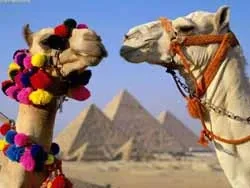
Egyptian pyramids will not be a wonder of the world
The Pyramids of Giza have been removed from the list of the "New Seven Wonders of the World," an Internet contest conceived by Swiss-Canadian filmmaker Bernard Weber. This was done at the request of Egyptian authorities, who were outraged by the project itself. "The pyramids are the only surviving ancient wonder, they do not need any voting, it's simply ridiculous," said Zahi Hawass, head of the Supreme Council of Antiquities, according to France Presse.
Weber's contest, supported by UNESCO, was conceived in 2004. Its final will take place on July 7, 2007. The shortlist, formed in autumn 2006, included 21 candidates, but after Egypt's protest, the pyramids disappeared from it. Weber tried to find a compromise and proposed calling the pyramids an "honorary candidate for the title of the new seven wonders," but even this wording was considered offensive in Cairo.
The original list of seven wonders was compiled by the ancient Greek historian Herodotus. It included the Lighthouse of Alexandria, the Colossus of Rhodes, the Temple of Artemis at Ephesus, the Statue of Zeus at Olympia, the Hanging Gardens of Babylon, the Mausoleum at Halicarnassus, and the Egyptian pyramids. Bernard Weber invited Internet users to compile their own list. Among the candidates are the Great Wall of China, the Taj Mahal, St. Basil's Cathedral, the statues of Easter Island, and others.
Australia may tighten migration legislation
Australian Prime Minister John Howard said that immigrants infected with HIV should not be allowed into the country, AP reports. He also said that the government is studying the possibility of tightening existing migration legislation. Howard's statements caused outrage among HIV-infected people and AIDS specialists, who accused the head of state of xenophobia and disrespect for those suffering from the disease.
The prime minister expressed his views on the need to ban entry for infected migrants and refugees in Melbourne during a radio interview, adding that exceptions could be made in individual cases. The discussion was sparked by a statement from the Victorian Minister of Health that out of 334 HIV-infected people registered in 2006, 70 were immigrants.
A representative of a non-governmental AIDS organization, in turn, said that migrants are already tested for HIV infection, and if it is detected, they are denied entry on the grounds that they are a burden to the public health system. According to infectious disease specialist Chris Lemoh, denying a person the right to enter because of health problems is "immoral" and "unethical."
Meanwhile, restrictions regarding HIV-infected people exist in the migration legislation of many countries, including the United States. Australia already has a ban on entry for people with tuberculosis.
25 million people worldwide have internally displaced status
The number of internally displaced persons at the end of 2006 was 25 million worldwide, the UN News Centre reported. According to a report by the Norwegian Refugee Council, a partner of the UN Refugee Agency, the problem of internal displacement exists in 50 countries worldwide, but the sharp increase in their numbers last year is primarily linked to crises in Africa and Iraq. The sad world leadership in the number of displaced persons belongs to Sudan, Colombia, and Iraq.
For example, in Iraq, every eighth resident was forced to leave their homes to save their lives. Nearly 2 million people became internally displaced, and more than 2 million fled to neighboring countries. Every month, between 40,000 and 50,000 people become internally displaced in this country.
The authors of the report draw attention to the fact that forced internal migrants are one of the most vulnerable and defenseless categories of the population. Their own states are not always willing or able to provide them with security guarantees. In some conflict zones, authorities themselves or with the involvement of armed groups commit acts of violence against displaced persons, attack their camps, loot, and treat them roughly.
The report emphasizes that in Somalia, Iraq, and Sudan, humanitarian agencies have limited or no access to internally displaced persons, which exacerbates the catastrophe.
EU countries adopt plan to combat racism
As part of ongoing six-year negotiations among EU member states aimed at combating racism and intolerance, an agreement was reached to establish minimum standards subject to approval by national parliaments.
According to the plan, EU governments must impose criminal sanctions on individuals or groups who 'publicly incite violence or hatred' on the basis of race, religion, ethnicity, or nationality. As reported by the Associated Press, European states are proposed to set a three-year prison term for denial of genocide (particularly the murder of Jews by Nazis during World War II and the destruction of the population of Rwanda in the 1990s). This rule applies only to cases of genocide recognized as such by the International Criminal Court.
An anti-racist group uniting 600 non-governmental organizations in the relevant field called the adopted plan weak and stated that 'there are many reservations that allow member states to avoid fulfilling their obligations.' However, reaching even such an agreement was not easy - for example, in Germany, France, Spain, Austria, and Belgium, Holocaust denial is already banned, while in Denmark, under the law on freedom of expression, the publication of literature inciting intolerance is permitted.
Turkey allows mortgages for foreigners
Turkish banks have started offering mortgage loans to foreigners for the purchase of housing in the country, reports the website «Prian.ru». The registration of such loans became possible thanks to the adoption of the Turkish mortgage law on March 6.
Loan rates are 7.8% per annum for loans in euros and 8.4% per annum for loans in US dollars. The loan term ranges from 3 months to 10 years. To apply for a loan, it is necessary to conclude a contract for the purchase of housing with the seller, as well as obtain a residence permit by presenting this contract to the police along with a copy of the document certifying the seller's rights to the housing. In addition, to buy a house or apartment, a technical passport of the building (the so-called «iskan»), a tax identification number of the borrower (which can be obtained from the tax office) and a certificate of income with a copy of the borrower's passport are required.
A square meter of a new building in Antalya or Alanya costs from €800 to €1,000. Currently, for €80,000 you can buy an apartment in Turkey with an area of about 100 sq. m on the first or second line from the sea. However, after the mortgage law came into force, housing prices began to rise.
Belarusian Duty Free faces liquidation
The administration of the Belarusian president is considering a draft decree that would liquidate almost all duty-free shops operating in the country, reports «Belarusian News» citing a source close to the government of the republic.
According to the document, it is proposed to leave only two duty-free outlets on the territory of the country: at Minsk-2 airport and another one for servicing diplomatic missions. Currently, there are more than 50 such stores in Belarus.
Thus, the Belarusian authorities intend to combat illegal supplies of alcohol, which, according to the State Control Committee, flows in significant volumes from duty-free shops to the domestic market. The publication recalls that plans to close duty-free outlets became known as early as the end of 2005, but, the source notes, 'the alcohol lobby of duty-free trade seems to have been so strong' that these stores are still operating in the republic.
China introduces restrictions for airline passengers
China has become another country imposing restrictions on carrying liquids and beverages in carry-on luggage of airline passengers. From May 1, the same rules will apply here as in the European Union, USA, Canada, Japan, South Korea, Taiwan, Australia, New Zealand, Egypt, Brazil, and some others.
These rules imply a ban on carrying any liquids, beverages, gels, creams, etc. in carry-on luggage. Exceptions are baby food (provided the passenger tastes it), necessary in-flight medications with a prescription, small volumes of other liquids in containers no larger than 100 ml, placed in a re-sealable transparent bag. These rules also apply to connecting passengers. The restrictions do not apply to liquids and beverages purchased at Duty Free shops in the departure area of the same airport.
These measures were first introduced in Europe and North America after British intelligence agencies announced in August of last year that they had uncovered a plot to blow up planes in mid-air using a liquid explosive mixture. Initially, carry-on luggage was virtually completely banned in the UK, but then the rules were relaxed. Moreover, opinions are now being voiced in Europe that the new rules have not increased security but have caused enormous inconvenience and financial losses for passengers, whose various drinks, including expensive ones, and perfumes are confiscated.
Czech President calls not to replace the crown with the euro
Czech President Vaclav Klaus has called for a referendum in the country on the issue of switching to the single European currency, AFP reports.
According to Klaus, the Czech Republic's entry into the eurozone should only occur if a majority of citizens vote in a referendum in favor of abandoning the national currency, the crown. In an article written by Klaus, published by several Czech media outlets, he says: 'Any national currency is an important symbol of statehood. Only the citizens of a country can decide whether they are ready to give up this symbol or not.'
The conditions of the Czech Republic's accession to the European Union, of which the country became a member in May 2004, provide for the transition to the single European currency, but do not clearly specify when this should happen. Earlier in April 2007, Czech Prime Minister Mirek Topolanek announced that the government had prepared and approved a plan for the country's transition to the euro, but has not yet set a specific date after which the crown would be withdrawn from circulation. According to the prime minister, the question of the timing of the euro transition will be decided after parliament approves the bill on taxation and budget expenditures submitted to deputies. The Czech Ministry of Finance, in turn, cites 2012 as a likely date for the country's transition to the euro.