
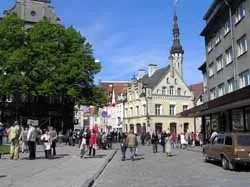
Tallinn Waits for Tourists at the Old Town Days
"Esteemed citizens, worthy masters" – under this motto, from May 28 to June 3, the traditional Old Town Days will be held in Tallinn. "This year we expect that, along with tourists, city residents will also take a very active part in the festivities, and therefore the city intends to put its residents at the forefront," said the mayor of the Estonian capital, Jüri Ratas.
The Old Town Days are one of the oldest traditions in Tallinn and open the summer season. The international theater festival Tallinn Teater Treff will also take place within the framework of the Days. Traditionally, during the Old Town Days in Tallinn, numerous concerts, conferences, museum days, and master classes will be held. The Old Town Days have been held in Tallinn since 1982.
Number of Foreign Specialists Increases in the Czech Republic
The project of the Czech Ministry of Labor to invite qualified foreign specialists to the country has already attracted 578 people. In exchange for their knowledge, skills, and talents, the Czech Republic offers the opportunity to obtain permanent resident status in 2.5 years (half the usual time).
The project to invite specialists started in 2003. The country's authorities hope to refine their immigration policy through it. Initially, only residents of three countries could participate in the project, but now the list has been expanded to eleven.
The first foreigners to take part in this program have already received permanent resident status. According to the Ministry of Labor, out of 578 people who received invitations, 79 are involved in information technology, 62 have technical professions, and 37 work in healthcare. Participants' families also came to the country and can also apply for permanent resident status. Among them are 313 spouses and 372 children. The largest number of participants comes from Bulgaria – 176 people, but this number will not increase, as the country has joined the European Union and its residents can now work in the Czech Republic without restrictions, reports The Czech Walker.
Incidentally, the number of legally working foreigners in the Czech Republic has also noticeably increased. At the end of February, there were 187,973 people, which is 40,000 more than a year ago. Among them, citizens of Slovakia (90,522) and Ukraine (46,596) lead. These data were published on the website Novinky.cz, citing a statistical report from the Ministry of Labor. 59,945 foreigners have work permits; the rest do not need them, as they are citizens of EU countries.
UK to Check Foreign Students
Foreign students wishing to work in British laboratories that have access to materials that could be used as biological weapons will have to undergo additional checks. These measures are aimed at preventing the transfer of new technologies to terrorist groups.
Currently, the Ministry of Foreign Affairs has warned universities about suspicions regarding students from non-EU countries. In a statement, the Foreign Office emphasizes that educational institutions should not deny foreign graduate students the opportunity to conduct scientific work. It is only about verification.
The student screening system was first revised after suspicions arose in 2002 that Iraqi students studying at Oxford were trying to create antibiotic-resistant bacteriological weapons. They were arrested and sent home.
Home Schooling Allowed for High School Students in the Czech Republic
The Czech Ministry of Education plans to allow home schooling for high school students starting September 2007. Until now, parents could only educate their children independently up to the fifth grade.
The Ministry believed that not everyone is capable of teaching subjects such as physics, chemistry, and foreign languages to their children competently. The main argument of parents was that they could hire the necessary teachers. This will become possible in the fall. The Ministry will test the new system for four years.
Home schooling in the Czech Republic has existed for 9 years. Currently, more than 300 children receive this form of education. An application for alternative education is submitted to any school, and the decision on permission is made by the principal. The student must take exams once every six months.
Dominican Republic and Puerto Rico – Most Popular in the Caribbean
The World Tourism Organization has named the Dominican Republic and Puerto Rico as the most popular holiday destinations in the Caribbean. Of the 19.5 million tourists who visited the Caribbean last year, the Dominican Republic received nearly 4 million people, which was the highest percentage compared to other countries in the region.
President of the Republic Leonel Fernández stated that 2006 was a turning point for the country in terms of tourism development. He reported that total investment in this sector exceeded $650 million, which allowed for the implementation of various projects to restore and update tourist zones and build more than 5 million hotel rooms. In 2007-2008, $250 million will be allocated for further development of tourism infrastructure.
Among the most important projects planned for the current year, the country mentions the completion of the Santo Domingo - Samaná highway construction, as well as the creation of its own airline, Air Dominicana. Initial investment in the aviation project will be $10 million, which will allow passenger air transportation to begin in 2008 with the first four aircraft.
China May Ban Dishes Made from Snakes and Shark Fins
As part of preparations for the 2008 Olympics, China may exclude from the menu dishes made from shark fins, which are often served at official receptions in this country.
One of the deputies of the National People's Congress, Xu Zhihong, came up with such an initiative. In his opinion, dishes that use wild fauna can "cause serious irritation among foreign visitors, especially supporters of the animal rights movement." "This is not just an environmental issue. This problem directly concerns the image of the Chinese people," the deputy said.
Irish Have Outdrunk the Entire European Union
According to the European Union, one in five Europeans aged 15 to 24 drinks heavily. The heaviest drinkers are residents of Ireland, Britain, Finland, and Denmark.
In a survey conducted in October-November last year, experts interviewed 28,500 people from 27 European countries, including Croatia and northern Cyprus. And 19% of European citizens admitted that they often drink up to five servings of alcohol - "drinks" - in one go. One "drink," according to various sources, equals 35-50 ml of vodka, a glass of dry wine, or a half-liter mug of beer. According to European experts, such a daily dose of alcohol is already reason to talk about systematic drunkenness.
The most inveterate drunkards in the European Union should be considered the Irish, as 34% of this country's citizens meet or exceed the norm of five "drinks." Following them, the biggest alcoholics are Finns (27%), Britons (24%), and Danes (23%). The most abstemious can now be called Italians and Greeks: in both countries, only 2% are such lovers of alcohol products.
European experts particularly emphasized that one might get the impression that Europe drinks quite moderately, since the majority (59%) drink no more than 1-2 mugs of beer or glasses of wine per day. However, 10% (55 million) Europeans drink too much. And most alcoholics are among people under 24 years old. So the consequences for Europe could be the most deplorable.
Adult Europeans are trying to find a way out of the crisis. For example, 77% of Europeans propose adding warnings about the harms of alcohol to alcoholic beverages. 76% talk about reducing alcohol advertising aimed at youth, and 73% about laws lowering the permissible blood alcohol level for drivers. According to statistics, about 200,000 people die annually from alcoholism in Europe.
EU Preparing Unified Fingerprint Database
A bill has been presented in the European Union to create a centralized fingerprint database that will collect information on all EU citizens convicted of crimes, as well as those accused or suspected of committing them. According to The Times, this large-scale project, affecting all 27 countries of a united Europe, was created as part of a campaign to counter the terrorist threat.
UK law enforcement agencies have already announced that they are ready to transfer all the fingerprint information they have to a single data bank. If the bill is approved, its creation should be completed by the end of 2008.
British authorities were among the first in the EU to introduce fingerprinting as a measure not only to prevent terrorist attacks but also to control migration. In particular, in the UK, all foreigners residing on its territory must submit fingerprints. In addition, British lawmakers intend to introduce mandatory fingerprinting for all entering the country.
However, not all EU countries, whose representatives sit in the European Parliament, share such initiatives. They argue that creating such a fingerprint database is one of the "attributes of a superstate" that encroaches on the national diversity of the European Union and contradicts the principles of a confederal structure. Moreover, in their opinion, "mass fingerprinting" will jeopardize the observance of civil liberties of EU residents. There is also a contradiction regarding the right of "third" countries, particularly the USA, to access the database in the framework of the fight against terrorism.