
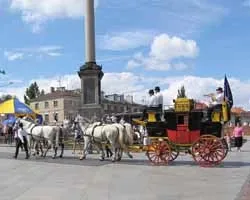
New Information Center Opened in Warsaw
A new tourist information point, InfoPraga, has opened in Warsaw. It got its name from the district where it is located - Praga. This information center is currently the only one on the right bank of the Vistula. The project's authors hope that the innovation will help make the district attractive to tourists and introduce them to its sights.
According to Turinfo.pl, Warsaw's Praga is known as the most dangerous district of the city - due to the large number of fraudsters and dark, unsafe alleyways. But it is here that unique Warsaw architecture and something of the pre-war life of Varsovians have been preserved. Here you can meet masters of such rare professions nowadays as blacksmiths or tailors.
Praga is a district of Warsaw located in the east of the city. It is divided into two parts: Praga South and Praga North. It covers territories that were only annexed to Warsaw in 1916. The name has nothing to do with the Czech capital: it comes from the Polish verb 'prazyc' (prażyć), meaning 'to burn'. There is a joke that Warsaw's Praga is a double deception, like a guinea pig - it's neither a city nor in the Czech Republic.
UK Raises Consular Fee for Visas
The British have announced a rise in fees for visa processing and other immigration charges for foreign nationals. The price increase will primarily affect those who try to legally come to the United Kingdom for 'financial gain', that is, those who want to obtain a work visa or indefinite leave to remain.
For a regular tourist visa, you will have to pay 63 pounds sterling instead of the previous 50. A student visa will cost 99 pounds, a work visa 200 pounds sterling (previously a fee of 85 pounds was charged for these types of visas).
Extending a work visa at the UK Home Office will now cost between 350 and 550 pounds sterling, obtaining indefinite leave to remain from 750 to 950 pounds. Previously, the maximum amount for these services was 500 pounds (with same-day processing). The UK Home Office certificate approving the right to marry or enter into a civil partnership for foreigners in the UK has increased from 135 to 295 pounds sterling.
'We think it is fair to charge more money from those who benefit the most from using our immigration system, that is, those who come here to live and work,' said British Immigration Minister Liam Byrne. It is planned that the additional funds will be directed to 'funding a firm and fair immigration system aimed at eradicating illegal employment, organized crime, extremism, and terrorism.'
The UK Foreign Office also raises rates for consular services from April 1, in particular passport issuance and document legalization for British nationals living abroad.
Jordan Tightens Entry for Young Women
According to preliminary information, changes to entry rules for Jordan have been in effect since March 1, 2007. The tightening of the visa regime has affected women under 40 who are citizens of Ukraine, Russia, Belarus, Armenia, Estonia, as well as Bulgaria and Romania. Moldova is also mentioned in the list, but citizens of that country have long been unable to obtain a visa to Jordan without prior approval from the kingdom's Ministry of Interior, regardless of gender.
For male citizens of the listed countries, the rules have not changed: visas are still issued without problems at Jordanian consulates or upon arrival at any border crossing.
Female citizens of the listed countries who have reached the age of 40 or are traveling with a brother or husband (apparently, they must have the same surname or a notarized translation of the marriage certificate into English) can still obtain a visa at the border, as before. All others must apply for visas in advance, reports Jordan club. There is also a possibility that the decision to issue a visa will be made not by the consular department of the embassy, but by officials of the Jordanian Ministry of Interior in Amman. Quick visa acquisition under this procedure will become virtually impossible. Women traveling to Jordan for tourism without male accompaniment are advised to contact travel companies and book hotels for the entire duration of their stay in the country.
Ukrposhta Introduces Money Transfer Exchange with Syria
On March 6, the Ukrainian state postal enterprise 'Ukrposhta' conducted a bilateral exchange of international postal money transfers with Syria. Syria became the 17th country with which clients of the Ukrainian operator can carry out such a money transfer.
International postal money transfers coming to Ukraine are paid out in national currency. Money transfers are delivered to the recipient's place of residence (transfers to company accounts are not accepted). The amount of a transfer from one person from Ukraine to Syria cannot exceed the hryvnia equivalent of $600 per month. The fee for the transfer is charged depending on its amount: for transfers up to 500 hryvnia - 6%, 500-1,000 hryvnia - 5%, over 1,000 hryvnia - 4%. The minimum fee for a transfer is $1.
Earlier, Ukrposhta introduced such operations with Estonia, Belarus, Latvia, Russia, Kazakhstan, Azerbaijan, Moldova, Armenia, and Portugal. The National Bank of Ukraine issued a general license for foreign exchange operations to Ukrposhta in December 2005.
European Commission Updates Blacklist of Airlines
The European Commission has updated the list of airlines whose aircraft are banned from flying in EU airspace as of March 7.
When compiling the updated list, European Commission experts paid special attention to the technical condition of aircraft. In particular, the Pakistani carrier Pakistan International Airlines, which actively uses outdated aircraft models, was sharply criticized. According to experts, many airlines whose fleets include old Boeing and Airbus airliners cannot ensure an adequate level of aircraft maintenance. The European Commission allowed Pakistani aviators to operate Boeing-777 aircraft to the UK, Germany, France, Italy and the Netherlands, indicating that this would guarantee regular, high-quality maintenance of the aircraft.
Also blacklisted were five Bulgarian and nine Russian air carriers, including the corporate airlines of Gazprom and Lukoil. The relevant authorities of both countries imposed a ban on flights of these airlines after European Commission experts discussed the safety issue.
The Europeans noted safety problems with African and Asian airlines, including 11 Kyrgyz ones. At the same time, the European Commission removed 49 airlines from the previous list because they had addressed the deficiencies previously identified by EU experts.
The unified blacklist was first compiled at the end of 2005 after a series of accidents in which EU citizens also suffered. It is regularly updated to help improve safety standards in air transportation. Previously, air carriers whose flights and landings were banned at airports in one EU country would fly to another EU country where less strict rules applied.
Czech Republic No Longer Interested in Ukrainian Migrant Workers
The Czech government does not intend to conclude another agreement on the employment of Ukrainian citizens. According to experts, such an agreement could help resolve the issue of illegal employment of Ukrainians in the Czech Republic.
However, according to Deputy Minister of Labor Marian Gošek, the Czech Republic will try to resolve this issue by issuing work permits only for certain in-demand professions. The Ministry of Labor is preparing a bill under which so-called 'clients' (illegal employers) will lose the opportunity to act as intermediaries in the employment of Ukrainians.
Today, 150,000 Ukrainians live in the Czech Republic. Of these, 48,000 do not have residence permits.
Ontario Wants to Accept Even More Immigrants
Official authorities of Canada's largest province have joined the demands of Toronto lawyers to increase the number of immigrants accepted annually into Canada from 250,000 to 350,000. This, in their view, should help reduce waiting times for decisions, including for relatives wishing to reunite with their families.
Currently, more than 800,000 cases are under review, and according to Ontario Minister of Citizenship and Immigration Mike Colle, a critical situation has developed. 'We would like to contribute to the case processing, but that requires federal subsidies because the available workforce is aging. Canada is a very attractive destination for immigrants, but the excessively long waiting times simply deter many.'
Ontario receives about 140,000 immigrants annually.