
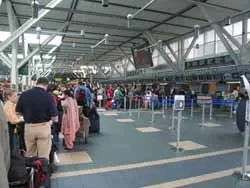
US airlines have become more likely to be late and lose luggage
The past year was the most problematic for American airline passengers in recent times. In addition to the numerous inconveniences caused by the ban on carrying liquids onto planes, airlines have become more likely to delay flights and lose luggage. In 2006, the rate of passengers whose luggage was delayed or lost in the US was 6.7 per thousand – the worst figure since 1990. Flight schedule adherence was the worst in seven years, with regional carrier Atlantic Southeast only arriving on time for two-thirds of its flights. An increase was also noted in the number of passengers denied boarding due to overbooking.
Fingerprints required for Czech visa
In the future, applicants for Czech visas will be required to appear in person at the consulate, where a diplomatic mission employee will photograph them and take their fingerprints. This measure concerns citizens of countries that have a visa regime with the Czech Republic and the Schengen Agreement states.
The project will be implemented gradually and in parallel with the Czech Republic's accession to the EU's electronic visa issuance system, in which the use of biometric data is mandatory. All Czech consular offices will be appropriately retrofitted, according to a Foreign Ministry statement.
At the end of February, the government will decide on the financial aspect of the issue. According to the republic's Interior Ministry calculations, the nationwide introduction of the electronic system will cost approximately 700 million Czech crowns (?25 million).
As reported by the Czech Ministry of Foreign Affairs, the biometric data collection procedure will begin in August 2008 at North African diplomatic missions. The Czech electronic visa system, as well as its counterparts in other Schengen Agreement countries, will be connected to a single database that can be used, for example, at passport control points or consulates. The database will make it possible to check the so-called "visa history" – where and when a visa was issued or why it was refused.
Voice of America leaves Russian radio airwaves
Major changes in the operation of the Voice of America radio station may occur in the 2008 fiscal year. Among other things, it is planned to cease broadcasting in Russian.
According to the U.S. Broadcasting Board of Governors, the president's budget proposal for 2008 includes an increase in spending on international broadcasting. However, Voice of America will change its priorities: it will work more actively in Cuba, North Korea, Venezuela, and for Muslim listeners.
At the same time, there will be cuts that will affect many programs in English, as well as in 12 other languages. Among other things, broadcasting in Georgian and Uzbek is planned to be abolished, and restrictions may also affect programs in Ukrainian. If the proposal is approved, radio programs in Russian will cease to air.
British Airways to charge for extra bag
British Airways is introducing an additional fee for carrying more than one piece of baggage. Moreover, it is not about excess weight: even if the total weight of an economy class passenger's baggage does not exceed the established limit, but there are two or more pieces of baggage.
In other words, British Airways is willing to carry only one suitcase or bag free of charge in economy class. The new rules take effect on February 13. Passengers on long-haul flights will have to pay £120 ($235) for each additional piece of baggage for a one-way flight. On European flights, a second suitcase will cost £60, on domestic British flights - £30. Sports equipment can be checked in free of charge.
The new rules do not yet apply to flights to the US, Canada, Mexico, Nigeria, and the Caribbean. Additionally, discounts are given to those who pay for extra pieces online.
Analysts believe that the airline is thus covering its rising costs without significantly increasing ticket prices. Additionally, British Airways needs funds to move to the new Terminal 5 at London's Heathrow Airport.
Obviously, the first victims of the new rules will be pensioners and indeed anyone who prefers a couple of lighter suitcases to one heavy one. However, British Airways is not the trendsetter for paid baggage. The budget airline Ryanair, for instance, charges for luggage.
6 out of 100 Italians have no money for food
About 6% of Italians admitted they have no money for food, representatives of the Center for the Fight for Citizens' Rights told journalists. According to the results of a study conducted by this organization's experts, the traditional Italian lunch, usually consisting of four courses excluding wine, has recently been reduced to a "single course" even for an average-income resident.
This, according to the authors of the study, is due to the need to save money, as the cost of apartment rent and utilities is constantly rising. Center representatives consider this situation unacceptable and urge the government to immediately solve this problem. "Instead of raising taxes, it is necessary to listen to the people," their appeal to the government states.
Greece tightens traffic rules
In an effort to curb road fatalities, Greek authorities have sharply tightened traffic rules. Greece ranks among the lowest of the 25 EU countries in road safety. Every year, about 1,500 people die on the country's roads, and more than 20,000 are injured.
The new rules sharply increase fines for various violations, in some cases several times over. For example, a driver who runs a red light will have to pay €700 — twice as much as before. The same fine amount is set for a number of violations, including such seemingly unusual ones as driving in reverse on high-speed highways, which drivers who miss their exit on the autobahn occasionally do. Fines for overtaking on the right and other dangerous maneuvers on the road will also rise to several hundred euros. Passive road safety will also be very strictly controlled. Fines for motorcyclists riding without helmets and for unbuckled seat belts of passengers have been raised to €300.
The new rules are especially strict with drunk drivers. The minimum fine for exceeding the permitted alcohol limit will rise to €1,200, and the maximum penalty for driving under the influence will be six months in prison and a five-year license suspension.
A new rule allowing drivers to accelerate on highways to 130 km/h (previously 120 km/h) will sweeten the pill. In addition, mandatory court hearings for minor and moderate violations have been abolished. This means that offenders, having paid triple the usual fine for their offense, will avoid lengthy court proceedings and a criminal record.
Beijing restaurants may restrict smoking
Beijing authorities are taking the first steps toward banning smoking in public places, despite China being recognized as one of the most smoking-prone countries in the world (the country has 350 million smokers).
The Beijing Health Bureau has sent more than 40,000 letters to public catering establishments in the capital, asking them to restrict or ban smoking by customers. Currently, such restrictions are only found in some five-star hotels in Beijing. In other public places, smokers feel free. However, ahead of the Olympics, Chinese authorities plan to fight smoking.