
World weather turned upside down
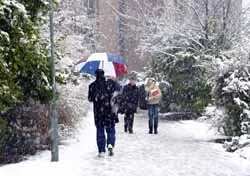
Over the past two weeks, all climate records have been broken in Europe. According to scientists, the past autumn was the warmest in several centuries.
The Royal Netherlands Meteorological Institute reported that autumn with an average temperature of +13.5 degrees was the mildest in the last three centuries. In the UK, such autumn temperatures have not been seen since 1659, when the country began recording meteorological data. The average autumn temperature there was +12.6, and the previous record of +11.8 was set in 1730-1731. For Germany, this autumn was the warmest since 1901. The average temperature in September-November was +12, which is 3-4 degrees higher than at the beginning of the 20th century. In eastern Spain, thermometers rose to +26, and in northern Italy to +16 degrees. And there, such temperatures have not been recorded since the beginning of the 20th century.
Most new EU members not yet ready to adopt euro
Of the ten new EU member states that joined the regional organization in May 2004, only Slovenia is ready to join the eurozone so far, and it will enter the so-called "eurogroup" on January 1, 2007. This conclusion was reached by the European Commission and the European Central Bank (ECB), which released data from a special expert report.
It says, in particular, that the Czech Republic, Estonia, Cyprus, Latvia, Hungary, Malta, Poland, Slovakia, as well as Sweden, which is on the list of "veteran EU countries," "have made progress in terms of convergence but are moving at different paces." Among the new EU members, Cyprus has good chances of joining the eurozone in 2008. Lithuania was denied the transition to the euro from January 2007 by the European Commission and the ECB in May of this year due to high inflation. Candidate countries for eurozone accession need to have stable prices, improve public finances, stabilize the exchange rate of the national currency and the level of interest rates over the long term, and harmonize monetary and financial legislation in accordance with EU requirements.
Recall that the eurozone currently includes 12 EU countries: Austria, Belgium, Germany, Greece, the Netherlands, Ireland, Spain, Italy, Luxembourg, Portugal, France, and Finland.
Those returning to Russia to be exempt from customs duties
People returning to Russia for permanent residence under the program to assist the resettlement of compatriots will be exempt from customs duties for three years. This is provided for in a draft government resolution developed by the Federal Customs Service of the Russian Federation (FCS).
"Setting a three-year period for importing personal property will help avoid evasion of customs payments and provide a real opportunity for resettlers and refugees to exercise the right to import property left in the country of departure," the draft says. In addition to participants in the state program for the return of compatriots from abroad, the benefits are expected to be extended to refugees and forced resettlers.
A car can be imported without paying duties if it was owned for at least one year before entering the territory of the Russian Federation. One car per resettler family is exempt from duties. In addition, the draft resolution says that Russian citizens will be able to import a car from former USSR countries without paying duties if it was in their ownership as of December 31, 1991.
As previously reported, the program of measures to assist the voluntary resettlement of compatriots in the Russian Federation was approved in June 2006. It is expected that the resettlement of compatriots to 12 pilot regions of Russia will begin in January 2007.
France to instill culture of alcohol consumption
Diseases caused by excessive alcohol consumption claim the lives of 45,000 residents of France every year. This information, provided by the Ministry of Health, was made public at a national conference in Paris that summed up two months of debate on the dangers of drunkenness and alcoholism.
As Health Minister Xavier Bertrand noted at the conference, mortality related to excessive alcohol consumption in France is 30% higher than the European Union average. According to the minister, the maximum allowable level of wine consumption - the most familiar alcoholic drink for the French - as determined by doctors, is three glasses a day for men and two for women. However, according to a survey by the Ministry of Health, more than half of French people ignore these norms or say they have not heard of their existence.
In this regard, conference participants proposed a number of measures aimed at reducing alcohol consumption. These include a ban on the sale of alcoholic cocktails in retail chains, a national "alcohol-free day," the creation of alcohol-free menus in cafes and restaurants, and even the abolition of the long-standing tradition in which winners of Formula 1 races and some other sporting competitions actively spray each other with champagne on the podium.
At the same time, members of the Economic Affairs Committee of the National Assembly (the lower house of parliament) prepared their own report, which proposes the implementation of "educational and training programs informing about the beneficial effects of moderate wine consumption." According to the authors of the report, "the cultivation of good habits and tastes should begin in childhood and become part of the general education system."
Smoking to be banned in public places in England
From July 2007, a complete ban on smoking in enclosed public places and workplaces will be introduced in England. This was announced by UK Health Secretary Patricia Hewitt.
This ban, according to the minister, will support the existing smoking restrictions in Scotland and Ireland. According to Patricia Hewitt, such a decision is a 'triumph of public health care for people.' 'Thanks to the introduction of this ban, thousands of lives will be saved, and the health of thousands more will be protected,' Hewitt said. 'This bill will prevent the deaths of people who die each year from passive inhalation of tobacco smoke and will provide greater public support to those who want to quit smoking.'
The smoking ban will not extend to public establishments located outdoors.
Quarter of New York residents speak English poorly
According to the US Census Bureau, 1.6 million out of 7.3 million New York residents over the age of five admit that they speak English poorly. That amounts to 22% of the city's total population.
In particular, in the largest immigrant community of the metropolis – Spanish-speaking people from Latin American countries (1.8 million people) – about 850,000 believe they speak the US state language poorly. There are 360,000 people from China, and only 128,000 of them know English. Of the 199,000 Russian speakers living in the largest US city, only 76,000 do not have a problem with the language, reports 'Echo of the Planet'.
This situation sharply contrasts with the data nationwide, where out of 268.1 million residents over the age of five, only 8.6% of the population has poor command of English.