
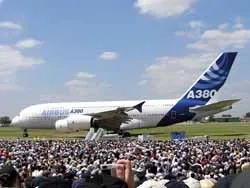
A-380 Tested in Round-the-World Flight
The world's largest passenger aircraft, the A-380 from the European concern Airbus, has completed a series of validation tests before certification, which is expected to take place in December. Last Thursday, the A-380 landed at the factory airfield in Toulouse, southern France, after a round-the-world flight with intermediate stops in Johannesburg, Sydney, and Vancouver, during which the airliner flew over the South and North Poles. In the standard version, the A-380 will be able to carry 555 passengers, and in an economy version, up to 840.
Consular Days of the German Embassy in Kharkiv
On December 12 and 13, 2006, consular days of the Embassy of the Federal Republic of Germany in Ukraine will be held in Kharkiv. Embassy staff will provide information on the following issues:
- conditions for obtaining visas to Germany (except for issuing visas and providing information on the rejection of visa applications, and information on the current processing of visa applications);
- new provisions regarding Jewish emigration;
- other general consular matters (citizenship issues, marriage between German and Ukrainian citizens, legalization of Ukrainian documents, certifications, consular certificates, etc.).
Appointments are accepted until 12:00 on December 8, 2006, by calling the German embassy in Kyiv during regular working hours: (044) 247-68-27. The consular days in Kharkiv will be held at the Nuremberg House at 51 Chernyshevskoho Street. Consultation is free.
Non-Citizens of Latvia and Estonia Will Be Able to Travel within the EU Without Visas
A completely visa-free regime for movement within the EU for non-citizens of Latvia and Estonia may be introduced as early as the end of January. This statement was made to the Latvian newspaper "Chas" by Latvian MEP Tatjana Ždanoka.
The bill to abolish visa restrictions for non-citizens of the EU will be approved by the European Parliament by December 11-14, and, subject to all protocol formalities, it may come into force as early as the 20s of January. Currently, non-citizens — permanent residents of the EU — do not have the right to visa-free movement within the EU. On the initiative of Tatjana Ždanoka, the European Parliament decided to revise these norms and equalize the right of non-citizens of Latvia and Estonia to visa-free border crossing with EU citizens.
Currently, about 400,000 non-citizens live in Latvia. Another 110,000 have acquired Latvian citizenship through naturalization.
New Rules for Importing Goods into the European Union
The European Union is increasing duty-free allowances for importing goods from abroad. Since these rules apply to individuals, they directly affect tourists.
The duty-free allowance for air and sea travel has been increased from €175 to €430 per person. For land travel, this allowance is €300. The new rules regulate duty-free imports from so-called third-world countries. Within the EU itself, the movement of goods by individuals is unrestricted. When crossing the EU border, all imported goods not intended for personal use must be declared. To avoid problems when exporting newly purchased goods from the EU to other countries, it is recommended to carry a cash receipt or other documents confirming the purchase.
Strict restrictions remain on the transport of tobacco from countries that recently joined the EU. Residents of Austria can only bring out 25 cigarettes from Slovakia, Slovenia, the Czech Republic, and Hungary. For citizens of other states, this limit is increased to 200 cigarettes, and the list of countries additionally includes Estonia, Lithuania, and Poland. // "Sluzhba Kontinentov".
Canada Recognizes "Quebec Nation"
The Parliament of Canada granted the French-speaking province of Quebec the status of "a nation within a united Canada." The bill was introduced by Prime Minister of the Conservative government of Canada, Stephen Harper.
The prime minister was quick to seize the initiative from the separatists of the "Quebec Bloc," who were planning to propose their own bill on the province's independence from Canada. "The time has come for national reconciliation," Harper said before the vote in parliament. However, a split occurred within the government itself. Minister of Intergovernmental Affairs Michael Chong resigned in protest against the parliament's recognition of "ethnic separatism." The Quebec Bloc announced its intention to seek the right for Quebec's independent representation on the international stage. In referendums in 1980 and 1995, Quebecers rejected the idea of independence from Canada.
Check and Collect Baggage in Sweden via Fingerprint
SAS airline is introducing a new baggage handling system for passengers in Sweden. Now travelers will place their finger on a special scanning device during check-in. The fingerprint will correspond to the checked baggage. Upon arrival at the destination airport, the same procedure will occur when collecting suitcases and bags.
Biometric baggage identification, it is claimed, practically eliminates the possibility of errors, speeds up the process, and enhances flight safety. The new technology will begin operating at SAS airline counters in December. After baggage collection, the fingerprint is erased from the computer memory. Passengers will have the option of using the old baggage check-in methods with tags as well.
The biometric system was developed by Precise Biometrics. SAS thus became the first airline to implement the method approved by the EU Aviation Safety Commission. It is expected that within a year, all airports in Sweden will be equipped with this system, and it will be used by all airlines on domestic flights. In December, baggage will be received and issued via fingerprint at six airports in the country; in January, five more will join. And during 2007, over 10 million passengers will use the new service.
New scanning system will strip passengers at airports
At the international airport Sky Harbor in Phoenix, Arizona, test operation of a new security system will soon begin. Specialists claim that it is much more effective at detecting concealed weapons, explosives, and other dangerous substances.
This development, called the backscatter method, has been discussed for several years, but it was not implemented in the United States due to possible human rights violations. The fact is that the system simply "undressed" a person, showing their naked body on the monitor screen. As the U.S. Transportation Security Administration (TSA) reports, they have now found a way to obtain an image without violating human rights. Some parts of the body will be deliberately blurred. The TSA assures that in the first phase, passengers will be offered a choice between the new and old screening systems.
In addition to the details of the human body, the method also reveals all jewelry and valuables on the passenger's body, which human rights advocates say is also unacceptable. To which the TSA stated that the monitor will only be located with the security officer and neither other passengers nor even the agent at the checkpoint will be able to look at it. Moreover, the image will be deleted after the passenger leaves the scanning area. The device will not be able to save, print, or transmit it.
Russian carriers raised prices due to the euro
Starting December 1, airfare prices from Russia abroad will be set in euros, not dollars, as has been the case until now. The change will affect both foreign and Russian companies that are members of the International Air Transport Association.
These include major carriers such as Aeroflot, S7 Airlines, and Rossiya. At the same time, Transaero, also a member of the association, intends to keep fares for international flights in rubles. Specialists predict that switching to euro calculations will increase ticket prices by about 6%.
Austrian Airlines resumed free meals on flights
Austrian Airlines has resumed free meals on European flights lasting between 66 and 150 minutes. They were canceled three years ago to save costs.
Prepared meal sets are served in special lunch boxes, the lid of which is a postcard. If desired, the passenger can send it to any address free of charge. The offered snacks are based on Austrian cuisine traditions – for breakfast it is usually muesli with yogurt and cold cuts, in the afternoon – meat salad and strudel. Drinks and bread are also given free of charge.
Infection brought on board the largest cruise ship
On board the world's largest cruise ship, Freedom of the Seas, there was a mass outbreak of gastric infection, the carrier of which, according to Reuters, was one of the passengers.
The ship returned to the port of Miami on December 3, after a week-long cruise in the Caribbean Sea. A total of 338 passengers and 46 crew members were affected by the infection. According to Reuters, all received medical assistance, and their condition is currently satisfactory.
Royal Caribbean's Freedom of the Seas is considered the largest cruise ship in the world. Its displacement is 160,000 tons. The ship has an ice rink, a boxing ring, and a pool with an artificial wave for surfing.