
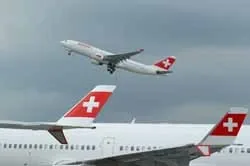
SWISS has published norms for transporting ski equipment
SWISS airline has published norms for transporting ski equipment on its flights. Each passenger is entitled to carry one set of equipment, consisting of one pair of skis, one pair of ski poles, and one pair of ski boots, or one snowboard and one pair of boots. Transporting a second set of equipment costs the same as three kilograms of excess baggage on flights with a weight-based baggage concept, or 33% of the fixed fare on transatlantic flights to North America. The third and subsequent sets of ski equipment are paid for according to the standard excess baggage rates.
Britons have spoken out for dividing their country
The United Kingdom of Great Britain and Northern Ireland should be divided into separate states, according to Britons. These are the results of a public opinion poll conducted by the sociological agency ICM for the newspaper The Sunday Telegraph among residents of England and Scotland.
In particular, 52% of respondents living in Scotland and 59% of those polled in England favored Scottish independence. Independence for England is supported by 48% of English and 58% of Scots.
The poll also showed that respondents (60% of English and 36% of Scots) are dissatisfied with the distribution of the country's budget expenditures, believing that per capita spending in Scotland is higher than in England. English dissatisfaction was also caused by the fact that Scottish members of parliament often vote on matters that concern "exclusively English affairs," while matters concerning Scotland's internal affairs are usually decided in Edinburgh. Furthermore, sociologists found that the English consider themselves British more often than the Scots.
The survey was conducted on the eve of the 300th anniversary of the signing of the Act of Union between England and Scotland, which will be celebrated in 2007. According to British analysts, Scottish independence will be the main focus of political games ahead of the elections to the Scottish Parliament in spring 2007. Independence is expected to be actively promoted by the Scottish National Party, while the nationwide parties—Labour, Conservative, and Liberal Democrats—will oppose it.
At the ongoing congress of the Scottish branch of the British Labour Party in Oban, Prime Minister Tony Blair and his most likely successor, Chancellor of the Exchequer Gordon Brown, sharply spoke out against Scottish independence. They reminded of the irreversible political and economic consequences of the possible disintegration of the country.
Scotland and England, after numerous wars in the Middle Ages, formally united under a single monarch in 1603, and finally formed the single state of Great Britain in 1707, when both national parliaments were dissolved and a new unified legislative body was created.
In 1997, a referendum was held on the re-establishment of the Scottish Parliament and the transfer of certain powers to the national authorities, particularly control over education, transport, and healthcare. The new Scottish Parliament has been in operation since 1999.
Latvia demobilized its last conscript soldier
A ceremonial event was held in Riga to mark the end of military service for the last "conscript" of the Latvian armed forces, which have fully transitioned to a contract basis. This is reported by Postimees, citing a correspondent of Estonian radio in Riga.
The salary of a contract soldier in the Latvian army will range from €500 (about 7,800 kroons) to €1,200 (18,800 kroons). Moreover, the Russian-speaking part of the republic's population will have no problems entering contract service, as unofficial bilingualism has been established in the Latvian army.
As is known, Latvian soldiers currently serve not only at home but also in various hotspots, for example, in Iraq and Afghanistan. The current strength of the Latvian army is about 5,000 people. The last draft was conducted in November 2005. From autumn 1991 to the end of November 2005, a total of 40,700 young people were called up for compulsory military service.
British universities to be paid for poor students
Higher education reform is being prepared in Great Britain. Universities that admit students from middle and poor backgrounds will receive as much state funding as elite universities that mainly conduct research, reports The Times.
According to David Eastwood, Chief Executive of the Higher Education Funding Council for England (Hefce), the main goal of the reform is to make universities that educate representatives of the middle class play a more active role in society.
Universities must show what they are capable of and provide a return on investment. At the same time, as Eastwood noted, they do not need to compete with elite universities in traditional research areas. They should focus on teaching and training specialists, contributing to the economic development of their regions.
Representatives of elite institutions, for their part, fear that equalizing funding with provincial universities will lead to an outflow of talented students and thus reduce the competitiveness of British educational and research centers.
According to The Times, currently almost a third (32%) of state funding is distributed among five universities: Oxford, Cambridge, the University of Manchester, Imperial College London, and University College London—among whose students there are practically no representatives of the middle class and poor layers.
The World Wide Web has entangled more than 1 billion people
For the first time, the number of Internet users in the world has exceeded 1 billion people. This data is contained in the report "On the Information Economy" compiled by the United Nations Conference on Trade and Development. According to the document, by the beginning of 2006, 1 billion 20 million 610 thousand people had access to the global network. Compared to the previous year, this figure increased by 19.5%. The top three countries in terms of the number of Internet users were the United States (about 200 million people), China (111 million), and Japan (85.29 million).
Russia is in 11th place in the world and first among Eastern European and CIS countries. In the Russian Federation, the number of worldwide web users at the end of 2005 was 21.8 million people, increasing by 17.8% over the year. Next come Ukraine (4.5 million people) and Belarus (3.39 million).
Seattle is the safest city in the United States
Americans consider Seattle the safest city in the United States. According to Washington ProFile, a Gallup poll showed that 80% of respondents hold this opinion.
Also in the top ten safest US cities were Atlanta, Boston, Dallas, Las Vegas, Minneapolis, San Francisco, Philadelphia, Houston, and Chicago. The capital of the country – Washington took only 13th place, New York was in 11th place. The last were Detroit and New Orleans. In general, Americans view the crime situation in the country optimistically: 61% of respondents do not think that the crime rate is very high, and 57% say that they are not afraid to walk at night near their home.