
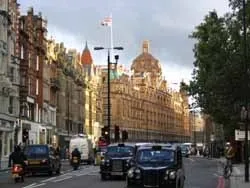
Russians buy up British real estate
Since 2000, Russians living in the UK have bought real estate in that country worth £2.2 billion ($4.2 billion), writes The Sunday Times, citing research by real estate company Knight Frank. At the same time, the publication notes that this figure may actually be much higher, since transactions worth less than £1 million were not taken into account in the calculation.
According to the newspaper, Russians buy expensive houses in London more often than American bankers or Middle Eastern sheikhs. In addition, in 2006, a Russian bought the most expensive apartment in the British capital (a five-bedroom penthouse), paying about £16 million for it. The Sunday Times notes that, contrary to the stereotype, real estate is bought not only by oligarchs, since we are talking about 250,000 transactions.
Norway named best country to live
Norway has been named the best country in the world to live. This Scandinavian state has topped the corresponding ranking compiled by the UN Development Programme (UNDP) for the sixth time in a row.
According to the published report of the organization, Iceland, Australia, Ireland and Sweden follow in the list of countries with the best conditions for human living. The top ten also includes Canada, Japan, USA, Switzerland and the Netherlands.
When compiling the report, presented annually since 1990, factors such as per capita income, development of education, healthcare and average life expectancy are taken into account.
Ukraine ranks 77th, Georgia - 97th, and Turkmenistan is in 105th place, one line below sunny Jamaica. Russia in the list of most favorable countries for living this year is in 65th place - between Libya and Macedonia. Following the Balkan state in 67th place is the Republic of Belarus.
Niger has been recognized as the least favorable for human living for the second year in a row (177th place). Compared to the inhabitants of Norway, residents of this African state are 40 times poorer, live almost twice as short, and are five times less educated. Countries such as Iraq, Afghanistan, and Somalia did not make it into the ranking at all because the UN does not have sufficient information about the living conditions of local residents.
Russia tightens migration legislation
Amendments to the 'Code of Administrative Offenses' have come into force, sharply toughening Russia's migration legislation. The fine for violating by a foreigner the regime of stay in the country will be from 2 to 5 thousand rubles, an employer for using the labor of illegal migrants will be obliged to pay a fine of 250 to 800 thousand rubles, and the activity of such a company may be suspended for three months, writes Rossiyskaya Gazeta.
In addition, legislators increased the statute of limitations for violations related to illegal migration from two months to one year. Moreover, now the corresponding fines are imposed not only on foreign citizens, but also on stateless persons. Punishment for providing illegal migrants with commercial, warehouse and other premises has also been tightened - according to the amendments that came into force, the fine for this will be from 45 to 800 thousand rubles.
Director of the Federal Migration Service (FMS) Konstantin Romodanovsky stated that in the future, criminal liability for organizing illegal migration may be strengthened. The FMS also prepared two draft laws, implying the introduction of labor quotas for foreigners from the CIS and reduction of the period of stay for foreigners with multiple visas in Russia from 180 to 90 days.
Number of tourists in the world steadily growing
As noted by the World Tourism Organization (WTO, now UNWTO), the number of tourists in the world is steadily growing. In the first eight months of 2006, 578 million people traveled abroad, which is 25 million more than in the same period of 2005 (553 million).
Last year was a record for world tourism: a total of 806 million people visited other countries. The authors of the 'World Tourism Barometer' report predict that in 2006 there will be 4.6% more tourists than in 2005. For comparison, in 1950 there were no more than 20 million international tourists.
The largest growth in tourist flows - 9.8% - was recorded in the African direction: travelers especially loved South Africa, Kenya, Mozambique, and Swaziland, reports Newsru.com. The second most popular destination is the countries of Asia and the Pacific: the number of tourists there increased by 8.3%. In third place remain the countries of the Middle East, despite their difficult political situation. In particular, in the first eight months of 2006, the Middle East received 6% more guests. Experts predict that by the end of this year, the scale of tourism to the region will exceed last year's figure by 7.2%.
Next come the USA - growth of 4.3%, Europe - 3.1%. At the same time, travel to Eastern Europe and the former USSR decreased - by 0.1% compared to last year.
UK strongest in teaching English
According to data published by Language Travel Magazine, the United Kingdom continues to be the most attractive country for learning English.
According to data for 2005, 586,186 adults and children visited it for this purpose. Next come Canada (178,261), USA (162,055), Ireland (113,940), Australia (101,087), Malta (61,607), New Zealand (35,749), South Africa (13,835).
The English language learning services market in 2005 is estimated at $9.2 billion. This is higher than in 2004, when financial indicators were $8.3 billion, but lower than in 2003, when the industry as a whole earned $9.6 billion. Of the revenues generated, the lion's share (53.9%) went to the United Kingdom in 2005. In numerical terms, the picture was as follows: United Kingdom – $4.9 billion, USA – $1.4 billion, Canada – $1.9 billion, Australia – $0.7 billion, Ireland – $0.55 billion, New Zealand – $0.2 billion, Malta – $0.94 billion, South Africa – $0.44 billion.
Dutch authorities intend to ban Muslim headscarves
Last week, representatives of the ruling coalition in the Netherlands announced their intention to ban the wearing of hijabs and other specifically Muslim women's headgear that covers the face, writes the British newspaper The Guardian. According to the authors of the ban, it is justified because it may help in ensuring public security.
Rita Verdonk, the Minister for Immigration, explained that the government will insist on a complete ban on hijabs, although this may contradict Dutch laws protecting citizens' religious freedom. Current legislation provides for a partial ban on wearing hijabs. For example, they are already not allowed in schools and on public transport.
The government's plans, according to The Guardian, diverge greatly from the liberal image of the Netherlands. This country shows tolerance towards drug addicts and prostitutes, and euthanasia is also allowed here.
It should be recalled that partial bans on wearing hijabs are already in place, in addition to the Netherlands, in the United Kingdom, France, Bulgaria, and many other countries.
Irish women named the heaviest drinkers in the world
Irish women turned out to be the heaviest drinkers in the world. This conclusion was reached by researchers from five universities worldwide, who studied the alcohol preferences of women from 21 countries aged 17 to 30.
Researchers classified as heavy drinkers those women who, within two weeks, consume four or more servings of alcohol in one sitting at least once. Based on this criterion, 57% of Irish women, according to scientists, abuse alcohol, reports This is London. In second place are English women, 33% of whom also drink too much alcohol in one sitting.
Then in descending order, starting at 5%, come women from Germany, Greece, Italy, Romania, and South Africa. Researchers also found that among those who like to drink, most often are girls from well-off families who live in an apartment separate from their parents.