
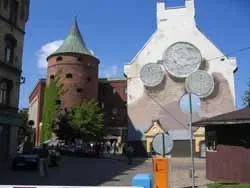
Soviet-era park to be created in Riga
The experience of the Lithuanian Grutas Park near Druskininkai, where a local entrepreneur placed Soviet-era monuments on his land, has inspired the authorities of the Latvian capital to create a similar park. Expenses for creating a park of monuments from the tsarist and Soviet past have already been included in the Riga budget for next year. It is expected that the park will be laid out not far from the Brothers' Cemetery in Riga. Its territory is planned to house Soviet-era monuments as well as tombstones previously removed from the Great Cemetery of the Latvian capital. The warehouses of the Riga Monument Agency store not only Soviet monuments but also more valuable unique works by sculptors and stonemasons, such as the Victory Column from the Patriotic War of 1812. All of them will take their place in the newly created park.
Protests in the Netherlands against deportation of illegal immigrants
A demonstration against the government's plans to deport more than 30,000 illegal immigrants from the Netherlands took place in The Hague. According to Dutch television, over a thousand protesters gathered on the square in front of the Dutch parliament building. They demanded that the government abandon plans to deport 31,000 illegal immigrants whose asylum applications were rejected before 2001.
The protest was mainly attended by representatives of left-wing political parties and movements, but there were also members of Christian democratic organizations. Absent were representatives of the right-liberal People's Party for Freedom and Democracy, whose member Rita Verdonk - Minister for Immigration and Integration - is the author of the deportation plan.
The participants of the rally demanded amnesty for these illegal immigrants, allowing them to stay in the Netherlands, and criticized the government's policy towards immigrants.
Immigrants in Italy boost demographics
The number of legal migrants in Italy this year has reached 3 million 35 thousand, or 5.2% of the country's population. This is according to the annual report of the organization Caritas Migrantes.
According to Caritas, the share of legal migrants is increasing by 300,000 annually, and if this trend continues, there will be more immigrants in Italy than currently live in countries with a traditionally strong presence of foreigners, such as Germany and Austria. 'Immigrants will increasingly become the only factor of demographic growth capable of correcting the excess of deaths over births,' say Caritas experts. Indeed, migrant families have an average of 2.4 children, while Italians have 1.2. In 2005 alone, 52,000 children were born to legal foreigners in Italy, accounting for 9.4% of all Italian newborns.
More than half of immigrants (59.2%) are in the industrialized north of Italy. In Lombardy alone, about 25% of immigrants have settled, of which 11.4% are in the regional capital Milan. However, almost the same number of officially registered foreigners (10.9%) are in Rome, where they make up 9.2% of the total population.
Furthermore, out of ten foreigners, five are Europeans, two are Africans (most often Moroccans), two are from Asia (mainly Chinese and Filipinos), and one comes from the Americas (usually from Peru or the USA). The largest foreign community on the Apennine Peninsula is Albanian, followed by Ukrainian.
Approximately half of foreigners (49.1%) are Christians, 33.2% are Muslims (about one million). Almost all foreigners are in Italy either for family reasons or because they managed to get a job here, the report says. More than 130,000 immigrants own their own business in Italy (38% more than last year).
In recent years, the standard of living of migrants has significantly improved. One out of every four people taking a driving test is a foreigner. Moreover, according to experts, immigrants are an important component of the consumer market, since 91% of them have a mobile phone, 80% a TV, and 55% their own car. 60% have opened bank accounts. However, only 12-15% of foreigners own their own home.
Italians themselves are not very friendly towards foreigners: 40% of them believe that immigrants are more involved in criminal activities than the native population. However, Caritas clarifies that in Great Britain and Germany this opinion is much more widespread.
Nevertheless, two or three reports of racial discrimination are filed by foreigners every day - 867 reports were registered in 2005. Most often, such cases involve citizens of African countries in the north and central regions of Italy and are mainly related to employment or housing.
2010 may become 'year of the euro' for the Baltics
The euro could be introduced in all three Baltic countries (Latvia, Lithuania and Estonia) in 2010. This was stated by European Commissioner for Economic and Financial Affairs Dalia Grybauskaitė, speaking in Riga at the conference 'Business and Finance in the Baltics'.
'All three republics can coordinate their actions, but the European Commission will consider each candidate separately. According to calculations, Lithuania will meet the EU's three percent inflation criterion in 2008. Estonia and Latvia will probably only do so in three years, perhaps later. Brussels is cautious because there will be no turning back. The chances of 2010 being called the 'year of the euro' for the entire Baltics are still quite high today,' she said.
Earlier, the Latvian authorities wanted to introduce the euro first in 2006, then in 2008, but extremely high inflation - about 6% - prevents the republic from meeting the Maastricht criteria required for adopting the euro, which require inflation of about 3%.
Higher education prices are rising in the United States
In the current academic year, American public universities raised tuition fees by an average of 6.3%, while the average cost reached $5,836. This is stated in the annual report "Trends in College Pricing," published by the College Board.
According to the study, inflation only partially influenced this increase - this year it was the lowest in six years and amounted to only 2.4%. Tuition fees also rose significantly at prestigious private American universities - by 5.9%, reaching an average of $22,218 per year.
According to experts, the last decade has seen an unprecedented rise in higher education prices in the United States. Over five years, education prices increased by a total of 35%. In the 30 years that the College Board has been studying the American education market, this has never happened.
Numerous student financial aid programs are failing to cover rising tuition payments. As the chief analyst of the College Board, Sandy Baum, told reporters, for 62% of students receiving financial aid and studying at public colleges, the actual tuition fee increased by an average of 8% to $2,700 per year.
"Financial aid to students is provided in large amounts, but due to rising prices, the aid program may prove ineffective," Baum emphasized. At the same time, this year the largest and most prestigious universities in the United States announced unprecedentedly large sums they plan to receive in donations from charitable foundations, commercial and religious organizations, students, and private individuals.
For instance, the administration of Cornell University, where annual tuition this year reached $43,707, hopes to raise $4 billion; Stanford University intends to raise $4.3 billion; Columbia University - $4 billion; Yale University and the University of Virginia - $3 billion each.
According to local media, university administrations hope that these donations will partially help expand financial aid programs and increase their effectiveness.