
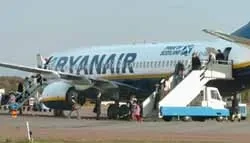
Ryanair forced to take care of passengers
The UK Office of Fair Trading has forced Ryanair to review its obligations in cases of flight delays or cancellations, as well as loss of passenger baggage, Sky News reports. "Ryanair's policy on delayed or canceled flights did not comply with European Union regulations and was unfair to the airline's customers," the officials said.
The Office of Fair Trading was prompted to contact the airline's management by numerous complaints from Ryanair passengers who threatened to file lawsuits against the airline for poor service. According to EU laws, airlines that cancel flights must compensate passengers for losses and transport them to their destination; if a flight is delayed, they must accommodate passengers in hotels and provide meals. However, these conditions were mostly ignored by Ryanair.
Furthermore, the officials stated that passengers of this airline experienced inconveniences with baggage transportation. Ryanair management instructed its employees to refuse passengers the transportation of oversized items such as skis, snowboards, or surfboards, forcing them to incur additional expenses. Before each flight, passengers signed a special document that essentially released the airline from any responsibility for lost baggage. According to a representative of the office, Ryanair management pledged to change internal instructions and bring them into line with EU standards.
Ryanair was founded in 1985, with its head office in Dublin, Ireland. It operates flights to European countries and is considered a budget airline, offering its services at low fares.
State Duma increases fines for illegal immigrants and employers
The Russian State Duma in the third reading adopted amendments to the Code of Administrative Offenses, toughening penalties for illegal migrants and their employers.
For working in Russia without a permit, if its presence is stipulated by law, an illegal immigrant may be fined up to 2,500 rubles. In cases where obtaining a permit is stipulated by federal laws, fines of 2,000 to 5,000 rubles are imposed. The same penalty applies if a foreigner indicates a false purpose of stay in Russia in documents. In addition, the violator may be deported from Russia.
For the hiring party, the following fines are established: for individuals - from 2,000 to 4,000 rubles; for officials - from 40,000 to 50,000 rubles; for legal entities - from 400,000 to 500,000 rubles. Moreover, enterprises will be fined for each illegal migrant individually, not for the fact of violation itself.
Additionally, for hiring a foreigner without a work permit in Russia, if required by law, the fine for legal entities may range from 250,000 to 800,000 rubles. Authorities also gain the right to suspend the activities of a company where foreigners work illegally for up to 90 days.
Jews in Germany not safe
Jews in Germany do not feel safe. This was stated in an interview with the German newspaper Neuer Osnabrucker Zeitung by Israeli Ambassador to Germany Shimon Stein.
According to Stein, German Jews can no longer lead a normal lifestyle, in particular, freely perform religious rites. He drew attention to the forced strengthening of security at synagogues and Jewish cultural centers and regretfully noted the lack of desire on the part of authorities to change the situation. Overall, Stein expressed concern about the rise of anti-Semitism, the increasing number of neo-Nazis, and the growing propensity for violence in some segments of German society.
At the same time, the Israeli ambassador is convinced that these trends do not call into question the existence of democracy in Germany—in his opinion, these are peripheral phenomena. However, to counteract them, the mobilization of all German society is necessary.
The problem of the growing influence of neo-Nazi parties is seriously troubling the current "Grand Coalition" government, AFP reports. On October 20, the German cabinet allocated €5 million to combat extremism in 2007.
Transaero to introduce online check-in for flights
Transaero Airlines intends to introduce an online check-in system for flights. It will start operating in November.
Initially, check-in will be available in Russian and English. Then Chinese, French, and Spanish versions will be added, according to a press release from the SITA booking system. Online check-in with self-printing of boarding passes will allow passengers to avoid queues at airport check-in and choose the most convenient seat on the plane.
Discounts at Swiss ski resorts
The Swiss Travel System has made changes to the rules for using some travel passes in Switzerland. The Swiss Pass, which provides unlimited travel throughout the country for 4, 8, 15, or 22 consecutive days or one month, since the beginning of this year gives the right to free admission to most Swiss museums, as well as a 50% discount on a number of mountain trains and funiculars.
Another pass, the Swiss Flexi Pass, which provides free travel on any 3, 4, 5, 6, or 8 days within a month, gives a 50% discount on travel on all other days within the same month.
In the upcoming winter season, every holder of a Swiss Pass can expect a 50% discount when purchasing a ski pass at Swiss ski resorts. The wide variety of Swiss Pass tickets allows significant savings for those traveling in small groups (Saver Pass). According to MySwitzerland.com, tourists under 26 can purchase a Youth Pass.
Entry for "Wild Tourists" into Vietnam Temporarily Banned
Vietnamese authorities have banned entry into the country for "wild tourists" with "D" visas from October 15 to November 30. According to "Service of Continents," these measures are taken to ensure security at the summit of APEC (Asia-Pacific Economic Cooperation) member countries, which is taking place in Hanoi from November 12 to 19.
During this period, holders of business visas, participants of any conferences, and tourists arriving on invitation from organizations or individuals will be able to enter Vietnam unhindered. Group tourists who obtain their visa at home or upon arrival most often receive a "C" visa for short-term stay, which is not affected by this ban. The "D" visa for 15 days is issued to tourists traveling independently without booking a tour through a travel agency.
Hong Kong to Ban Smoking in Public Places
The Hong Kong parliament has approved a decree banning smoking in public places: from restaurants to beaches and parks. The rules will come into effect in early 2007.
It will be forbidden to smoke in billiard halls, karaoke bars, and other similar establishments, on beaches, in swimming pools, and in most parks. The law does not apply to adult entertainment complexes - nightclubs and bars that allow entry only to persons over 18. However, smoking in such places will be allowed only until July 1, 2009. Possibly, restaurant owners will be permitted to set up separate sections for non-smokers in their establishments.
Ukraine Received 15 Million Tourists This Year
According to the State Tourism and Resorts Service, 14.9 million foreign tourists visited Ukraine in the first 9 months of 2006. This is 8% more than in the same period of 2005.
As stated in a press release from the State Tourism and Resorts Service, the total number of tourists served by tour operators and travel agents increased by 17.2%, the volume of services by 10%, and budget revenues by 14%.
In Ivano-Frankivsk region, the number of tourists increased by 72%, in Mykolaiv by 40%, in Zakarpattia by 28%, in Kyiv by 16%, in Lviv and Ternopil regions by 10%. In Crimea, the number of tourists decreased by 1.8% compared to the same period last year, but budget revenues increased by 20%.
In the first ten months of 2006, the State Tourism and Resorts Service issued over 1,200 new licenses for providing tourism services. During this period, 79 licenses were canceled for violations, 52 licenses were declared invalid, of which 48 were reissued. Currently, there are about 4,000 licensed tourism entities operating in Ukraine.
In 2006, 5 hotels of the "five-star" category, 28 - "four-star", 73 - "three-star", 40 - "two-star", and 41 - "one-star" were certified by the State Tourism and Resorts Service. Overall, as of October 1, the tourist accommodation base in Ukraine comprised 1,230 hotel enterprises and over 1,000 individual entrepreneurs providing accommodation services.
New Security Rules at EU Airports
New security rules at European Union airports, coming into force on November 6, will somewhat complicate passengers' lives. They are a consequence of a tougher stance on carrying liquids on planes after the uncovering of a terrorist plot in the UK in August.
From November 6, it is forbidden to bring on board drinks and other liquids purchased before passing security check. Exceptions will be medications necessary during the flight and baby food, as well as small quantities of liquid toiletries. The latter must be in containers of no more than 100 ml and placed in a transparent plastic bag, which is inspected separately from other hand luggage at security. Bags can be taken before security check.
It remains possible to buy liquids and drinks without restrictions after security check, including in Duty Free shops, and then bring them onto the plane. In cases where security check is located at the boarding gate, liquids purchased before passport control are forbidden. For liquids bought between passport control and security check, special rules apply – they must be sealed in bags by the shop and accompanied by a receipt confirming the purchase on that day at that airport.
Significant complications await passengers with connecting flights at EU airports. Now, liquids purchased at the airport of initial departure cannot be taken into the cabin during a transfer. Placing them in checked baggage will also be difficult, as baggage is usually not handed out at the transfer point.