
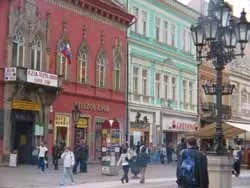
Photo "Zagranitsa"
Slovakia Introduces New Transit Rules
Since October 13, 2006, for transit through Slovakia or stay in the country for no more than 90 days per half-year, a visa is not required if one of the following documents is held: a residence permit in an EU state, a long-term visa issued by an EU state (except Ireland and the United Kingdom); a multiple-entry short-term visa issued by an EU state; another residence document issued by an EU state (it could even be a refugee certificate). It must be remembered that the period of stay of a citizen of another country in Slovakia is limited by the validity of the visa issued by an EU member state. A transit visa for Slovakia is necessary if the citizen has only a single-entry short-term visa issued by an EU state.
Ukrainian Guest Workers Pushed Out of the UK
From January 1, 2007, the UK terminates the employment program for Ukrainians under the SBS temporary work visa, which was issued for one year. This was reported by ProUA, citing British Ambassador to Ukraine Timothy Barrow.
According to the diplomat, the employment program for Ukrainians under the temporary work visa will only be valid until the end of 2006. Experts link the closure of the program to the migration of labor to the UK from Poland and the Baltic states.
The employment program for Ukrainians under the SBS visa has been in effect since 2002, with up to 5,000 people traveling for work annually. This year, the British embassy in Kyiv issued 27,000 visas to Ukrainian citizens, of which about 20% traveled abroad to work.
Russia Counts 30 Million Compatriots Abroad
The Russian diaspora abroad has reached 30 million people, said Alexander Chepurin, director of the Department for Work with Compatriots Abroad of the Russian Foreign Ministry. The diplomat noted that the Russian diaspora is one of the largest in the world.
According to him, about 20 million compatriots live in CIS countries and another 10 million in the rest of the world. Chepurin proposed interpreting the category of 'compatriot' broadly, not limited to ethnic Russians. In his opinion, they are 'people connected with Russia by ethnic, cultural, historical, spiritual ties, who feel the need to maintain contacts with their historical homeland.' As an example, the diplomat cited Ukraine, where, according to him, 'about 12 million compatriots live, and only about 8 million are Russian.'
Recall that according to the law 'On State Policy of the Russian Federation towards Compatriots Abroad,' 'compatriots are persons born in the same state, living or having lived in it and having signs of commonality of language, religion, cultural heritage, traditions and customs, as well as descendants of these persons in the direct descending line.'
UK to Pay for Return to Homeland
The UK will pay foreign prisoners a cash allowance for agreeing to serve their sentence in their home country. The payments could range from 500 to 2,500 pounds. This measure was proposed by British Home Secretary John Reid to solve the problem of overcrowded British prisons, reports The Times. It will apply to citizens of countries outside the European Economic Area.
The money will not be given in cash. Assistance in the agreed amount will be provided for education, housing, or starting a business. Moreover, the right to this grant will be granted to all foreigners, regardless of the severity of the crimes they committed.
The initiative of the British home secretary was called madness. Reid's critics argue that paying rapists and murderers for their crimes is not only immoral but also unwise, writes The Daily Mail. According to British conservatives, a foreign criminal equipped with a substantial sum in pounds sterling could relatively easily return to the UK and continue his illegal activities.
Furthermore, implementation of Reid's plan would remove a significant deterrent: a potential murderer or rapist would know that the punishment for his crime would, at worst, be a check for 2,500 pounds and a free ticket home.
Recall that earlier the British Home Office proposed another measure to combat overcrowding in prisons and police stations: police proposed giving them the right to bill prisoners for their time in custody and services provided to offenders while in detention.
Sweden to Reinstate Museum Entrance Fees
The new Swedish government plans to reinstate entrance fees to state museums, according to Swedish media. In early 2005, entrance fees were abolished at 19 state and dozens of municipal museums in Sweden. As a result, the number of visitors more than doubled in a year.
However, the state had to compensate museums from the budget for losses, as they no longer received revenue from ticket sales. The new conservative government believes that citizens should pay for access to culture. Museum management received the government's plans without enthusiasm.
English in London Schools Becomes Like a Foreign Language
For students in half of British primary schools located in central London, English is a second language. Among secondary school students in London, a similar ratio: in 53 out of 132 schools, English is not the native language for more than half of the students. Outside London, in every fourth primary school, half of the students are not English-speaking. The same situation exists in every fifth secondary school.
Nationwide, about one in five primary school students is a representative of ethnic minorities living in the UK. This situation is explained by the increased influx of immigrants from both former British colonies (Bangladesh, Pakistan) and Eastern Europe, in particular from Poland. As The Daily Mail reports, in some cases school administrations have to resort to translators for conducting classes.
According to Conservative Party education spokesman David Willetts, Tony Blair's government risks creating genuine ghettos in British cities in the future, whose population cannot be integrated into society because of the language barrier. He also drew attention to the obvious difficulty for people for whom English is not their native language to obtain higher education at British universities.
Meanwhile, according to official data from the UK Department for Education, in only one out of eight primary schools is English the second language for the majority of students.
Britons will be banned from smoking near bars and restaurants
The British Ministry of Health is considering introducing a ban on smoking not only in bars, restaurants, and clubs, but also at the entrances to these establishments.
The Westminster Legislative Council, which proposed this initiative, emphasized that it does not in principle support the introduction of a smoking ban. However, as the Daily Telegraph writes, the councilors noted that the consequence of the ban would be gatherings of drunk people at the entrances to various drinking establishments. The only way out of this situation (apart from lifting the 'draconian ban'), according to the Westminster Council, would be to impose a restriction on smoking near bars, clubs, and restaurants.
Let us recall that a complete ban on smoking in public places in the UK will come into force next summer.